


Ireland: The enterprising nun who started a mill
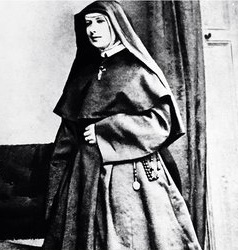
Mother Agnes Morrogh-Bernard
On the banks of the River Moy in Co Mayo stands one of Ireland's most remarkable industrial success stories. Foxford Woollen Mill, now known simply as FOXFORD, has survived more than 130 years of economic upheaval, changing fashions, technological transformation and even the threat of closure. At the heart of its story is an extraordinary woman: Mother Agnes Morrogh-Bernard, a Catholic nun who believed that the answer to poverty was not simply charity, but meaningful employment.
Agnes Morrogh was born in Cheltenham on 24 February 1842 and was the eldest of ten children born to a wealthy Catholic family, the Morroghs of Glanmire near Cork City. Soon after, the family returned to Glanmire House and resided there until her father, John Morrogh, inherited the 7,000-acre Bernard estate from his grandmother near Killarney, as well as the Bernard name.
It was here that Agnes witnessed first-hand the devastation the potato blight was wreaking on the lives of rural dwellers. Her father was a fair landlord. He was conscious of the double prejudice of being both poor and a woman in those times, and so he always made sure to provide work for the women tenants on his land. It was in this early setting that Agnes learned the importance of providing people with an opportunity to make their own living.
Agnes was educated at home by her mother, Frances Blount, before being sent to Laurel Hill Convent in Limerick for three years and then on to the Dames Anglaises Convent in Paris for a further two years. Shortly after her 21st birthday for which her parents organised a ball, she told them that she wanted to become a nun. Reports suggest that her father was devastated by her choice of career.
On 2 July 1863, influenced by her Catholic faith and the poverty she had experienced in Kerry, she exchanged a life of privilege for one of self-sacrifice when she entered the novitiate of the Sisters of Charity - founded by Cork woman, Mary Aikenhead, in 1815.
Agnes was professed Sr Mary Joseph Arsenius on 16 January 1866. Her first posting was as a teacher in Stanhope Street National School in Dublin. In 1877, she was assigned to Ballaghaderreen in Co. Mayo as superior of a new convent. There she set up a national school, a technical school that offered training in different farming methods, a bakery, a laundry, a pharmacy, and a lending library. Significantly, she set up a textile business where local girls were trained in spinning, weaving, knitting, dressmaking as well as lace-making and crochet.
By the time she arrived in Foxford in December 1890, she had already developed a reputation as an energetic and practical organiser. During her years in Ballaghaderreen, she had seen at first-hand how education and employment could transform people's prospects and standard of living.
Foxford presented an even greater challenge. It was a small, impoverished community in the west of Ireland that had never fully recovered from the effects of the Great Famine. Mother Agnes was determined to do something practical about the poverty she encountered. Her ambition was summed up in the phrase associated with her vision for the town: "Brighter Homes, Better Work and Greater Happiness."
A Mill as an Answer to Poverty
She recognised that Foxford possessed two important resources. The first was the River Moy, whose water could provide power for an industrial enterprise. The second was the abundant supply of wool produced by sheep farmers in the surrounding countryside. A small spinning and weaving enterprise already existed in Ballaghaderreen, and Mother Agnes saw the possibility of transferring and expanding that experience in Foxford.
She did not regard the proposed woollen mill simply as a commercial enterprise. It was a social project. The purpose was to create steady employment so that local people could earn a decent living without having to leave Mayo. The mill would also provide opportunities for women to learn useful skills and for families to build more secure lives.
The idea, however, was considerably easier to conceive than to execute. A nun with little conventional business experience needed technical knowledge, finance and someone who understood the woollen industry. That was where an extraordinary partnership began.
The Protestant Mill Owner from Tyrone
Mother Agnes turned to Michael Davitt, the Mayo-born Land League leader, for advice. Davitt had personal experience of the textile industry, having worked in mills in Lancashire as a child, and he knew the importance of finding someone with practical expertise. He suggested John Charles Smith, the owner of Caledon Mill in Co. Tyrone.
Smith was an unlikely ally. He was a Protestant and a Freemason, while Mother Agnes was a Catholic nun in an Ireland where religious divisions remained deeply entrenched. According to the account of their first contact, Smith pointed out the apparent incongruity himself, responding to her approach with the words: "Madam, are you aware that you have written to a Protestant and an Orangeman?"
Mother Agnes was undeterred. Religious difference did not matter to her when the objective was the welfare of the people of Foxford. Smith subsequently provided valuable advice in the design, construction and management of the mill. FOXFORD itself describes the relationship as a rare example in nineteenth-century Ireland of a Protestant and Freemason working with a Catholic nun to create a major local enterprise.
Financial support followed. The Congested Districts Board, established to address poverty and under-development in parts of Ireland, recognised the potential of the project and provided grants and loans. The Board was also impressed by Mother Agnes' management abilities and supported training for local workers. The Sisters of Charity took the risk of mortgaging their Dublin headquarters to support the project. In 1892, the Providence Woollen Mill, as it was initially known, began its life.
From Local Enterprise to National Name
The mill grew rapidly. Its early products included rugs, blankets, woven cloth, tweeds and other woollen goods. Training was an important part of the enterprise, ensuring that the workforce acquired the skills needed to produce quality textiles. Within little more than a decade, the mill was employing more than 100 people, and by the middle of the twentieth century its workforce had reached more than 200.
Foxford products developed a reputation well beyond Mayo. By 1905, they were being sold through major Dublin retailers including Brown Thomas and Arnotts. At its height, the mill became an important supplier of textiles across Ireland; FOXFORD records that its looms even produced fabric for Garda uniforms.
The mill was never isolated from the wider life of Foxford. Mother Agnes regarded economic development as part of a much larger programme of community improvement. She supported schools, agricultural and domestic training, music and sport, helped establish a brass and reed band, and arranged housing for mill workers. Roads and other improvements followed. Her aim was not simply to put wages into people's pockets but to create a healthier, more confident community.
Mother Agnes continued to oversee and develop the enterprise until her death in 1932. Her legacy, however, belonged as much to Foxford itself as to the mill.
The Crisis of the 1980s with Changing Consumer Habits
The great challenge came decades later. The very products that had made Foxford famous became vulnerable to changing consumer habits. The growth of synthetic fibres and, particularly, the popularity of duvets undermined the market for traditional woollen blankets. By the 1970s and 1980s the business was in serious decline.
In 1987 the mill went into receivership and its gates closed. For a town that had depended on the mill for generations, the prospect was devastating. The Sisters of Charity had increasingly concentrated on their religious and educational work, while the industrial business required a new commercial direction.
Then Another Unlikely Saviour Appeared.
Joe Queenan, a young Mayo accountant, was involved with the receivership and was initially expected to help deal with the closure. But he understood what the loss of the mill would mean for Foxford. After potential buyers failed to emerge, Queenan gathered investors and bought the business, determined to preserve its skills, employment and heritage.
The revival was not immediate or easy. The workforce was drastically reduced, machinery had to be upgraded and the company had to discover what a traditional woollen mill could become in a world that no longer needed millions of conventional blankets. But the looms survived, and so did the name.
FOXFORD Today
The transformation since the 1980s has been profound. Rather than attempting to compete with mass-produced textiles, FOXFORD has increasingly positioned itself as a premium Irish design and lifestyle brand. The company continues to weave throws, blankets and scarves at the Mayo mill, using wool including lambswool, merino, mohair and cashmere, while also working with designers and suppliers on bed linen, homeware and clothing.
The collaboration with designer Helen McAlinden around the turn of the millennium helped establish a more contemporary design language, drawing inspiration from the colours and textures of the western Irish landscape. Subsequent collaborations have allowed the brand to combine its traditional weaving skills with modern design.
The mill is now both a manufacturing business and a visitor destination. Its café, shops and heritage experience welcome visitors who can learn about the history of the enterprise and see aspects of the weaving process. It typically attracts well over 130,000 visitors each year, making it Mayo's number two tourist attraction after Westport House. When I visited it recently, both the shop and the café were busy with visitors of varying nationalities.
FOXFORD says it now employs more than 70 people across its mill and shops, with most based locally, while also working with a wider network of designers, creatives and small businesses. Its combination of factory + visitor centre + retail + café gives it an economic footprint larger than most attractions with higher heritage status.
There is a pleasing symmetry to that modern incarnation. Mother Agnes established Foxford to use local resources and human skills to give people a future. More than a century later, the company still presents itself as a business rooted in place, craftsmanship and employment.
The story of Foxford Woollen Mills is therefore much more than the history of a textile company. It is the story of a nun who refused to accept poverty as inevitable; a Protestant mill owner from Tyrone who crossed religious boundaries to share his expertise; a community that made the enterprise part of its identity; and a young accountant who, when the mill appeared destined for closure, decided that its story was not finished.
From Providence to FOXFORD, the central idea has remained remarkably consistent: that good work can strengthen a community. The products have changed, the machinery has evolved and the market is now global, but the original purpose of Mother Agnes Morrogh-Bernard still runs through the mill - woven, quite literally, into its fabric.
Mother Agnes and her legacy are a significant part of the rich religious heritage of Co Mayo - a unique heritage that has great potential for the development of tourism in the region.
Further viewing or reading: www.youtube.com/watch?v=B8EXoZ-c2P0. 'Agnes MorroghBernard: Foundress of Foxford Woollen Mills' (Mercier Press, 2014) by Mayo author and historian, Margaret Molloy, and a Foreword by Ballina native, Mary Robinson, former President of Ireland.
Matt Moran - a native of Ballina - is a writer and author living in Co. Cork. His books - "The Legacy of Irish Missionaries Lives On" and "The Theology of Integral Human Development" - are available from mattmoran2021@gmail.com. He is currently researching the religious heritage of Co. Mayo.
 Facebook
 Twitter
 LinkedIn
 Print
Print Email
Email








 Facebook
 Twitter
 YouTube
 LinkedIn
 Pinterest