

Ireland: St Muredach's College exemplifies role of Catholic Church in Education
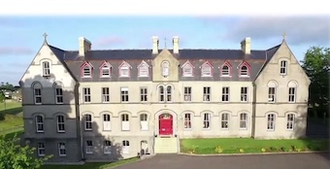
St Muredach's College
St Muredach's College in Ballina is one of the most historically significant educational institutions in County Mayo. Opened in 1906, it was established by the Diocese of Killala to provide a Catholic secondary education for boys at a time when there was no comparable school between Belmullet and Sligo.
Its story mirrors many of the major developments in Irish education during the twentieth century when the Catholic Church developed schools when the state wasn't doing so.
A significant number of diocesan colleges were established or expanded in the early decades of the Irish state, and St Muredach's is a very representative example of that pattern.
Foundation and early years
The idea for the college originated with Dr John Conmy, Bishop of Killala. The National Inventory says the design was signed in 1893. Recognising the lack of post-primary education for boys in north Mayo, Bishop Conmy proposed building a diocesan college despite the financial challenges facing the region only a generation after the Great Famine.
Construction began in 1904, and the college officially opened its doors on 10 September 1906 with 76 boarding students. The original construction cost was £16,000, rising to nearly £20,000 including landscaping and furnishings. Initially, the college functioned almost entirely as a boarding school, with the first floor of the original building devoted to dormitories. Day pupils were also admitted, paying an annual fee of £3, while boarders paid £30 per year.
Architectural significance
The impressive Edwardian building was designed by the distinguished Dublin architect William Henry Byrne (W.H. Byrne), who specialised in ecclesiastical and institutional architecture. The Dictionary of Irish Architects records the St Muredach's Seminary project under W. H. Byrne from 1893 although construction did not commence until 1904. The college occupies an elevated site overlooking the River Moy and not far from St Muredach's Cathedral, creating one of Ballina's most striking architectural ensembles.
Like the Cathedral, the college is constructed in local limestone and displays restrained Gothic and Classical influences typical of high-quality institutional architecture of the early twentieth century. Because of its architectural importance, it is included on Mayo County Council's Record of Protected Structures. The architectural survey entry for the building (Reg. No. 31204119), lists it as a structure of architectural, artistic, historical, and social interest.
A diocesan college
Unlike many Irish secondary schools established by religious orders such as the Christian Brothers or the Mercy or the Presentation Sisters, St Muredach's has always been a diocesan college, operating under the patronage of the Bishop of Killala. That distinction gave it a unique place within the educational landscape of the west of Ireland, preparing generations of students for university, the professions, the priesthood, the civil service, and public life. After five years there in the 1960s, I joined the civil service in Galway.
Growth and change
The college expanded steadily throughout the twentieth century. A major extension in 1937 provided additional classrooms and boarding accommodation. The introduction of free secondary education in 1967 transformed the school. Student numbers rose dramatically, prompting further building works and the introduction of practical subjects such as woodwork, technical drawing and art, reflecting national educational reforms.
New classrooms were added in 1969, followed by a sports hall in 1973. As boarding declined, former dormitories were converted into science laboratories. Boarding was finally phased out in 1987, and a substantial new teaching block was opened in 1990. Computer facilities, a library and a canteen followed during the late 1990s and early 2000s.
In 2008, the first lay principal was appointed replacing Fr. Martin Barrett. The era of priest-teachers continued into the early 1980s. Canon James Nallen, who joined the staff in 1960 and taught mathematics and geography, retired from teaching in 1983. He was among the last of the priest-teachers who had been such a distinctive feature of the college's earlier history.
Sporting tradition
St Muredach's has long enjoyed a formidable reputation in Gaelic games, particularly Gaelic football. The college has produced numerous county footballers who have represented Mayo at senior level, while generations of students have competed successfully in Connacht schools' competitions. Sport has remained central to the school's identity alongside academic achievement.
An architectural pairing with St Muredach's Cathedral
Perhaps the most interesting aspect from a heritage perspective is the relationship between St Muredach's Cathedral (begun in 1827) and St Muredach's College (opened in 1906). Together they form the principal ecclesiastical complex of the Diocese of Killala in Ballina.
The cathedral symbolised the confidence of Irish Catholicism after Emancipation, while the college represented the Church's commitment to education in the early twentieth century. Their close proximity overlooking the River Moy was no accident; together they created a visual and spiritual centre for the diocese that still defines Ballina's skyline today.
In the context of heritage, St Muredach's College deserves recognition not simply as a school but as one of Ballina's most important public buildings. Its Edwardian architecture, riverside setting, and more than 120 years of educational service make it a fitting companion to St Muredach's Cathedral and an integral part of the town's architectural and social history.
The official history of the college - A Century of Service from 1906 to 2006 - was written by the late Canon Martin Halloran (who taught me maths in the 1960s) and published to celebrate the centenary of the college. The book documented the school's founding, heritage, and 100-year evolution of educating generations of young men in the Diocese of Killala. That evolution continues apace.
The Foundational Role of the Catholic Church in Education
Catholic religious congregations played a foundational role in providing education in the early decades of the Irish state, stepping into a gap the government simply did not yet have the financial or administrative capacity to fill. From 1922 onward, congregations such as the Christian Brothers, Presentation Sisters, the Mercy Sisters, the Presentation Brothers, the Loreto Sisters, and the Patrician Brothers built, staffed, and managed schools across the country, often funded through their own networks, charitable contributions, and community support.
Their involvement ensured that universal access to basic education - one of the new state's core social ambitions - could be delivered long before the state had the infrastructure, trained workforce, or capital to do so independently. In practice, these congregations provided not only buildings and teachers but also organisational stability, curriculum continuity, and a nationwide educational footprint that became the backbone of Ireland's schooling system for much of the 20th century.
Dioceses, like religious congregations, stepped in because the new state lacked the capital, administrative capacity, and trained teaching workforce to build a national secondary system. As a result, many bishops invested heavily in diocesan colleges between the 1920s and 1950s, often funded through diocesan resources, parish contributions, and local fundraising. Schools such as St Muredach's College, St Jarlath's College in Tuam, St Nathy's College in Ballaghaderreen, Summerhill College in Sligo, St Flannan's College in Ennis, and St Mel's College in Longford either originated or were substantially developed during that period. These institutions provided structured secondary education at a time when the state's focus and limited resources were directed primarily towards maintaining and expanding the national primary school system.
Diocesan colleges therefore formed a parallel but essential pillar of Irish educational development: they supplied academic pathways, teacher training pipelines, and regional access to secondary schooling long before the state introduced free secondary education in 1967. Their establishment was not incidental but rather a deliberate and Christian response to a national need the state could not yet meet.
This was the foundation for Irish missionaries developing primary and secondary school systems in many African countries, in India, and in Latin America. Those countries have never forgotten the trojan work done by these missionaries in providing education for their young people. I wrote about this in my book - The Legacy of Irish Missionaries Lives On - for which Mary Robinson, former President of Ireland and a fellow native of Ballina wrote the Foreword.
(Matt Moran is a writer living in Co Cork. He is author of 'The Legacy of Irish Missionaries Lives On' and 'The Theology of Integral Human Development: the role of faith in international development and public affairs' - available from mattmoran2021@gmail.com).
 Facebook
 Twitter
 LinkedIn
 Print
Print Email
Email






 Facebook
 Twitter
 YouTube
 LinkedIn
 Pinterest