


St Muredach's Cathedral: The Gothic landmark that has watched over Ballina for two centuries
For nearly 200 years, the soaring spire of St Muredach's Cathedral has stood as Ballina's most recognisable landmark, rising above the River Moy and serving as both a place of worship and a symbol of the town's enduring heritage. Generations of residents have celebrated baptisms, marriages and funerals within its limestone walls, while countless visitors have paused to admire one of the finest examples of Gothic Revival architecture in the west of Ireland.
This cathedral has a special significance for me because I was baptised there, received my first Holy Communion, was confirmed, and attended Sunday Mass there until I moved from Ballina at the age of 18 to join the civil service in Galway. My 'mother church' as they say.
The cathedral is named after St Muredach O'Finn, an eighth-century Bishop of Killala who died around AD 735. His feast day is celebrated on 12 August, and the dedication links the modern cathedral to one of Mayo's earliest Christian traditions.
The parish is home to numerous historical sites, including the ruins of Moyne Abbey and Rosserk Friary, both established in the 15th century. Indeed, an Augustinian Abbey was located adjacent to the site of St. Muredach's Cathedral and was originally the site of a religious community known as the 'Augustinian House of St. Mary of Ardnaree'. The foundation date of the abbey is unknown but a reference from a Papal degree mentioned the Augustinian House in 1410. These structures highlight the area's religious importance and architectural grandeur from medieval times.
The story of St Muredach's Cathedral begins in 1827, when construction commenced at a time of renewed confidence for Ireland's Catholic community following Catholic Emancipation. The ambitious project was championed by the future Archbishop of Tuam, Dr John MacHale, then Coadjutor Bishop of Killala, whose vision was to provide the growing diocese with a cathedral worthy of its importance. Construction continued through some of the darkest years in Irish history, including the Great Famine (1845-52). The fact that work continued, albeit slowly, illustrates the determination of the local community.
Designed by Galway architect Dominick Madden, the building reflected the Gothic Revival style that was transforming church architecture across Britain and Ireland during the nineteenth century. Built from locally quarried limestone, the cathedral adopted a traditional cruciform plan, with a broad nave, prominent transepts and an elegant sanctuary. Pointed arches, soaring windows and finely carved stonework echoed the great medieval cathedrals of Europe while showcasing the skill of local craftsmen who brought Madden's vision to life.
Construction progressed steadily despite the economic hardship that affected Ireland during the mid-nineteenth century. The cathedral was largely completed before the Great Famine, although work continued for several decades as additional architectural and artistic features were introduced.
Perhaps its most striking addition came in 1855, when celebrated architect James Joseph McCarthy designed the cathedral's magnificent tower and spire. Rising approximately 46 metres (150 feet), the slender limestone spire transformed the building into the defining feature of Ballina's skyline, visible for miles across the surrounding countryside.
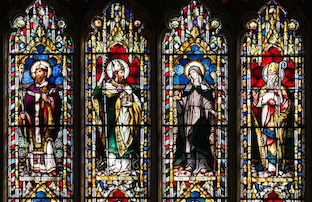
Inside, the cathedral reveals a richness that contrasts beautifully with its restrained exterior. Sunlight pours through stained-glass windows, illuminating an interior that combines Gothic elegance with Victorian craftsmanship.
Among its artistic treasures are the beautifully carved side altars created by James Pearse, father of Patrick and Willie Pearse, whose own place in Irish history would later become legendary during the Easter Rising of 1916.
The cathedral also houses magnificent stained glass produced by the renowned Franz Mayer & Company of Munich, one of Europe's leading ecclesiastical glassmakers during the nineteenth century. Intricate decorative mosaics and a striking groin-vaulted ceiling, inspired by Rome's Basilica of Santa Maria sopra Minerva, further enhance the sense of grandeur while reflecting the confidence and ambition of the Irish Catholic Church in the decades following emancipation.
Like many historic churches, St Muredach's has evolved over time. Sensitive restoration projects and liturgical reordering following the Second Vatican Council ensured that the building remained a living place of worship while preserving its architectural integrity. Great care has been taken to retain the character and craftsmanship that have made the cathedral one of County Mayo's most important heritage buildings.
Beyond its religious significance, the cathedral has become inseparable from Ballina's identity. Standing proudly beside the River Moy, it provides a dramatic backdrop to civic celebrations, community gatherings and national events.
During US President Joe Biden's visit to Ballina in 2023, the cathedral once again took centre stage, its iconic spire forming part of the images broadcast around the world and reminding viewers of the town's rich history and enduring links with the Irish diaspora.
As St Muredach's Cathedral approaches its bicentenary next year, it remains far more than an architectural landmark. It is a monument to faith, perseverance and craftsmanship, reflecting the aspirations of those who built it and the generations who have cared for it ever since. Whether admired for its Gothic beauty, appreciated for its artistic treasures or cherished as the spiritual heart of the Diocese of Killala, the cathedral continues to inspire all who pass beneath its towering spire. It remains, quite simply, one of Ballina's greatest treasures.
Refurbishment work has been carried out over recent decades, for example, to preserve the stained-glass windows, but further essential repairs and decoration are planned for as funds become available. During my recent visit, the need for this refurbishment was obvious. A special fundraising effort is in place.
Anyone wishing to donate to the fund can do so at https://ballinaparish.org/restoration-fund/.
Matt Moran is an author and writer living in Co. Cork and is a native of Ballina.
 Facebook
 Twitter
 LinkedIn
 Print
Print Email
Email















 Facebook
 Twitter
 YouTube
 LinkedIn
 Pinterest