


Ballintubber Abbey enters new chapter with major heritage project
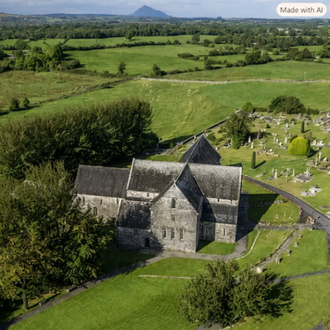
Ballintubber Abbey with Croagh Patrick on horizon
For more than 800 years, Ballintubber Abbey has stood in the County Mayo countryside in the west of Ireland as a place of worship, pilgrimage and community life. Now, the historic site is entering another significant chapter as major works begin on a new cultural and heritage visitor centre.
The development marks one of the most ambitious projects in the Abbey's modern history, combining the conservation of its historic buildings with plans to create a new attraction telling the story of the site and its enduring importance to Irish religious and cultural heritage.
Works commenced in June when construction teams arrived on site to begin work on the entrance to the long-awaited Cultural and Heritage Visitor Centre. The occasion was marked by a blessing from Fr Michael Farragher, parish priest and chairperson of the Ballintubber Abbey Trust.
The project has received more than €6.4 million in funding through the Rural Regeneration and Development Fund.
The redevelopment will include conservation work on the Abbey's historic east wing, including the chapter house and cloister, as well as improvements to the surrounding grounds. A new three-storey visitor and heritage attraction is also planned.
For Ballintubber, the project is about more than bricks and mortar. It represents an attempt to ensure that a building which has survived centuries of political, religious and social change can continue to play a role in the life of the community while becoming a destination for visitors from Ireland and abroad.
Founded in 1216 by King Cathal Crobhdearg O'Conor, Ballintubber Abbey is recognised as the only church in Ireland founded by an Irish king that remains in daily use. Its history stretches back even further, with local tradition associating the area with St Patrick and the early Christian landscape of the west of Ireland. The Abbey was established for the Canons Regular of St Augustine and dedicated to the Holy Trinity. Construction began in 1216 and was completed around 1225.
There is also a well-known local legend behind its foundation. Before becoming king, Cathal was said to have found refuge in Ballintubber, where a man named Sheridan treated him kindly. After becoming king, Cathal reportedly promised to build a new church there in gratitude. The first church he ordered to be built was mistakenly constructed at another place called Ballintubber in County Roscommon, after which he supposedly ordered an even grander church to be built at Ballintubber, Mayo. We will never know if that legend is true.
The Abbey's reputation as "the Abbey that refused to die" reflects the extraordinary challenges it has faced. It survived suppression and periods of neglect and continued as a place of worship during the Penal Laws era. That continuity has become one of the defining elements of its identity.
Its story is also one of repeated restoration
An early attempt to restore the Abbey church began in 1846, but the work was halted by the catastrophic events of the Great Famine. A later generation renewed the restoration effort, attracting support not only from people in Mayo but from members of the Irish diaspora around the world. Letters from people of Irish descent in countries including the United States, Australia and New Zealand recorded their interest in helping preserve the ancient building.
That tradition of community involvement continues today. The current restoration project seeks to preserve the physical fabric of the Abbey while making its history more accessible to the public. According to the Ballintubber Abbey Trust, the proposed visitor centre will provide an interpretive experience designed to educate, engage and inspire visitors, while highlighting the site's spiritual and cultural legacy.
The timing of the project is particularly significant following the death last month of Fr Frank Fahey, a Mayo priest who is widely credited with playing a major role in the restoration of the Abbey.
Fr Fahey died peacefully surrounded by family and friends, and tributes described him as a driving force behind the restoration of the 800-year-old Abbey and the development of the new visitor centre. Appropriately, his funeral Mass was held in the Abbey.
His contribution adds a deeply personal dimension to the latest phase of the Abbey's story. For many in the local community, the preservation of the Abbey has never been simply an exercise in protecting an old building. It has been about maintaining a living place of worship and a physical connection with generations of Mayo people.
That sense of continuity is also evident in the Abbey's relationship with pilgrimage
The Abbey lies on the ancient Tóchar Phádraig pilgrimage route, traditionally associated with the journey towards Croagh Patrick at Murrisk, near Westport on the shores of Clew Bay. The route remains an important part of the site's heritage, linking the Abbey to a much older tradition of pilgrimage and spiritual travel across the Mayo landscape where religious heritage spans more than fifteen centuries.
The new development at the Abbey is therefore intended to bring together several strands of the Abbey's identity: its medieval origins, its religious history, its architecture, its connection with pilgrimage and its place in the life of the surrounding community.
There is also a practical challenge behind the project. Maintaining an ancient building is a continuous undertaking and financial burden. The Abbey's restoration plans identify the need to protect historic stonework and stained glass, while conservation priorities include repair work to the Holy Trinity stained-glass window by French artist, Gabriel Loire.
The project consequently seeks to balance preservation with public access. Rather than turning the Abbey into a museum detached from its original purpose, the ambition is to interpret its history while retaining its character as a living religious site.
That distinction is important
Across Ireland, historic churches, monasteries and abbeys face the difficult question of how to preserve buildings that remain meaningful to local communities while also attracting the visitors and funding needed for their long-term survival. Ballintubber's answer is to embrace both roles.
Visitors already come to the Abbey to experience its architecture, history and spiritual atmosphere. Guided tours and pilgrimage walks form part of the existing visitor experience, while the new centre is intended to provide a more comprehensive interpretation of the site.
National Heritage Week in August 2026 will further highlight that history, with events at the Abbey focusing on its foundation, architecture, the Augustinian Canons and its place on the Tóchar Phádraig pilgrimage route. The visitor centre is expected to open in summer 2027, meaning that the work now under way is only the beginning of a wider transformation.
For a building founded more than eight centuries ago, the idea of another new beginning may seem fitting. Ballintubber Abbey has survived famine, suppression, fire, abandonment and generations of changing circumstances. Its survival has depended repeatedly on people deciding that the building and what it represents are worth preserving.
As construction begins on the latest chapter, the challenge will be to ensure that modern investment strengthens rather than overwhelms that remarkable legacy. For the people of Ballintubber and County Mayo, the hope is that the project will safeguard the Abbey for future generations. For visitors, it promises a deeper understanding of a place where Ireland's medieval past, religious traditions and modern community life continue to meet.
Eight centuries after its foundation, Ballintubber Abbey is once again being renewed - not as a relic of the past, but as a living part of Mayo's future.
(Matt Moran is a writer living in Co. Cork. He is author of 'The Legacy of Irish Missionaries Lives On"'and 'The Theology of Integral Human Development: the role of faith in international development and public affairs' - available from mattmoran2021@gmail.com).
 Facebook
 Twitter
 LinkedIn
 Print
Print Email
Email















 Facebook
 Twitter
 YouTube
 LinkedIn
 Pinterest