


Mayo Abbey: How a quiet village shaped the religious identity of an entire county
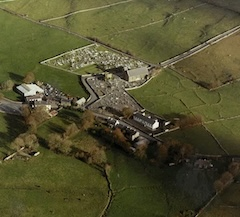
Mayo Abbey ruin with new church
Long before Croagh Patrick drew pilgrims, before Ballintubber Abbey defied centuries of turmoil, and before Knock Shrine became a global centre of Marian devotion, Mayo Abbey was the spiritual engine of County Mayo. Known across Europe as Mayo of the Saxons, this early monastic settlement forged international links, shaped medieval politics, and ultimately gave the county its name.
When the Synod of Whitby rejected the Celtic calculation of Easter in 664, St Colman refused to conform. Leaving Lindisfarne with Irish and English monks, he founded a monastery on Inishbofin - but tensions soon forced him to establish a new community on the mainland at Maigh Eo. This foundation - a community of Saxon monks living in Ireland - gave rise to the name Mayo of the Saxons.
That community became Mayo Abbey, founded around 668-670. From the outset, it was a rare blend of Irish and AngloSaxon monastic life, a cultural and religious hybrid unmatched elsewhere in Ireland.
By the early eighth century, Mayo Abbey had gained international recognition. It appears in Bede's Ecclesiastical History, marking it as a respected monastic centre where English monks could follow their own traditions within an Irish framework.
Under Gerald of Northumbria, its first canonical abbot, Mayo Abbey flourished as a centre of scholarship. The monks corresponded with major European figures, including Alcuin of York, adviser to Charlemagne. In the 770s, Alcuin sought their guidance on ecclesiastical reform - a remarkable sign of Mayo's intellectual standing.
Medieval accounts describe Mayo Abbey as a bustling monastic town with churches, colleges, and a cathedral. Whether exaggerated or not, the scale of its influence is clear.
A Site at the Crossroads of Power
Mayo Abbey's prominence made it a target in turbulent times. The Annals of the Four Masters record that in 1169, the monastery and its churches were burned. In 1236, Mac William plundered the abbey, leaving its lands devastated.
Yet Mayo remained politically significant. In 1176, Donnell O'Conor, brother of the last High King of Ireland, was buried there - a testament to its status within Gaelic Ireland.
By the late 14th century, AngloNorman influence reshaped the religious landscape. A parliamentary decree in 1380 banned "mere Irishmen" from entering religious life at Mayo Abbey, illustrating how monastic institutions became tools of political control.
From Celtic Monastery to Augustinian Abbey
A major shift occurred in 1370, when Mayo Abbey was reorganised under the Augustinian Canons. Papal confirmation followed in 1411, granting the abbey special protections and exemptions.
The Vatican later described Mayo as a place where "there was once a famous university with seven colleges, two abbeys and other churches besides its cathedral." While medieval accounts often blend fact and legend, they reflect the widespread belief that Mayo Abbey was a centre of learning and religious authority.
This Augustinian phase connected Mayo Abbey to a broader European monastic tradition, complementing the Augustinian presence at Ballintubber and the friaries at Murrisk, Rosserk, Moyne, Straide, and Rathfran.
Decline and Enduring Legacy
The Reformation brought profound change. In 1570, Bishop Patrick O'Healy, associated with Mayo, was executed for the faith. By 1578, the monastery was described as largely ruined - a cloister, six rooms, and a small cemetery remained. Its lands were granted to the burgesses of Athenry.
In 1631, the Diocese of Mayo was formally united with Tuam, ending its independent ecclesiastical status which had been served by a total of fourteen bishops. Yet Mayo Abbey's legacy endured. In 1578, the name "Mayo" was adopted for the entire county - a striking testament to the abbey's historical importance.
Why Mayo Abbey Matters Today?
In the modern narrative of Mayo's religious heritage, Mayo Abbey is often overshadowed by more visible sites. But its significance is profound:
- Early international monasticism blending Irish and AngloSaxon traditions
- Major role in early Christian scholarship, influencing thinkers across Europe
- Political and ecclesiastical importance in medieval Connacht
- The origin of the county's name in 1578, embedding its legacy in Mayo's identity
- The earliest chapter in a sacred landscape that later includes Ballintubber Abbey, and abbeys at Cong, Murrisk, Rosserk, Moyne, Straide, Errew, Rathfran, Urlaur, and Burrishoole, as well as Knock Shrine and the Fr Patrick Peyton Centre.
As heritage tourism expands, Mayo Abbey offers something rare: a story linking local identity to global Christian history.
A Call for Recognition
As County Mayo continues to develop its heritage infrastructure, such as that currently planned for Ballintubber Abbey, Mayo Abbey deserves renewed attention. Its story enriches the county's narrative, connecting its sacred landscape to the wider world and anchoring its religious heritage in the earliest centuries of Irish Christianity.
Mayo Abbey with a population of twelve hundred people may be quiet today, but its legacy remains central to understanding the religious heritage of County Mayo. Readers wishing to know more about this historic place can view this video produced in 2003 by Mayo Abbey Community Council - www.youtube.com/watch?v=8I4xrQNHYsU.
Matt Moran is an author and writer living in Co. Cork. His books: 'The Legacy of Irish Missionaries Lives On' and 'The Theology of Integral Human Development' are available from mattmoran2021@gmail.com. He is currently researching the religious heritage of Co. Mayo.
 Facebook
 Twitter
 LinkedIn
 Print
Print Email
Email





 Facebook
 Twitter
 YouTube
 LinkedIn
 Pinterest