


Gospel in Art: Feast of Saint Bartholomew, Apostle
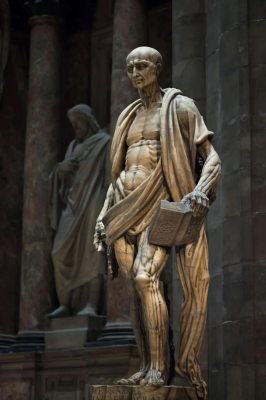
Saint Bartholomew Flayed by Marco d'Agrate,1562, Marble © Milan Cathedral / Alamy
Source: Christian Art
Gospel of 24 August 2026
John 1:45-51
At that time: Philip found Nathanael and said to him, 'We have found him of whom Moses in the Law and also the prophets wrote: Jesus of Nazareth, the son of Joseph.' Nathanael said to him, 'Can anything good come out of Nazareth?' Philip said to him, 'Come and see.' Jesus saw Nathanael coming towards him and said of him, 'Behold, an Israelite indeed, in whom there is no deceit!' Nathanael said to him, 'How do you know me?' Jesus answered him, 'Before Philip called you, when you were under the fig tree, I saw you.' Nathanael answered him, 'Rabbi, you are the Son of God! You are the King of Israel!' Jesus answered him, 'Because I said to you, "I saw you under the fig tree", do you believe? You will see greater things than these.' And he said to him, 'Truly, truly, I say to you, you will see heaven opened, and the angels of God ascending and descending on the Son of Man.'
Reflection on the sculpture
Today we celebrate the Feast of Saint Bartholomew, one of the Twelve Apostles. Most scholars identify him with Nathanael, the disciple whom Jesus saw sitting under the fig tree and praised with the words: "Here is a true Israelite, in whom there is no deceit" (John 1:47), hence our reading of today. The reason we think Bartholomew and Nathaniel are the same person is quite simple. The first three Gospels (Mark, Luke, Matthew) always list Bartholomew among the Twelve Apostles, but never mention Nathanael. Saint John, on the other hand, never includes Bartholomew in his list of disciples, yet he speaks several times about Nathanael, presenting him as one of Jesus' closest followers. It therefore seems likely that they are the same person. "Bartholomew" is not really a first name anyway but a family name, meaning "son of Tolmai" (Bar-Tolmai). Nathanael would have been his personal, first name.
After the Resurrection, Bartholomew devoted his life to proclaiming the Gospel far beyond the Holy Land. Ancient Christian tradition tells us that he travelled widely, preaching in places such as India, Mesopotamia, Lycaonia (in modern-day Turkey), Parthia (modern Iran) and, finally, Armenia. There, according to tradition, he converted many people to Christianity, including members of the royal household. This angered King Astyages, who ordered Bartholomew to be brutally executed. He was first flayed alive and then beheaded.
Our sculpture today, in the Duomo of Milan, portrays this extraordinary, cruel martyrdom with remarkable honesty. Created by Marco d'Agrate in 1562, it shows Saint Bartholomew standing calmly, with what at first appears to be a cloak draped over his shoulders. On closer inspection we realise that it is his own skin. It is a shocking image, yet the sculptor avoids any sense of horror or drama. Bartholomew's face is peaceful, almost serene. The work reflects the fascination of the Renaissance with the beauty and structure of the human body, making the sculpture not only a tribute to the saint but also an astonishing study of human anatomy.
The sculpture is so classically beautiful that Marco d'Agrate feared people might think it was the work of the great Greek sculptor Praxiteles. He therefore carved an inscription at its base: "I was not sculpted by Praxiteles, but by Marco d'Agrate." It is a charming glimpse of the artist's pride in his achievement. Yet the real masterpiece is not the sculptor's skill, but Bartholomew's faith. He was stripped of everything, even his own skin, yet he never let go of Christ. Most of us will never be asked to make such a sacrifice. But we are all invited to let God strip away whatever keeps us from Him: our pride, our selfishness, our fears and our attachments. The more we allow God to remove these layers, the more our true self is revealed.
Saint Bartholomew, pray for us.
LINKS
Christian Art: www.christian.art
Today's image: https://christian.art/daily-gospel-reading/john-1-45-51-2026/
(Note to readers: We're bringing you the 24 August page late - because there was a problem earlier today. Its been resolved now.)
 Facebook
 Twitter
 LinkedIn
 Print
Print Email
Email








 Facebook
 Twitter
 YouTube
 LinkedIn
 Pinterest