

Gospel in Art: Peter, I will give you the keys of the kingdom of heaven
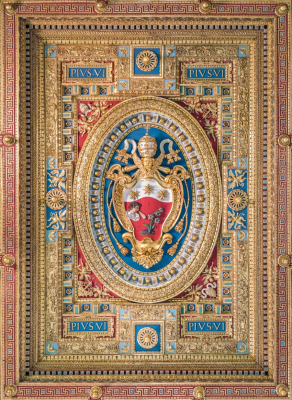
Pope Pius VI coat of arms in the Basilica of Saint John Lateran in Rome, late 18th century © Alamy
Source: Christian Art
Gospel of 23 August 2026
Matthew 16:13-20
At that time: When Jesus came into the district of Caesarea Philippi, he asked his disciples, 'Who do people say that the Son of Man is?' And they said, 'Some say John the Baptist, others say Elijah, and others Jeremiah or one of the prophets.' He said to them, 'But who do you say that I am?' Simon Peter replied, 'You are the Christ, the Son of the living God.' And Jesus answered him, 'Blessed are you, Simon Bar-Jonah! For flesh and blood has not revealed this to you, but my Father who is in heaven. And I tell you, you are Peter, and on this rock I will build my Church, and the gates of hell shall not prevail against it. I will give you the keys of the kingdom of heaven, and whatever you bind on earth shall be bound in heaven, and whatever you loose on earth shall be loosed in heaven.' Then he strictly charged the disciples to tell no one that he was the Christ.
Reflection on the ceiling panel
When Jesus asks His disciples, "Who do you say I am?", Peter gives one of the clearest professions of faith in the Gospels: "You are the Christ, the Son of the living God." Jesus then entrusts Peter with a unique mission: "I will give you the keys of the kingdom of heaven." In the ancient world, keys were much more than mere practical objects. They were a symbol of authority, responsibility and trust. The person who held the keys acted on behalf of the master of the house, opening the door to those who were welcome and caring for all that had been placed under his charge. Still nowadays, if we give friends the keys to our house, it implies that we trust them. Jesus is therefore entrusting Peter as a faithful steward, giving him the responsibility of caring for the Church.
The image of the keys would also have reminded Jesus' listeners of the Old Testament. In the Book of Isaiah (22:22), the "key of the House of David" is given to Eliakim as a sign of authority: "What he opens no one shall shut; what he shuts no one shall open." Jesus deliberately echoes these words. He, the true Son of David, now entrusts Peter with a share in His own mission. The keys in the bible are therefore symbols of humble service. Peter will spend the rest of his life opening the way to Christ for others... something all of us are asked to do as well, to lead people through our Church doors to encounter God.
Throughout Christian art, Saint Peter is almost always shown holding two keys. Traditionally, one key is gold, representing the authority of Heaven. The other is silver, representing the Church's mission here on earth. Together they remind us that heaven and earth are united in Christ, and that Peter's ministry was to help people pass from one to the other.
The two crossed keys remain one of the most recognisable symbols of the Catholic Church. They still appear on the coat of arms of the Holy See, on the Vatican flag, and in the personal coat of arms of every Pope. Although the keys had appeared in Christian art for many centuries, they only became firmly established as the official emblem of the papacy during the 14th century, under the Avignon Popes. By the 15th century, the crossed keys beneath the papal tiara had become the standard papal coat of arms, and ever used since.
Our photo is of a carved giltwood and polychrome painted ceiling panel, depicting the papal coat-of-arms of Pope Pius VI ( 1717 - 29 August 1799) in the Basilica of Saint John Lateran in Rome, showing the two crossed keys.
LINKS
Christian Art: www.christian.art
Today's image: https://christian.art/daily-gospel-reading/matthew-16-13-20-2026/
 Facebook
 Twitter
 LinkedIn
 Print
Print Email
Email





 Facebook
 Twitter
 YouTube
 LinkedIn
 Pinterest