


Gospel in Art: Saint Bernard of Clairvaux, Abbot, Doctor
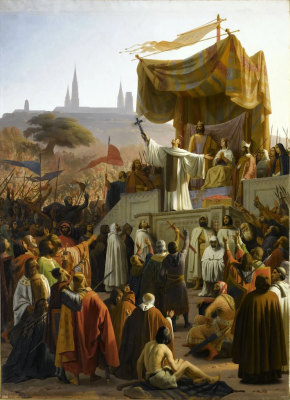
Saint Bernard preaching the Second Crusade in Vézelay in 1146 by Émile Signol 1880 © Palace of Versailles
Source: Christian Art
Gospel of 20 August 2026
John 17:20-26
At that time: Jesus lifted up his eyes to heaven, and praying said, 'Holy Father, I do not ask for these only, but also for those who will believe in me through their word, that they may all be one, just as you, Father, are in me, and I in you, that they also may be in us, so that the world may believe that you have sent me. The glory that you have given me I have given to them, that they may be one even as we are one, I in them and you in me, that they may become perfectly one, so that the world may know that you sent me and loved them even as you loved me. Father, I desire that they also, whom you have given me, may be with me where I am, to see my glory that you have given me because you loved me before the foundation of the world. O righteous Father, even though the world does not know you, I know you, and these know that you have sent me. I made known to them your name, and I will continue to make it known, that the love with which you have loved me may be in them, and I in them.'
Reflection on the painting
Saint Bernard of Clairvaux (1090-1153) was one of the most influential figures of the Middle Ages. Born into a noble family near Dijon in France, he entered the newly founded Cistercian Order at the age of twenty-two. Just a few years later he established the Abbey of Clairvaux, which under his leadership became one of the greatest monastic centres in Europe. Bernard was renowned for his holiness, his powerful preaching and his deep love for Christ. He advised popes and kings, wrote extensively on the spiritual life, and was eventually declared a Doctor of the Church because of the lasting importance of his teaching.
One of the most famous episodes of Bernard's life took place at Vézelay in 1146, the moment depicted in our painting. At the request of Pope Eugenius III, Bernard preached in support of what became known as the Second Crusade. The crusade was launched after the County of Edessa, one of the Crusader states in the Holy Land, had fallen to Muslim forces in 1144, causing great alarm throughout Christian Europe. Bernard believed that the expedition would help defend Christian communities and safeguard access to the holy places associated with the life of Christ. The crowds at Vézelay were so large that an outdoor platform had to be built for him to preach from. Our canvas by Émile Signol, painted circa 1880, beautifully depicts this.
History, however, reminds us that the Crusades were deeply complex. While many participants sincerely believed they were defending fellow Christians and protecting pilgrims, the Crusades also brought immense suffering, violence and lasting division between peoples. The Second Crusade itself ended in failure. Today the Church recognises both the sincere religious motives of many who took part and the tragic consequences that accompanied these military campaigns. They remain an important chapter in our Christian history, inviting us to reflect on the challenges of living out faith, justice and peace in a fallen world.
Bernard's greatest legacy lies not in the Crusades but in his spiritual writings. He taught that the Christian life begins and ends with the love of God. His sermons on the Song of Songs remain among the masterpieces of Christian mysticism, describing the soul's loving relationship with Christ. Bernard also had a profound devotion to the Blessed Virgin Mary, helping to deepen Marian spirituality throughout the Church. Saint Bernard also shaped the arts in a distinctive way. He believed that beauty should lead the soul to God rather than distract it. For this reason, he criticised the excessive decoration found in some monastic churches of his day, arguing that monks should not be diverted by lavish ornamentation. Cistercian abbeys therefore favoured simplicity. Bernard did not reject beauty; rather, he sought a beauty rooted simplicity to encourage prayer, silence and contemplation.
LINKS
Christian Art: www.christian.art
Today's image: https://christian.art/daily-gospel-reading/john-17-20-26-2026-3/
 Facebook
 Twitter
 LinkedIn
 Print
Print Email
Email










 Facebook
 Twitter
 YouTube
 LinkedIn
 Pinterest