


Gospel in Art: Sell what you possess and give to the poor
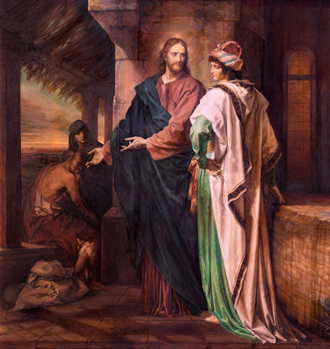
Christ and the Rich Young Man, Chiesa di Santi Quattro Evangelisti, Milan by Ahtos Renzo Briosch, Heinrich Hofmann, 1889 © Alamy
Source: Ahtos Renzo Briosch, Heinrich Hofmann
Gospel of 17 August 2026
Matthew 19:16-22
At that time: Behold, a man came up to Jesus, saying, 'Teacher, what good deed must I do to have eternal life?' And he said to him, 'Why do you ask me about what is good? There is only one who is good. If you would enter life, keep the commandments.' He said to him, 'Which ones?'
And Jesus said, 'You shall not murder; You shall not commit adultery; You shall not steal; You shall not bear false witness; Honour your father and mother, and, You shall love your neighbour as yourself.' The young man said to him, 'All these I have kept. What do I still lack?' J
esus said to him, 'If you would be perfect, go, sell what you possess and give to the poor, and you will have treasure in heaven; and come, follow me.' When the young man heard this he went away sorrowful, for he had great possessions.
Reflection on the painting
The young man who approaches Jesus in today's Gospel is an attractive and sincere character. He is not trying to trap Jesus or argue with him; he genuinely wants to know how to attain eternal life: "What must I do to inherit eternal life?" Jesus first directs him to the commandments, highlighting those that govern our relationships with other people. In doing so, he reminds us that the road to eternal life is not simply about personal devotion but aways involve actively loving those around us.
Yet the young man senses that something is still missing. He has faithfully observed the commandments, but he longs for a deeper response to God's call. He is seeking, he is discerning. Jesus therefore invites him to a path that is uniquely his: to let go of his possessions, give to the poor, and follow him wholeheartedly. The invitation is not merely about giving up wealth; it is about removing whatever prevents complete trust in God and wholehearted love of neighbour.
It is worth remembering that we are never told the end of the young man's story. He walks away saddened, but the Gospel leaves his future unwritten. Perhaps, after wrestling with Jesus' words, he eventually found the courage to respond. We simply do not know. For that reason, we should be careful not to judge him too quickly. Instead, the story invites each of us to ask an uncomfortable but important question: What is Jesus asking me to let go of so that I can follow him more freely? The path to eternal life will always be the path of love, but the concrete form that love takes is different for each one of us.
Our painting captures the encounter between Jesus and the rich young man. The young man stands before Christ in magnificent clothing, his elegant garments and refined appearance immediately revealing his wealth and social standing. Jesus, however, gently redirects his gaze away from himself, extending his hand towards a group of poor people in the background. That simple gesture becomes the heart of the composition. Rather than delivering a lecture, Christ lets the needy become the living answer to the young man's question about eternal life. The contrast between the richly dressed seeker in the foreground and the overlooked poor in the distance powerfully illustrates that true discipleship is measured not by what we possess, but by how generously we love. Heinrich Hofmann's original 1889 composition presents Christ not as a stern judge but as a compassionate teacher.
LINKS
Christian Art: www.christian.art
Today's image: https://christian.art/daily-gospel-reading/matthew-19-16-22-2026/
 Facebook
 Twitter
 LinkedIn
 Print
Print Email
Email












 Facebook
 Twitter
 YouTube
 LinkedIn
 Pinterest