

Gospel in Art: Rejoice that your names are written in heaven
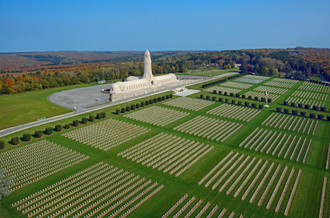
The Douaumont Ossuary (French: Ossuaire de Douaumont), aerial view, Inaugurated 7 August 1932, UNESCO World Heritage Site © Alamy
Source: Christian Art
Gospel of 3 October 2026
Luke 10-17-24
At that time: The seventy-two returned with joy, saying, 'Lord, even the demons are subject to us in your name!' And Jesus said to them, 'I saw Satan fall like lightning from heaven. Behold, I have given you authority to tread on serpents and scorpions, and over all the power of the enemy, and nothing shall hurt you. Nevertheless, do not rejoice in this, that the spirits are subject to you, but rejoice that your names are written in heaven.'
In that same hour he rejoiced in the Holy Spirit and said, 'I thank you, Father, Lord of heaven and earth, that you have hidden these things from the wise and understanding, and revealed them to little children; yes, Father, for such was your gracious will. All things have been handed over to me by my Father, and no one knows who the Son is except the Father, or who the Father is except the Son, and anyone to whom the Son chooses to reveal him.'
Then turning to the disciples he said privately, 'Blessed are the eyes that see what you see! For I tell you that many prophets and kings desired to see what you see, and did not see it, and to hear what you hear, and did not hear it.'
Reflection on the war memorial
There is a wonderful sense of joy running through today's Gospel. The seventy-two return from the mission Jesus had given them almost bursting with excitement. They have seen their work bear fruit; even the forces of evil seemed powerless before them. Jesus shares their joy, we read this beautiful line: "Jesus rejoiced in the Holy Spirit". Joy all round. Jesus then goes on to gently redirect that joy. Their deepest reason for rejoicing should not be what they have achieved, however impressive that may be. Rather, he tells them, "rejoice that your names are written in heaven." Their joy is to be rooted not in success, but in belonging to God.
To have our name "written in heaven" is a biblical way of saying that we are all known personally by God. Our names matter to God, because we matter to him. Jesus is reminding the disciples that their identity does not ultimately rest upon what they accomplish, how successful they are, or even how much good they manage to do. All of those things matter, yes, but they can change. There will be days when their preaching bears fruit and days when nobody listens. There will be triumphs and disappointments. There will be days of good homilies and bad homilies. Jesus himself would eventually appear, in the eyes of the world, to have failed completely as he hung upon the Cross. Yet beneath all these changing circumstances there remains something wonderfully constant: we belong to God. Our names are known to him. They are, as Jesus puts it so beautifully, already "written in heaven."
When Jesus tells us that our names are "written in heaven", I sometimes wonder what such a list might look like. If every one of our names is there, Heaven must have a rather substantial register! Of course, Jesus is not suggesting that somewhere beyond the clouds there is an enormous leather-bound book with billions of names in it. But the image of a seemingly endless list of names is one we do encounter here on earth. We see it most poignantly on war memorials: names carved one after another into stone, sometimes in such numbers that we find ourselves stepping closer to read just one. Behind every name was an entire life.
Few places bring this home more powerfully than the Douaumont Ossuary, near Verdun in north-eastern France. It stands amid the landscape where the Battle of Verdun was fought in 1916, one of the longest and bloodiest battles of the First World War. Around 300,000 French and German soldiers were killed during the fighting. After the war, the surrounding fields were still filled with human remains, many of which could no longer be identified. The great ossuary at Douaumont was built to receive them. Today it contains the remains of approximately 130,000 unidentified French and German soldiers. In front of it lies an immense military cemetery containing more than 16,000 individual graves. Inside the 137-metre-long building, tens of thousands of names are inscribed on its walls and stones, remembering those who died or disappeared at Verdun.
And perhaps this is where the words of Jesus become especially moving. At Douaumont there are thousands of names we do know, but beneath the ossuary lie the remains of some 130,000 people whose names we do not. History has lost their identities. Their bones became mixed together in the soil of the battlefield, French and German, friend and enemy alike. We call them the "unknown" dead. Yet not one of them is unknown to God. He knows the name of each of these soldiers that history has forgotten.
LINKS
Christian Art: www.christian.art
Today's Reading: https://christian.art/daily-gospel-reading/luke-10-17-24-2026/
 Facebook
 Twitter
 LinkedIn
 Print
Print Email
Email






 Facebook
 Twitter
 YouTube
 LinkedIn
 Pinterest