


Gospel in Art: The kingdom of heaven is like a master of a house...
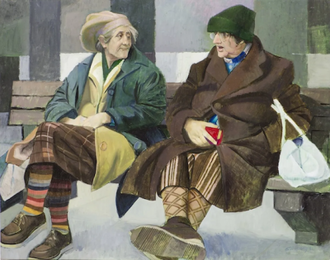
Two Auld Wifies, Dundee, by Ron Stenberg 1982, The McManus: Dundee's Art Gallery and Museum, Dundee City Council © Estate of Ron Stenberg. Donated by the artist, museum number 2015-61
Source: Christian Art
Gospel of 19 August 2026
Matthew 20:1-16
At that time: Jesus told his disciples this parable, 'The kingdom of heaven is like a master of a house who went out early in the morning to hire labourers for his vineyard. After agreeing with the labourers for a denarius a day, he sent them into his vineyard. And going out about the third hour he saw others standing idle in the market-place, and to them he said, "You go into the vineyard too, and whatever is right I will give you." So they went. Going out again about the sixth hour and the ninth hour, he did the same. And about the eleventh hour he went out and found others standing. And he said to them, "Why do you stand here idle all day?" They said to him, "Because no one has hired us." He said to them, "You go into the vineyard too."
'And when evening came, the owner of the vineyard said to his steward, "Call the labourers and pay them their wages, beginning with the last, up to the first." And when those hired about the eleventh hour came, each of them received a denarius. Now when those hired first came, they thought they would receive more, but each of them also received a denarius. And on receiving it they grumbled at the master of the house, saying, "These last worked only one hour, and you have made them equal to us who have borne the burden of the day and the scorching heat." But he replied to one of them, "Friend, I am doing you no wrong. Did you not agree with me for a denarius? Take what belongs to you and go. I choose to give to this last worker as I give to you. Am I not allowed to do what I choose with what belongs to me? Or do you begrudge my generosity?" So the last will be first, and the first last.'
Reflection on the painting
We all have a strong sense of fairness. When we feel that we have been treated unjustly, it can stir deep frustration. Likewise, when we witness injustice in the world, our instinct is to want things put right. It is perhaps this natural desire for fairness that makes today's Gospel one of Jesus' most challenging parables. At first hearing, the story of the labourers in the vineyard can seem unfair. It is easy to sympathise with those who worked all day and felt aggrieved when those who had laboured for only one hour received exactly the same wage. Not fair.
Yet the heart of the parable is not about fairness in the way we usually understand it. The landowner does not cheat the workers who began at dawn; he pays them precisely what he had promised. What surprises everyone is not his justice, but his generosity. Jesus invites us to recognise that God's ways cannot be measured by our human calculations. His mercy and generosity overflow the limits of what we think people deserve!
This is both comforting and humbling. None of us can earn God's love by our achievements alone or claim a greater share of His grace because of our efforts. Everything we receive from Him is ultimately a gift. Whether we have followed Christ for a lifetime or have only recently turned to Him, we stand before God not as people who have earned a reward, but as beloved children who have received far more than we deserve.
At first glance, Ron Stenberg's Two Auld Wifies, Dundee, painted in 1982, appears to be a simple scene of two elderly people gossiping on a bench in a shopping precinct. Yet the painting reminds us that appearances can be deeply misleading. Years after it was painted, the figures were identified as a mother, Janet, and her beloved son, Alexander, who had profound learning disabilities. Every Friday she would meet him in the centre of Dundee, where they would sit together, talk, and quietly enjoy one another's company. The painting beautifully echoes today's Gospel. Like the labourers in the vineyard, we are tempted to judge by outward appearances and by our own standards. We instinctively measure, compare and reach conclusions about people or sections of society we don't know. Yet Jesus asks us to look with God's eyes rather than our own eyes.
The story has an even more remarkable ending. Janet, the humble woman on the left of our painting, had often been misunderstood and ostracised by others. She quietly amassed a substantial estate and, after her death, left it to establish a charitable trust for the benefit of the people of Dundee. The woman who had received so little generosity from society responded with astonishing generosity herself. Her life reflects something of the landowner in Jesus' parable: generosity that is not calculated, measured or deserved, but freely given.
LINKS
Christian Art: www.christian.art
Today's image: https://christian.art/daily-gospel-reading/matthew-20-1-16-2026/
 Facebook
 Twitter
 LinkedIn
 Print
Print Email
Email















 Facebook
 Twitter
 YouTube
 LinkedIn
 Pinterest