


Gospel in Art: Jesus asked Peter three times: 'Do you love me'
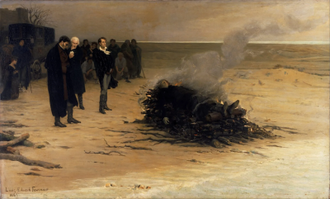
The Funeral of Shelley by Louis Édouard Fournier 1889 © Walker Art Gallery, Liverpool
Source: Christian Art
Gospel of 21 August 2026
John 21:15-17
When Jesus had revealed himself to his disciples and they had finished breakfast, Jesus said to Simon Peter, 'Simon, son of John, do you love me more than these?'
He said to him, 'Yes, Lord; you know that I love you.' He said to him, 'Feed my lambs.'
He said to him a second time, 'Simon, son of John, do you love me?' He said to him, 'Yes, Lord; you know that I love you.' He said to him, 'Tend my sheep.'
He said to him the third time, 'Simon, son of John, do you love me?' Peter was grieved because he said to him the third time, 'Do you love me?' and he said to him, 'Lord, you know everything; you know that I love you.' Jesus said to him, 'Feed my sheep.'
Reflection on the painting
One of the most difficult things in life is learning to let go. Parents must eventually allow their children to follow their own path, even when it leads in unexpected directions. Friends must give one another the freedom to grow and change, rather than expecting them to remain as they once were. Countless people throughout history have been forced to leave behind their homes, their communities and even their loved ones because of war or persecution. Think of those fleeing Ukraine or other war torn areas, letting go of their homeland. Yet perhaps the hardest farewell of all comes at the graveside, where tears speak of the deep love that makes parting so painful and where we have to let go of the person we loved.
Today's Gospel takes us to the shores of the Sea of Galilee, shortly after the Resurrection. Peter has already encountered the risen Jesus, but he is still coming to terms with all that has happened. He saw his friend Jesus dead on the cross, and he had to let go of him... in order to find Jesus in new ways. Three times Jesus asks him in today's reading, 'Do you love me?', gently healing the threefold denial that had taken place only days earlier, before entrusting him with the care of His flock. This conversation is preparing Peter for what lies ahead. Jesus knows that His Ascension is drawing near, and that Peter will soon have to let go of His physical presence. He will no longer be able to walk beside Jesus as he once did. Instead, Peter must learn to recognise Christ in a new way. Only by letting go of Jesus in earthly terms would Peter discover that the risen Lord would be even more intimately present than before.
As I mentioned, perhaps the hardest form of letting go is the one we experience at a funeral. Standing beside a coffin or a graveside, we are confronted with the painful reality that someone we love is no longer physically present. Tears are the natural language of love, expressing both our sorrow and our gratitude for a life shared. Yet Christian funerals hold together two realities that seem almost impossible to reconcile: genuine grief and steadfast hope. We mourn because death is real, but we also believe that death does not have the final word. In Christ, every farewell becomes the promise of a future reunion with the person we loved.
Our painting by Georges Clairin Fournier, The Funeral of Shelley, captures something of this poignant tension. It depicts the cremation of the great English Romantic poet Percy Bysshe Shelley, who drowned off the Italian coast in 1822 when his small yacht was caught in a violent storm. Around the funeral fire stand three of his closest companions: Edward John Trelawny, Leigh Hunt and Lord Byron, each silently absorbed in the solemnity of the moment. Although Shelley died in the heat of an Italian summer, the artist deliberately paints the scene beneath heavy grey skies. The cool, muted colours heighten the sense of loss, while the burning pyre becomes the only source of warmth and light. Shelley himself is portrayed not as the victim of a tragic accident but almost as a fallen hero from classical antiquity, giving the scene a timeless, almost mythic quality.
The painting reminds us that every generation has wrestled with the pain of saying goodbye. Yet, unlike the mourners gathered on that lonely Italian beach, Christians look beyond the funeral fire or the open grave. We believe that death is not an ending but simply a passage to the next life.
LINKS
Christian Art: www.christian.art
Today's image: https://christian.art/daily-gospel-reading/john-21-15-17-2026/
 Facebook
 Twitter
 LinkedIn
 Print
Print Email
Email













 Facebook
 Twitter
 YouTube
 LinkedIn
 Pinterest