

Protecting aid workers means respecting humanitarian law

Source: Caritas Internationalis
Every year on 19 August, the international community marks World Humanitarian Day to honour humanitarian workers supporting communities affected by crises and conflicts. At a time of record levels of violence against them, Caritas Internationalis highlights the role of religious actors in promoting respect for international humanitarian law.
On this World Humanitarian Day, we pay heartfelt tribute to all those who have lost their lives while carrying out humanitarian work.
This day is a reminder that respect for International Humanitarian Law (IHL) is essential to ensuring the protection of those serving in conflict zones. When a humanitarian worker is deliberately targeted, it is not only an attack on an individual, but also on the humanitarian principles and the international legal framework that safeguard human dignity in times of war.
Humanitarian workers under attack
Over the past three years, more than 1,000 humanitarian workers have been killed around the world. Among them are several members of the Caritas family, including Caritas staff who lost their lives in Mariupol and Gaza amongst others.
Most recently, on 26 July, Yana Zhernovskaya, a social worker with Caritas Kharkiv, was killed when a Russian missile struck her home. Her 10-year-old son was injured in the same attack. These tragedies highlight the immense dangers faced by humanitarian workers every day.
According to the United Nations, the war in Gaza has reached the highest level of violence against humanitarian personnel ever recorded in modern history. Despite the danger, Caritas continues to serve in Gaza, where humanitarian workers carry out their daily mission with extraordinary commitment and courage despite the constant risk to their lives. Watch the video: www.youtube.com/watch?v=dPFG-uEItEo
These events remind us that the existence of legal rules alone is not enough to ensure compliance. Protecting humanitarian workers also depends on fostering respect for the principles of international humanitarian law within societies and strengthening community ownership of those principles.
The moral force of faith-based advocacy
In this regard, faith-based organisations and religious leaders have a vital role to play. Deeply rooted in their communities, they often enjoy trusted relationships and moral authority that enable them to promote the values of international humanitarian law in ways that resonate across different audiences.
Their commitment to peace, the protection of civilians, and respect for every human life and human dignity can help strengthen support for humanitarian principles. As highlighted in the report Strengthening the Moral Force of International Humanitarian Law Through Faith-based Advocacy - produced by the Graduate Institute of International and Development Studies in Geneva in collaboration with Caritas Internationalis, ACT Alliance and the World Council of Churches-combining humanitarian expertise with the credibility of religious leaders makes advocacy for respect for international humanitarian law significantly more effective.
The Central African Republic: faith leaders on the frontline
The Central African Republic offers a powerful example of the role faith leaders can play in promoting peace despite persistent violence. For more than a decade, the country has endured successive humanitarian crises. In the eastern regions, tensions have escalated further since May 2025, creating new threats to civilian populations. At the same time, shrinking humanitarian funding and the gradual withdrawal of some international actors have significantly reduced operational capacity.
Against this backdrop, the Catholic Church continues to stand alongside the country's most isolated communities. Bishop Aurelio Gazzera of Bangassou, who has served in the Central African Republic for many years, bears witness to this reality and to the risks faced by those who choose to remain with communities in times of conflict.
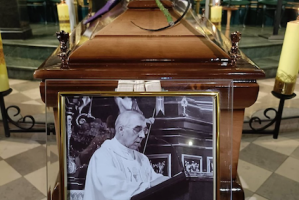
The recent killing of Fr Crépin Martial Monga, murdered in his diocese because of his commitment to peace, is a tragic illustration of these dangers. Fr Monga was killed in Zémio, in the Haut-Mbomou region of south-eastern Central African Republic, an area devastated by ethnic conflict between rival local militias. Widely respected as a mediator between armed groups and the authorities, his killing- for which no one has claimed responsibility -reflects the growing dangers facing peacebuilders and humanitarian actors alike.
Bishop Aurelio Gazzera: "Dialogue is key"
"Despite the very real threats, we continue because we are among the few who have the strength and courage to do so," Bishop Gazzera explains, referring to the role of the Catholic Church and other faith communities in a context where opportunities for dialogue remain extremely limited. Communities often have few means of making their voices heard or reporting the abuses they endure. Religious leaders therefore become essential interlocutors, able to amplify these testimonies and keep channels of dialogue open.
This ability to engage with different stakeholders is one of the greatest strengths of the Interreligious Platform for Peace, which brings together senior Catholic, Muslim and Evangelical leaders. According to Bishop Gazzera, the platform has enabled open dialogue with government authorities, armed forces and local communities, contributing to a better understanding of the conflict and tangible improvements on the ground.
Experience shows that calls to respect international humanitarian law are far more likely to be heard when they are grounded in relationships of trust and a deep understanding of local realities. Through the legitimacy they have earned within their communities, their long-standing presence among affected populations and the neutrality often attributed to them, religious leaders can reach conflict actors who remain inaccessible to many humanitarian organisations and help promote peace.
By combining the strengths and expertise of humanitarian and faith actors, the principles of international humanitarian law can truly come to life. Humanitarian organisations bring technical expertise in protection and international humanitarian law, while religious leaders contribute their deep knowledge of local contexts, their proximity to communities and the trust they have built over many years.
Together, this complementary partnership helps translate humanitarian principles into everyday realities, strengthens respect for international humanitarian law and contributes to better protecting those who risk their lives every day to assist people affected by conflict.
Because behind every protected humanitarian worker are entire communities that can continue receiving the assistance and support they desperately need. Protecting humanitarian workers means protecting life, dignity and hope for people caught up in conflict.
Anaïs Jeanjean is at the Department of European and International Studies, Sorbonne Nouvelle University, Paris
Watch the interview with Bishop Aurelio Gazzera: www.youtube.com/watch?v=Yym5EUTp8Qg
 Facebook
 Twitter
 LinkedIn
 Print
Print Email
Email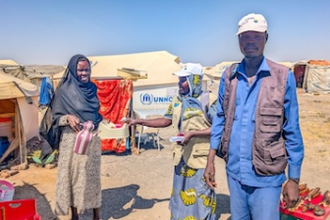






 Facebook
 Twitter
 YouTube
 LinkedIn
 Pinterest