

Calls for forgiveness as slain Polish priest laid to rest
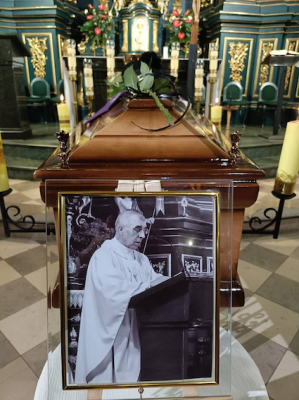
The funeral of Fr Stanisław Zbojnowicz, who was stabbed to death in a Benedictine monastery in Jarosław, south-eastern Poland, on 24th September, took place in his home parish in Grzęska, on 29th September where he was laid to rest in the family grave.
The assailant, Ihor M, was a 31 year-old Ukrainian refugee who was suffering a psychotic attack.
'Since last Thursday, September 24th, Father Stanisław has joined the ranks of martyrs for the faith. He died after leaving the confessional,' said Father Marian Bocho, Dean of the Jarosław Deanery, in his homily during the funeral Mass for Father Stanisław Zbojnowicz. He also called for forgiveness and overcoming evil with good at a time when the Polish welcome of hundreds of thousands of Ukrainian refugees, displaced due to the war with Russia, is seeing a marked wane and a rise in tensions. Jarosław is located about 25 miles from the Ukrainian border.
The Requiem Mass was celebrated in Fr Zbojnowicz's home parish, at the Church of the Exaltation of the Holy Cross in Grzęska.
Tribute was paid to the 40 years of Fr Zbojnowicz's priestly ministry and kindness. Fr Bocho, recalled in his homily that the deceased priest had served in parishes for many years, was chaplain of the Krosno hospital, and had been the the Benedictine nuns' chaplain at Jarosław Abbey for 16 years.
"We want to thank you for the good that Father Stanisław has done for four decades out of love for God and love for people," he said.
Fr Bocho highlighted the deceased priest's special charisma - his ministry in the sacrament of reconciliation which was highly valued. It was from a confessional that Father Zbojnowicz had emerged before the tragic attack.
He emphasized that for Fr Zbojnowicz the confessional was a place of daily, faithful service.
"He shed the light of the Gospel on human affairs and hearts that sought not only absolution, but also a kind word, encouraging, sometimes consoling, and guidance," he noted.
Noting that Fr Zbojnowicz was holding the keys to the tabernacle in his hand at the time of the fatal attack, Fr Bocho said, 'Father Stanisław proved to be the guardian of the heart of the Church, which is the tabernacle, until the end of his life.'
Later in the homily, the preacher prayed that the Lord would free those present from hatred so that 'we may be able to bless and not curse.' He cited St Paul: 'Do not be overcome by evil, but overcome evil with good.'
Fr Bocho recalled the sacrifice and martyrdom of Blessed Fr Jerzy Popiełuszko and recalled the words of forgiveness uttered by Fr Adrian Mantykiewicz who had also been attacked by the assailant in his psychotic rampage.
On 26th September , a silent march was held near the monastery in Jarosław to commemorate the murdered priest, preceded by a Mass for the repose of his soul. 'From this place, as a disciple of Jesus Christ, I want to say very clearly, in my own name, in the name of Fr Marek and in the name of Fr Stanisław: we forgive!' said Fr Adrian Mantykiewicz during his homily.
With his head bandaged and his bruised face swollen, the priest also urged people not to blame the Ukraine or Ukrainians. 'I ask you not to blame the perpetrator's country of origin, because the evil was committed by a specific person, a specific person who has his own name, his own life, and is responsible for his own actions.'
Fr Bocho recalled Christ's Gospel of Love and encouraged prayers for the attacker - 'his conversion and transformation' - who is currently in a secure psychiatric hospital.
Ihor M., entered the monastery complex, took a kitchen knife and attacked five people: four men and one woman. Fr Stanisław Zbojnowicz was in the confessional when the incident began. He tired to secure the church doors to protect parishioners and stop the assailant, but was stabbed fatally while doing so. Two other men remain hospitalized in a serious condition. One of them is another priest, Fr Marek Pieńkowski, head of the Council of the Foundation for Family Pastoral Ministry and deeply involved in assisting Ukrainian refugees.
 Facebook
 Twitter
 LinkedIn
 Print
Print Email
Email






 Facebook
 Twitter
 YouTube
 LinkedIn
 Pinterest