

Ian Linden: The Troubles - Unhiding the Truth
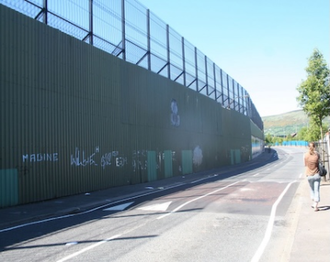
'Peace wall' along Cupar Way, Belfast 22/05/10. Duke Human Rights Center. Wiki Image
In Belfast in the mid-1980s I watched a fully armed British soldier, shouldering a rifle, inspecting a coach for weapons. The coach was full of primary school children waiting to go to the Servite priory in Benburb for a weekend retreat away from home, a poor and rough part of the city. At Mass, there was a prayer in thanksgiving for 'new shoes' and, somewhat competitively, for deceased grannies, first one who had died 'a year ago', followed by one who had died 'a month ago' and finally a granny who had shuffled off this mortal coil 'a day ago'. The celebrant wisely wound up the bidding prayers. It was sweet and funny but, of course, many people actually had been dying, and violently, in the Troubles - not just the first prayed for granny.
A month of so ago I went back to give a lecture in Queen's College. The Good Friday Agreement had come and felt long gone. It was sad to see, after the great achievement ending sectarian killing and the creation of a new political dispensation, how little had changed. Miles of walls separating working class unionist and nationalist communities, Catholic from Protestant, with gates shut early in the evening to separate them. Only 10% of schools integrated. Everything still fed into the sacred binary. I was lecturing about Gaza, Palestine and Israel. The Catholic students supported the Palestinians. The Protestants far less.
There are so many deaths still left uninvestigated. So many families with no real idea what happened to their loved ones. Their seeking answers after all this time, in a divided society with pockets of worrying residual thuggery, is an act both of courage and proof of how important is 'closure' for moving beyond grief.
Investigative journalism, finding out what others want to hide, is more dangerous: a great way to make powerful and/or dangerous enemies and for lawyers to guarantee investigations will need big budgets. Even without punishing legal proceedings, the work takes time and time costs money. With an impressive portfolio of articles, books and TV productions dating back to the 1970s, John Ware is a notable survivor of a rare breed of journalist.
Ware's Neither Confirm Nor Deny: British Intelligence, Lawless Agent Running and the Suppression of Truth, Merrion Press 2026, was published a few weeks ago. It exposes and sifts the dirt in the dirty war known in Ireland as The Troubles. It is a gift of truth for the many families of innocent victims whose deaths have been left uninvestigated, allegedly for national security reasons.
'Neither Confirm Nor Deny' is the refrain dear to the British Intelligence Services, used repeatedly by the Royal Ulster Constabulary, RUC, MI5 and the FRU, the Army's Force Research [agent running] Unit, and then by the British government. It served to hide the crimes of the extraordinary number of covert agents who had penetrated rival loyalist and nationalist organisations and their armed wings notably the Irish Republican Army (IRA), Ulster Defence Association (UDA) and Freedom Fighters (UFF). To survive and to harvest the hoped-for, high quality, intelligence highly placed agents were complicit in extreme violence. Ware struggles with this moral dilemma throughout the book.
The story focuses on the actions of two figures, Brian Nelson and Freddie Scappaticci (known as Stakeknife) and their handlers, chronicling how they engaged or colluded in abductions, torture and killings of IRA targets. Nelson was embedded in the UDA. Scappaticci worked his way up to a critical senior position in the IRA's Internal Security Unit (ISU), and was in charge of compiling their assassination lists, participating in the commission of murders. Stakeknife was too often in the habit of being in proximity to killings or abductions to absolve him from responsibility for them. He led a charmed, reckless life. Even his wife did not know he was working for the British.
Evidence, meticulously compiled by Ware from FRU contact forms (CFs), recording meetings with the two agents, indicates that even when Nelson and Scappaticci warned in good time of a planned assassination, no action appears to have been taken to protect the targets.
Ware's account suggests that senior officers in the different intelligence agencies valued their agents and potential intelligence 'take' more than the lives of potential and actual targets, however slim the evidence that they were active IRA members. To name an agent was in all senses beyond the pale. That their actions should not be totally outside the remit of criminal justice apparently less so. Britain is not, of course, the only State responding to what is declared a national security threat to have condoned assassinations.
It was in September 1989, in response to great pressure and very late in the day, that Nelson and Scappaticci became enough of a concern for the Chief Constable of the RUC, Hugh Annesley (later Sir Hugh), to initiate an independent investigation. In an attempt to show the UDA exclusively assassinated IRA gunmen, the UDA had been leaking documents demonstrating collusion between loyalist paramilitaries and the security forces. Chief Constable Annesley asked John Stevens (later Sir), a future Commissioner of the Metropolitan Police, then deputy chief constable of Cambridgeshire, to undertake the investigation. Laurie Sherwood, a CID inspector, Stevens' special senior assistant, were the only heroes in this ugly saga. They faced intractable systemic obstruction from the different intelligence services including the withholding of key documents and information as the highest authorities in the different agencies clung to what they hoped was 'plausible deniability'.
The principal front-line handlers who failed to stop the killings and their agents who were complicit in them were working for a British army military intelligence unit. For some time even the existence of this unit was kept from Stevens. From the Military's point of view, this was war. Most of the dead named in the cases against Nelson and Stakeknife were the enemy, active members of the IRA. Around the world in warfare, the consequence of treachery is often death.
But several of those killed both by the IRA and UDA/UDF, with assistance from British agents, were innocent Catholics and not, as alleged, informers. The irony is that Prime Minister Thatcher always insisted The Troubles weren't a war between the IRA and Britain. So the IRA were not belligerents. They were criminals and it followed they should be treated as criminals. This included not being given special treatment even if this meant making martyrs out of the hunger strikers.
The Irish Bishops remained steadfastly opposed to armed struggle as a way of solving unjust social conditions, Northern Ireland's problem of clashing identities, and were supported by Pope John Paul II in a passionate promotion of human rights and rejection of violence in an historic sermon in Drogheda during his October 1979 visit. "What Christianity does forbid is to seek solutions to these situations by the ways of hatred, by the murdering of defenceless people, by the methods of terrorism", he said. His appeal to "the moral sense and Christian conviction of Irish men and women"…. "that nobody may ever call murder by any other name than murder" was anathema to both warring sides in the Troubles and those who spied on them.
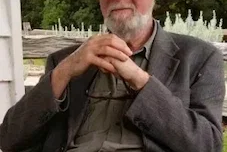
Professor Ian Linden is Visiting Professor at St Mary's University, Strawberry Hill, London. A past director of the Catholic Institute for International Relations, he was awarded a CMG for his work for human rights in 2000. He has also been an adviser on Europe and Justice and Peace issues to the Department of International Affairs of the Catholic Bishops Conference of England and Wales. Ian chairs a new charity for After-school schooling in Beirut for Syrian refugees and Lebanese kids in danger of dropping out partnering with CARITAS Lebanon and work on board of Las Casas Institute in Oxford with Richard Finn OP. His latest book was Global Catholicism published by Hurst in 2009.
 Facebook
 Twitter
 LinkedIn
 Print
Print Email
Email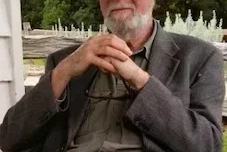











 Facebook
 Twitter
 YouTube
 LinkedIn
 Pinterest