

Ian Linden: Disappearing Christians from history
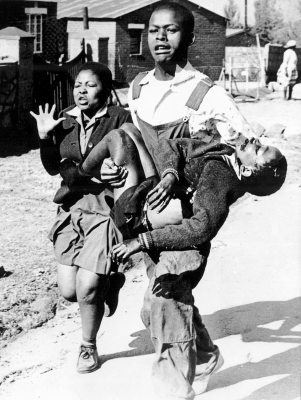
Mbuyisa Makhubu carries Hector Pieterson after he was shot and killed at the Soweto Uprising. Wiki Image
The growth of secularism in the last century has resulted in the role of the Christian Churches in television coverage of history often being written out of the script. This is noticeable in otherwise well-made TV and radio documentaries, much less so thankfully in historical scholarship.
The three episodes of James Rogan's Free Nelson Mandela, screened on Channel 4 in mid-June, provide a study of this failing in a TV documentary. Crafted to engage an English-speaking and young audience the series has excellent South Africa library footage, including of Nelson and Winnie Mandela, and contemporary interviews with his 1980s fellow Robben Island prisoner, James Mange, and also of Albie Sachs, badly damaged physically by car bomb in 1988, spiritually more intact than most of us. There are also plenty of chances to hear from decrepit late 20th century musicians and the music from their solidarity concerts, and to learn about Peter Hain and sports boycotts. President PW Botha along with Reagan and Thatcher star as the villains. Rogan neglects key players in resistance to apartheid; Communist Parties do not feature even as noises off, nor explored internally as part of the African National Congress (ANC), yet their role was crucial. Zero on the role of the Churches. Zero footage of Archbishop Desmond Tutu.
Most Gen Z have barely heard of the 1948-1994 apartheid regime, know what it was, or how the ANC finally came to power. So the series should be welcomed. But it shows what happens when a sequence of compelling images is substituted for history. Because the history of the end of apartheid, like all good history, is a quest for understanding, how one event leads to another, what precipitates change and why.
Rev Frank Chikane, a pastor in the Apostolic Faith Mission (AFM), general-secretary of the South African Council of Churches (SACC), 1987-1994, trusted by Mandela, surviving poisoning by the regime in 1989, is captioned as 'United Democratic Front', at the time a huge coalition of civil society organisations supportive of the ANC. He was indeed Vice-President of the UDF Transvaal Branch for two years whilst working in the radical Institute for Contextual Theology. His impact as a Christian leader irrelevant?
You might also conclude from the evidence provided that, when it comes to significant international interventions, viewers only need know about the American and British anti-apartheid movements. Though both were gathering large crowds and had been promoting sanctions against South Africa for many years, it wasn't until August 1986, after the South African government initiated meetings with Mandela while in hospital in November 1985, that the US Senate passed a weak Bill implementing sanctions.
Either Rogen doesn't know, or doesn't think it important, that inside South Africa the Free Nelson Mandela Campaign was a front for funding the expansion of the ANC within civil society. In his first term as Social Democrat Prime Minister of Sweden from 1969-1976, Olaf Palme began humanitarian funding of South African refugees in Central Africa. He had concluded that the ending of apartheid must not remain another proxy arena for the Cold War, with the ANC solely supported by the Communist Parties of the Soviet Union and East Germany. So, in the 1980s, he began undercover funding to support the peaceful development of ANC organization within South Africa. In the fourth year of his second term, 1982-1986, he was shot dead in a Stockholm street next to his wife, almost certainly as a result of this intervention.
Swedish money passed into the country clandestinely through a number of channels: two of the most important were the trades unions and the Churches. A small group of Christian leaders who were either members of, or supportive of, the ANC included Father Smangaliso Mkhatshwa, secretary-general of the South African Catholic Bishops Conference, Father Albert Nolan, undercover ANC member and Dominican Provincial, and Rev. Beyers Naudé, renegade ordained Minister in the Nederduitse Gereformeerde Kerk (Dutch Reformed Church), and Frank Chikane himself.
Thanks to wide consultations and deliberation, the group was able to direct Swedish money to where it was most needed in the internal movement. For example, at the height of resistance, 1985-1986, the apartheid regime was decapitating by repeated arrests the Congress of South African Students, COSAS, the main ANC-front youth organization,. Anarchy threatened: young people began 'necklacing' individuals suspected of being government informants and collaborators, putting burning tyres around their necks. The imperative was to fund training for youth leaders to instill discipline. So via the Christian network COSAS became a funding priority.
Oliver Tambo the exiled ANC leader (1967-1991), made it clear the ANC rejected such violence. He had founded the ANC Youth League in 1944. Tambo was himself a devout Anglican Christian. I remember him meeting Archbishop Denis Hurley of Durban in the then Paddington Railway Hotel in 1983. Choreographed to enter the hotel by different doors, they met out of sight. Old friends, big hugs, beer and sandwiches ordered from room service.
The apartheid regime indicted Archbishop Hurley in 1984, not for his support for resistance to apartheid but under the Police Act for exposing - with the help of the Justice and Peace Commission - torture and atrocities committed by "Koevoet" the apartheid paramilitary police unit in Namibia. They dropped the case in the upheavals of 1985, then, in October 1988, badly burned Khanya House, the Bishops' Conference headquarters, in an arson attack. Two people, a nun and lay worker in the building narrowly escaped death.
As South Africa became ungovernable in the second half of the 1980s, with sanctions biting, the Rand plummeting, Anglo-American knocking on the door of President P.W. Botha saying the game was up, Christians were playing a significant, if small, role in resistance. Cricket boycotts, the great solidarity concerts, black protest in the USA and by our UK anti-apartheid movement, built the impetus of the campaign for sanctions. And sanctions hurt those benefitting from apartheid. Archbishop Hurley was never convinced it wouldn't hurt ordinary Africans more. When we visited Mama and Walter Sisulu (Deputy ANC President, 1991-1994, imprisoned for over 25 years with Mandela) in Soweto, just after his release, they both thanked him for all that he had done. He was much loved.
It was the resistance of those living with fear and the likelihood of arrest and torture, knowing they qualified for a bullet or bomb, building up overwhelming civic resistance and mass organization inside South Africa, who ended a regime which the world - apart from Israel, parts of the Tory Party and Reagan's Republicans - had turned against.
James Rogan is right: the massacre of students in 1976 protesting against making Afrikaans the language of instruction in schools was a turning point. The State's brutal response drew many into exile and guerilla training while the ANC took off internally The underground Church focused on youth then - as Pope Leo does today.
History is a pandora's box of stories left untold. Rogan's peg was the 50th anniversary of the Soweto massacres on 16 June. Our own school children should know why we commemorate this anniversary and, to that end, Rogan does a good job. It is a shame he 'disappeared' the Christians, and Communists, in the process. Compelling visuals. Poor history.
Professor Ian Linden is Visiting Professor at St Mary's University, Strawberry Hill, London. A past director of the Catholic Institute for International Relations, he was awarded a CMG for his work for human rights in 2000. He has also been an adviser on Europe and Justice and Peace issues to the Department of International Affairs of the Catholic Bishops Conference of England and Wales. Ian chairs a new charity for After-school schooling in Beirut for Syrian refugees and Lebanese kids in danger of dropping out partnering with CARITAS Lebanon and work on board of Las Casas Institute in Oxford with Richard Finn OP. His latest book was Global Catholicism published by Hurst in 2009.
To read Dr Linden's blog see: www.ianlinden.com/latest-blogs/
 Facebook
 Twitter
 LinkedIn
 Print
Print Email
Email






 Facebook
 Twitter
 YouTube
 LinkedIn
 Pinterest