

Ian Linden: The Pope's Visit to Africa
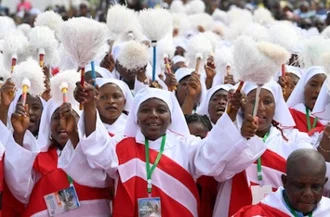
Mass at Yaoundé-Ville Airport Cameroon
The Pope is back safely from his visit to four African countries. Little was said about the danger to him when in Bamenda in Cameroon in the midst of a civil war, or Equatorial Guinea where Putin's Africa Corps (the old Wagner Group) look after its murderous President. During his visit to Nigeria in 2003, President George W Bush travelled protected in his heavily armoured Cadillac, The Beast. The airport café might have been mistaken for a Secret Service refectory at the Department of Homeland Security there were so many protection officers waiting. The popemobile looks very vulnerable on visits by comparison.
In five visits, Pope Francis visited ten African countries before his death, and Leo will probably do much the same. Accompanying journalists know that 20% of the world's Catholics live in Africa and the inequality and poverty in their different countries, hence papal attention, but few of them have much idea of what Church life is like when huge crowds aren't attending huge stadiums for Masses or thronging the streets as the popemobile drives past. Though Leo's emphasis of his Augustinian heritage in his Algeria visit to Annaba (Hippo) where St Augustine had been bishop, was distinctive. His focus on Christian-Muslim dialogue was more expected. There was no public mention of Algiers great missionary bishop, Cardinal Charles Lavigerie - probably because of his anti-Muslim statements in the late 19th century. It was a missed opportunity to praise the work of the Society of the Missionaries of Africa, the White Fathers, while at the Basilica of Our Lady of Africa. They surely deserved it.
Having lived in Malawi and Nigeria, done research in Rwanda and spent 1978- 1989 in and out of southern Africa, I can say with some confidence that 'Africa' names the continent but describes little else. The Sahara might as well be a vast sand ocean dividing two continents. In sub-Saharan Africa, cultures in different States are just as different as those between Germany and Spain and Norway. More so when Islam is considered. Politics similarly, from tyranny and military dictatorships to struggling democracies. Yet there is something recognisable as the 'African Church'. What is it exactly?
The first thing that comes to mind is liturgy. A significant number of African Catholics express joy and hope in their worship - in a very attractive way. Unlike Europeans, but like Muslims in prayer, they are at ease expressing worship with their bodies rather than just standing, kneeling and sitting down. We seem to have got rid of prostration on Good Friday, or it may just be the clergy are too old to get up again unaided.
At Midnight Mass in Lome in the mid-1970s, I sat next to a Togolese lady wearing a fabulous Kente dress and spectacular headgear. In the heat, and after what seemed a very long time before we were through the sermon and intercessions, I heard considerable noise outside the cathedral. Tuning in with my Nigerian antenna, it sounded to me like a protest. I quietly asked her if it was a riot. No, she said, it's the offertory procession. And it was. Drums and dancing, a swaying line of women appeared. Then there is the blessing of the fire at the Easter Vigil. In the UK, it is usually an anxious scene with the priest trying to light a few bits of wood in a bucket while the congregation freezes, and the lighting of the paschal candle seems temporarily in jeopardy. I remember going to Limbe Cathedral, Blantyre, Malawi one Easter Saturday evening and seeing a huge bonfire from about three miles distant. And the Poor Clares down the road used to celebrate a danced Mass.
In Zimbabwe, there was considerable thought given to christianising traditional transition rights, for puberty and ceremonies for the dead. In the 1970s there was full expectation in parts of central Africa that ordination of viri probati, men of proven Christian virtue, would soon take place. Missionaries were training them and their wives with this in mind in Likulesi, Malawi. This, of course, proved an inculturation too far.
In the 1980s. this openness carried over into politics. During the struggle against apartheid for example, there was something very moving in seeing the Red Flag go up behind Archbishop Denis Hurley during a funeral for a prominent ANC member. He would have preferred not but his presence said something about where the local Church's heart lay culturally. Christians and Communists were at the heart of resistance. The Bishops Conference was open to everyone from the Grail to black miners. I remember a lively but respectful debate at one of them over Marxism between Cardinal Owen McCann of Cape Town with two miners in full underground gear.
Since the Italian Jesuit Matteo Ricci in early 17th century China dialogued and adapted to Confucianism, politics and culture has remained a bone of contention in evangelisation. Even some modest forms of inculturation to African cultures did not have universal approval. Some bishops, a little too Romanised, banned drums in church as a pagan atrocity.
Such attitudes could knock on to the African diaspora. The Nigerian Cardinal Francis Arinze, Prefect of the Congregation for Divine Worship and the Discipline of the Sacraments from 2002 to 2008, now 93, used be a popular invitee of the Nigerian community at St Ignatius', Stamford Hill, London. There was one snag though, in full Prefectoral dudgeon, he let it be known that he would not come if there were girls on the altar during his Mass. The young Jesuit dealing with the visit was having none of it and boldly negotiated. Like all good negotiations a compromise was reached: the girls could be on the altar as long as they didn't move. Although I knew Arinze, travelled with him and enjoyed his company, I never told him this was the ruling for women in the Strip-Clubs of the 1950s.
Treatment of, and attitudes towards, women, Sisters, homosexuals, in several African countries has remained a disturbing bone of contention. Though bishops holding views contrary to the dominant European values have remained on the whole loyal to the papacy. The Anglican Church has not experienced the same loyalty to Canterbury. Popes are luckier.
Popes must find it very difficult having to go through formal receptions by brutal dictators. Yet they seem to enjoy visits to African countries. It is perhaps because they encounter there an infectious joy and hope, reflecting their own, expressed in the liturgies over which they preside, as well as the sense of a Church perhaps not often dramatically militant these days but still vibrant and growing.
Professor Ian Linden is Visiting Professor at St Mary's University, Strawberry Hill, London. A past director of the Catholic Institute for International Relations, he was awarded a CMG for his work for human rights in 2000. He has also been an adviser on Europe and Justice and Peace issues to the Department of International Affairs of the Catholic Bishops Conference of England and Wales. Ian chairs a new charity for After-school schooling in Beirut for Syrian refugees and Lebanese kids in danger of dropping out partnering with CARITAS Lebanon and work on board of Las Casas Institute in Oxford with Richard Finn OP. His latest book was Global Catholicism published by Hurst in 2009.
To read Dr Linden's blog see: www.ianlinden.com/latest-blogs/
 Facebook
 Twitter
 LinkedIn
 Print
Print Email
Email









 Facebook
 Twitter
 YouTube
 LinkedIn
 Pinterest