


Two Halves of Guinness
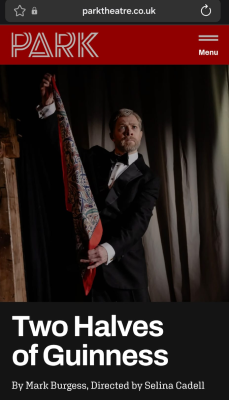
Two Halves of Guinness at the Park Theatre, Finsbury Park, London N4, is a delightful and moving one-man play about the great Catholic actor Sir Alec Guinness by Mark Burgess.
Zeb Soanes, the former Radio 4 newsreader, plays Guinness spendidly, re-creating his rich, velvety vocal cadence and the voices of over thirty other parts with aplomb.
He moves well too, whether it's miming the making of a martini, or dying the celebrated deaths of the aristocratic Ascoyne D'Ascoynes in the beloved Ealing Comedy Kind Hearts and Coronets. The versatile Guinness played all of the Ascoyne D'Ascoyne family and Soanes's own versatility is a fine tribute to his actor hero.
Guinness famously 'crossed the Tiber' in 1956 after playing Chesterton's sleuth-priest Father Brown. Part of this film was shot in Burgundy and one evening a little boy ran over to the actor in his soutane as he was walking along. He took his hand and babbled away in French excitedly, punctuating his discourse with 'mon père' at regular intervals.
Around the same time, Guinness's own son had been ill with polio. Filming at the Riverside Studios, the actor stopped off in the local Catholic church every evening to pray that all would be well. His son recovered and he was sent to be educated at the Jesuit Beaumont school, preceding his parents with his own conversion to Catholicism.
Over ten years previously, during the war, and fearing for his wife and son during the Blitz, Guinness was entertained by a wine-loving high Anglican priest, the Rev Cyril Tomkinson. Seeing a questing soul, the Reverend was as generous with his religious books as he was with his wine. One in particular made a profound impression: Revelations of Divine Love by Mother Julian of Norwich - the first book known to be written in English by a woman with its famous promise that 'All shall be well and all shall be well and all manner of things shall be well.' Guinness was also struck by the mystical passage which spoke of the littleness of a hazelnut which represented 'all that is made' and that it would last 'and ever shall because God loves it.' From that time on, Guinness would carry a hazelnut with him when acting and it would be with him, like a talisman, in every dressing-room.
The great actor achieved worldwide recognition for his role of the somewhat monk-like Obi Wan Kenobi in Star Wars which he breezily described as 'fairy-tale stuff'. He became incredibly rich as a consequence. Co-star Harrison Ford fondly nicknamed him 'Mother superior' on set.
However, Guinness's relations with his own mother were fraught. She was an alcoholic. In one devastating anecdote, she abandons him during evensong to go drinking, returning drunk several hours later to find the boy distraught. She never revealed who his father was (though it could have been a scion of, or employee from, the brewing family). His early years were spent in poverty and in flight from landlords due to unpaid rent, though one kind gentleman-caller was a benefactor, paying for Guinness's education.
All of this made for a tortured and complex soul who became a consummate and polished performer whilst despairing of his reality and unknown paternal origin. He was also convinced that his maternal pipe-smoking grandmother was a 'gypsy' and he spoke of his 'gypsy luck' which he felt deserted him in later years.
The married Guinness also led a homosexual double life at a time when homosexuality was illegal. While he does some coquettish kicks during some comic turns, he addresses this obliquely and with a dose of moral distaste and guilt.
We are treated to hilarious cameos of indiscreet John Gielgud and catty Larry Olivier, magnanimous Edith Evans, and ruthless David Lean. We witness the celebrated roles: Herbert Pocket and Fagin from Dickens, Colonel Nicholson from The Bridge over the River Kwai, and melancholy George Smiley from the Le Carré novels.
All the while, the sense of doubt and miscues remain. He played too many 'funny little men' for David Lean and turned down both Waiting for Godot and Death in Venice. He is obsessed with his status as a theatrical knight and is horrible to his wife.
He craves the haven and forgiveness he finds in the Church: 'In nomine Patris, et Filii et Spiritus Sancti. Amen.'
It is a shame then that the play omits any mention of one of Guinness's greatest film roles: that of Graham Greene's Monsignor Quixote. This vulnerable and quirky priest is caught between faith and doubt, and is all too human in his brokenness and suffering.
Nevertheless, this is a very fine play, excellently directed by Selina Cadell.
Two Halves of Guinness is at the Park Theatre until 2nd May.
For more information see: www.parktheatre.co.uk
 Facebook
 Twitter
 LinkedIn
 Print
Print Email
Email












 Facebook
 Twitter
 YouTube
 LinkedIn
 Pinterest