

Pope Leo in Equatorial Guinea
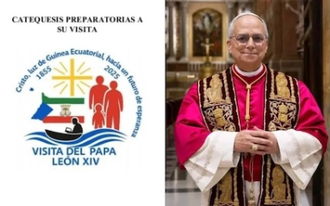
Radio Maria Equatorial Guinea/Vatican Media
Source: Vatican Media
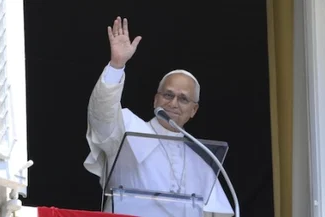
Pope Leo flew from Angola to Equatorial Guinea on Tuesday morning, on the last leg of his Apostolic Journey to Africa.
Speaking with journalists on the flight to Malabo he noted that it was the first anniversary of the death of Pope Francis - "who gave so much to the Church through his life, his witness, his words and his deeds: time and again, he demonstrated this by truly living in solidarity with the poorest, the most vulnerable, the sick, children and the elderly."
He said: "We can recall many things, for example: universal fraternity; seeking to foster genuine respect for all men and women; promoting this spirit of fraternity, of being brothers and sisters to one another, of seeking to live out the message we find in the Gospel whilst recognising this spirit of brotherhood amongst all.
"We can also recall the message of mercy, from that first time in the Angelus, or even in the Holy Mass he celebrated before the inauguration of his pontificate, on 17 March 2013, when he preached on the woman caught in adultery and how he spoke from the heart of God's mercy, how he spoke from the heart of this great love, of forgiveness, a generous expression of the Lord's mercy. And he wished to share this spirit with the whole Church, also by holding that beautiful celebration of an Extraordinary Jubilee of Mercy. Let us pray that he is already enjoying the Lord's mercy and let us thank the Lord for the great gift of Francis's life to the whole Church and to the whole world."
After wishing a happy birthday to two journalists on the flight, he took several questions - the first on how the Church can help Angola improve education and healthcare. Pope Leo said he had discussed these complex issues with the president and hoped they could work together "I believe that the Church has a responsibility, through witness, through the word and also through preaching - a courageous proclamation of the word of God - to recognise the rights of all and to help, in this sense, to promote universal rights."
One reporter noted that the Church was growing so fast he asker whether new dioceses might be established to accommodate the new believers. Pope Leo noted the importance of evangelisation, to continue proclaiming the Gospel and "seeking to invite others - not through proselytism, as Pope Francis has often said, but because of the beauty and appeal of the faith." Any proposals by the bishops would be considered with the cooperation of the Apostolic Nuncio.
On his arrival in Malabo, after a brief welcome from President Teodoro Obiang Nguema Mbasogoon, Pope Leo XIV addressed the country's political authorities, civil society and members of the diplomatic corps.
Recalling the words of Pope John Paul II, who in 1982 described the head of state as "the symbolic centre to which the living aspirations of a people converge for the establishment of a social climate of authentic liberty, justice, respect and promotion of the rights of every person", he noted that these words "remain timely" and continue to challenge those entrusted with public responsibility.
The Pope then went on to quote Gaudium et Spes, saying "the joys and hopes, the grief and anguish of the people of our time… are the joys and hopes, the grief and anguish of the followers of Christ as well." He explained that his presence in the country was intended "to confirm you in the faith and to console the people of this country undergoing rapid transformation."
Reflecting then on Saint Augustine of Hippo, particularly the distinction between the "city of God" and the "earthly city", the Pope described the former as "characterised by God's unconditional love," and the latter as marked by "the proud love of self… and the lust for power and worldly glory that leads to destruction." He invited those present to reflect personally and politically on this difference, asking: "which city they wish to serve."
Referring then to Equatorial Guinea's project of building a new capital, Ciudad de la Paz (City of Peace), he suggested that the name itself should prompt ethical reflection. Political life, he stressed, must not be driven by "the pursuit of unjust wealth and the illusion of dominion", but it must instead be oriented towards what is lasting.
Pope Leo also highlighted the role of the Church's social teaching, which he said offers "moral criteria and authentic ethical principles" while respecting "the autonomy of nations and their governments". He emphasised that each generation faces new challenges, requiring renewed discernment.
Turning then to more contemporary global issues, the Pope went on to warn that "exclusion is the new face of social injustice." He highlighted the the widening gap between a small minority and the majority and noted the paradox whereby "the lack of land, food, housing and dignified work coexists with access to new technologies," including mobile phones and artificial intelligence.
Pope Leo called on political leaders to "dismantle the obstacles to integral human development", grounded in solidarity and the universal destination of goods. He raised particular concern about the impact of technological and economic developments on natural resources, and warned that speculation risks overshadowing "the safeguarding of creation, the rights of local communities, the dignity of labor and the protection of public health."
Echoing Pope Francis, the Pope stressed: "We also have to say 'thou shalt not' to an economy of exclusion and inequality. Such an economy kills". Pope Leo then added that armed conflicts are increasingly linked to the exploitation of oil and mineral resources "with no regard for international law or the self-determination of peoples."
The Pope then warned against the misuse of technology for military purposes, emphasising that "the destiny of humanity risks being tragically compromised without a change of direction in the assumption of political responsibility". He urged respect for international institutions and warned that God's name "must never be invoked to justify choices and actions of death."
Bringing his address to a close, Pope Leo turned to the country's youth and future, describing Equatorial Guinea as "a young country" capable of forming "free and responsible consciences." He encouraged leaders to support "countercurrent politics" centred on the common good and finally called for "the courage of new visions and an educational pact that gives young people space and trust."
At the end of the audience, Pope Leo signed the Book of Honour, accompanied by the President of Equatorial Guinea.
The Pope's intensive schedule later in the day included a visit to the newly-named 'León XIV' Campus of the National University (Malabo) and staff and patients at the 'Jean Pierre Olie' Psychiatric Hospital.
Watch a video of the day on Vatican Media's Youtube channel: www.youtube.com/watch?v=9XUpXiNoNvw&t=1s
 Facebook
 Twitter
 LinkedIn
 Print
Print Email
Email





 Facebook
 Twitter
 YouTube
 LinkedIn
 Pinterest