


Ian Linden: Lebanon - the real war and the war of words
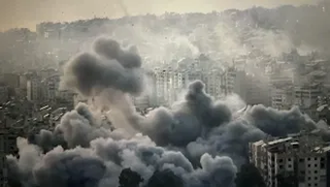
Bombings in Beirut - ICN screenshot
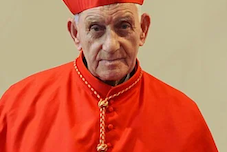
"The abuse and manipulation of God's name to justify this and any other war is the gravest sin we can commit at the present time". Cardinal Pierbattista Pizzaballa, Patriarch of Jerusalem, 17 March 2026.
What do Peter Hegseth, US Secretary of Defence, Naim Qassem, secretary-General of Hezbollah, and Itamar Ben-Gvir, Israeli Minister of National Security, have in common?
They all believe that military force is there to fulfill their version of God's will. Deus Vult, God Wills it.
That their use of force does not conform to the laws of war does not seem to bother them. Their own might is always right because it has a divine purpose whether inspired by Christian nationalism, extreme forms of Islamist thinking or Zionist Judaism.
Modern warfare has become an exercise in increasing the distance between those perpetrating the killing and the reality on the ground. 'Collateral damage' sounds like storm damage - to a building. But those words frequently indicate dead and maimed children, women and other non-combatants. Political leaders, military chiefs and nuclear scientists, called 'high value targets', are "taken out", not assassinated. With them often die their wives, children, and friends; it has been reported that Israel calibrates the number deemed acceptable against the estimated importance of each target. 'States have "capabilities": the vast array of technical resources capable of overwhelming an enemy not their capacity to resolve conflict diplomatically. Vague euphemisms, the 'cuttlefish ink' Orwell described in his 1946 essay "Politics and the English Language", are spurted out daily trying to obscure what television news reveals thanks to courageous war correspondents.
At the opposite pole from military euphemism is the word 'terrorist', covering a multitude of sins. The once functional definition of terrorism - violent actions by a sub-state actor to achieve political goals by instilling fear in communities is increasingly inadequate. States themselves can, and do, terrorise their citizens. Iran is an obvious example. Sub-state actors become a part of a government, or at some point take over the State itself. If terrorism simply means violence to achieve political aims there is no moral reason not to accuse brutal States of 'terrorism' Madeleine Albright, US Secretary of State under President Bill Clinton 1997-2001 pointed out - at a later date - that the United States has often had "limited success when declaring war against nouns".
Slovenly use of language creates a pernicious loop with what Orwell called 'foolish thoughts' and with what we today call 'spin'. This loop characterises the arsenal of disinformation and propaganda used to quieten citizens' moral concerns about today's wars. Had he not been a "Christian atheist" confronted by totalitarianism, Orwell might have added how misuse of language and poor theology links to 'foolish thoughts' about war and God's will. Christian nationalists are a good example.
Just war theory, both Islamic and Christian, makes the distinction between combatants and non-combatants. But the nature of today's weapons, modern warfare, the relationships within civil society created by Islamist dispensations, or implanted in other religious communities by propagandists, makes distinguishing actual combatants more difficult. Today's war in the Lebanon makes it almost impossible. If a war is God's Will, it seems, the Divine Will overrides moral restraints.
Trump and his circle convince themselves with their own misleading language. Given the information available to his Intelligence agencies, the US Administration's misconception about likely reaction to their attack on Iran is startling. Iran obviously had been long preparing for war and would prove a resolute opponent, drawing in Hezbollah, yet the White House didn't anticipate blocking of the Straits of Hormuz.
Hezbollah's origins lie in the war between Israel and the Palestinians and Israel's 1978 and 1982 invasions of Lebanon targeting refugees and the Palestine Liberation Organisation's (PLO) militia. Lebanon had fallen apart into a civil war between ten different religious communities and their militias, segregated along sectarian lines.
Export of its 1979 Islamic revolution was the foreign policy of the Islamic Republic of Iran lead by Ayatollah Khomenei. Hezbollah initially saw itself as an integral part of this new dispensation. In 1983 it placed bombs by the US embassy and marine barracks killing 241 Americans. The Ta'if Agreement mediated by Saudi Arabia and brokered by the Arab League, designed to end Lebanon's civil war, was signed in 1989: Hezbollah was recognised as the sole militia responsible for future resistance.
Modelled on Iran, Hezbollah created a multi-layered pyramidal structure for governance: a Majlis Shura al-Qarar, a consultative council of seven primarily clerical members, Sheik Naim Qassem amongst them, elected every three years by a convention of some 250 Hezbollah top cadres. There are executive, political, judicial, jihad/security and the parliamentary work, councils. By 1992 Ayatollah Khamenei, successor to Khomenei, was recommending Hezbollah adopt a policy of Infitah: participation in Lebanon's elections. They maintain on average ten deputies in Lebanon's parliament and are guaranteed two Government Ministers.
According to Joseph Daher's Hezbollah: The Political Economy of Lebanon's Party of God, Pluto Press 2016, Hezbollah developed organisations for health, education, seminary training, orphans, and emergency aid. Islam compliant loans, zakat tithing, donations and discount cards aided the poor. An extensive education system plus a TV network, radio station and publishing outlets inculcated the principal of Iltizam, religious commitment and adherence to strict Islamist practice including the duty of supporting Hezbollah.
Houses were rebuilt after bombing raids honouring the slogan 'reconstruction, resistance and rebirth'. Disciplined lives became prosperous lives; a Shi'a middle class grew. The vision was a pure society uncorrupted by the West, an Islamic milieu, hala islamiyya, a 'resistance society' against the Zionist enemy. The provision of public services and charitable outreach, a 'combination of consent and coercion', in Daher's words, encouraged Lebanese Shi'a acceptance of Hezbollah's authority.
Southern Lebanon, predominantly Shi'a, dotted with small towns with some ancient Christian villages, now under Israeli attack, has an agricultural economy. Its people are farmers plus well-off entrepreneurs, landowners and Hezbollah local government officials. There are possibly 60,000 fighters including part-time reservists and a UN peacekeeping force reduced to 7,500 mandated to secure a buffer zone south of the Litani river. A significant Shi'a community lives in the more mixed northern Beqaa Valley.
It is easy, especially in war time, to interpret attempts to understand a party to a conflict as support for that party. Support is clearly not the intention of Daher's Hezbollah. Nor is it mine. But for several reasons, including future negotiations, ignorance is not bliss as the Middle East today demonstrates.
With its armed wing, trained by the Iran's Islamic Revolutionary Guard Corps (IRGC), Hezbollah poses an intractable problem for Lebanon's army and government. Its rocket attacks provide Israel with their perennial justification for prolonged invasions of Lebanon and the bombing of "Hezbollah strongholds". Over one million people, 18% of Lebanon's population, have had to abandon their homes as the invading Israeli Defence Force (IDF) pushes further into the South again. In Dahieh, a densely populated southern suburb of Beirut, controlled by Hezbollah residents cannot easily be sorted into combatants and non-combatants. Bombs hit buildings which collapse burying people under rubble In Dahieh as in Gaza The death toll is already over 1,200, 10% children with 3,500 injured.
An infinite gulf exists between the Will of a loving, merciful and compassionate God and the will to power that States, and non-state actors, exert in war. It cannot be bridged - least of all by euphemistic language, ignorance and disinformation. On his right biceps, Peter Hegseth has a Deus Vult tattoo. A chant from the First Crusade, it marks the clear and present danger of Christian Nationalism.
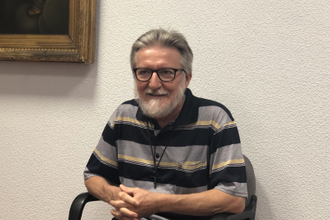
Professor Ian Linden is Visiting Professor at St Mary's University, Strawberry Hill, London. A past director of the Catholic Institute for International Relations, he was awarded a CMG for his work for human rights in 2000. He has also been an adviser on Europe and Justice and Peace issues to the Department of International Affairs of the Catholic Bishops Conference of England and Wales. Ian chairs a new charity for After-school schooling in Beirut for Syrian refugees and Lebanese kids in danger of dropping out partnering with CARITAS Lebanon and work on board of Las Casas Institute in Oxford with Richard Finn OP. His latest book was Global Catholicism published by Hurst in 2009.
To read Dr Linden's blog see: www.ianlinden.com/latest-blogs/
 Facebook
 Twitter
 LinkedIn
 Print
Print Email
Email






 Facebook
 Twitter
 YouTube
 LinkedIn
 Pinterest