

Ian Linden - Bonhoeffer's discipleship: Germany confronts its past
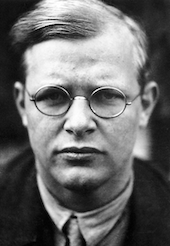
Dietrich Bonhoeffer
You bump into the past quite often in Berlin. There's the curated remains of the Wall, the vast architectural hymn to militarism of the Soviet war memorial in Treptow, and the disorientating claustrophobia of Daniel Libeskind's building housing the Jewish museum. To contemplate the confession of the Nazi horrors and the sufferings of war, spend time in the Kaiser Wilhelm Memorial Church, near the Zoological Garden.
Few tourists visit the Bonhoeffer-Haus in the western suburbs of the city. Just an ordinary, prosperous-looking detached, house but full of the memory of an extraordinary German pastor. Dietrich Bonhoeffer struggled with Christian ethics finally giving his life in their pursuit.
Bonhoeffer encountered Black theology's biblical themes of liberation while at Union Theological College in New York, 1930-1931, worshipping at the Abyssinian Baptist Church. He lived his own words: "silence in the face of evil is itself evil"; two days after Hitler came to power in 1933 he broadcast a warning against the idolatry of a Fuhrer cult - and was cut off. His condemnation of the Nazi euthanasia programme and persecution of the Jews was no less vocal. He later wrote most of his classic book, "The Cost of Discipleship" (Nachfolge), in an underground Lutheran seminary at Finkenwalde in North Germany.
In one of several attempts to assassinate Hitler, a group of German officers in the Wehrmacht High Command Centre (by the Tiergarten) hid a time-bomb in the cellar of Bonhoeffer-Haus. An unsuspecting officer not party to the plot carried it on board a plane carrying Hitler back to Germany from his forward military headquarters in Smolensk on 13 March 1943. The Bonhoeffer family had friends round celebrating their father's 75th birthday. They nervously awaited the coded phone call indicating all was well. A difficult evening. No phone call came.
There was a sadness about Bonhoeffer's frugal attic bedroom and study with his little desk by the window, and the books around the walls of his friend and confidant, pastor and theologian, Eberhard Bethge. After publication of Nachfolge in 1937, Bonhoeffer had scant time left at home. By 1938 he had a sizeable Gestapo file and on 11 January was banned from Berlin. He was arrested in April 1943 and executed in Flossenberg concentration camp two years later, a few weeks before the end of the War. His study felt like a memorial to him.
"Lest we Forget" is easier said at the Cenotaph than in the partly bomb-damaged Kaiser Wilhem Gedachtniskirche with, today, its cross of nails from Coventry Cathedral. Yet, the church provides a deliberate, and remarkable, contrast between its former worship of power, illustrated by the mosaics on the roof and walls showing a procession of Hohenzollen princes, the Kaiser in glory with his first wife, the Empress Augusta Victoria, and the church's contents, display cases and peace message. Under the same roof triumphalism versus an informed contrition and a memorial for the millions who died.
Next door is the new Evangelical church (the EKD was formed in 1948 by a federation of Lutheran, Reformed and United Churches) which presents a counter, Christian, understanding of power. In memory of Protestant martyrs killed between 1933 and 1945, there is a beautiful 12th century crucifix with a plaque quoting John 1:5.4: 'unser glaube ist der sieg der die welt uberwunden hat' ('And the victory that conquers the world is our faith'). Alongside is a 1942 charcoal sketch of Madonna and Child drawn at Stalingrad by the Protestant Pastor and military surgeon, Kurt Reuber, a friend of Albert Schweitzer, with on one side the defiant 'Licht , Leben, Liebe' (Light, Life, Love), against the darkness, death and hatred of war. A man literally drawing support from his faith in extreme adversity .
Berlin remembers martyrs executed locally in Charlottenberg at Plotzenzee prison where 3,000 were killed. They include those sadistically hanged for complicity in the famous 20 July 1944 plot to assassinate Hitler at the 'Wolf's Lair' in the Polish woods using plastic explosive in a briefcase. In subsequent purges some 5,000 were murdered. The bombed remains of Plotzensee prison were converted into a memorial centre attached to the site of the executions. Not far away is the Protestant Church of Atonement, inaugurated in 1964, with its wall in the forecourt inscribed with Hiroshima, Auschwitz and Plotzensee leading into the church's atrium with its inscription Golgotha.
Ecumenical memorial services take place every January. Further west, built in white brutalist style and consecrated in 1963, is the Catholic memorial church, Maria-Regina Martyrum. The crypt contains an inscription to Blessed Bernard Lichtenberg. Like Bonhoeffer, he was outspoken in his condemnation of the Nazi killing of the disabled and mentally ill. "I, as a human being, a Christian, a priest, and a German", he wrote to the Minister of Health, "demand of you, Chief Physician of the Reich, that you answer for the crimes that have been perpetrated at your bidding, and with your consent, and which will call forth the vengeance of the Lord on the heads of the German people". Rector of St. Hedwig's Cathedral from 1938 - from Unter den Linden behind the State Opera House - he prayed daily for persecuted Jews at Vespers, and was arrested on 23 October 1941 dying on 5 November 1943 after falling ill in Gestapo custody. He had just been committed to Dachau. In 2004, he was honoured in the Righteous Amongst Nations at Yad Vashem, the World Holocaust Remembrance Centre in Jerusalem for his unyielding opposition to the Nazi regime and support for fleeing Jews.
Berlin raises a question: for how many generations, should guilt and shame about the past be encouraged? It is understandable if German youth do not want to be burdened by a past they did not make. For the younger generation the best comparison in the UK might be how distant slavery seems in our own past and in the making of Britain's wealth. Perhaps an answer lies in the difference between guilt and shame: guilt created by a sense of responsibility for wrongdoing, how we see ourself; shame created by belonging to a community, more a painful sense of how others see us as a result of our wrongdoing. Psychologists seem to approve of guilt and disapprove of shame. But there is crippling survivor guilt. And fear of shame and blame can be a powerful restraint. German young people should not feel guilt about the Holocaust. Though there is something healthy and salutary in a communal sense of shame, at being reminded of the unspeakable events in Europe eighty to ninety years ago.
What better approach to the past than spending time in the Bonhoeffer-Haus with its excellent pastor and guide, and absorbing the message in the Kaiser Wilhelm Church in Berlin? But these are merely the limited experiences of a British bystander who barely remembers the sounds of the sirens and being evacuated from London.
The past is another country. Irrespective of nationality, we cross several countries into our present one. And a little history, painful and shocking as it is, should - with emphasis on should - make it easier not to repeat the enormity of the horrors in the years 1933-1945.
Professor Ian Linden is Visiting Professor at St Mary's University, Strawberry Hill, London. A past director of the Catholic Institute for International Relations, he was awarded a CMG for his work for human rights in 2000. He has also been an adviser on Europe and Justice and Peace issues to the Department of International Affairs of the Catholic Bishops Conference of England and Wales. Ian chairs a new charity for After-school schooling in Beirut for Syrian refugees and Lebanese kids in danger of dropping out partnering with CARITAS Lebanon and work on board of Las Casas Institute in Oxford with Richard Finn OP. His latest book was Global Catholicism published by Hurst in 2009.
To read Dr Linden's blog see: www.ianlinden.com/latest-blogs/
 Facebook
 Twitter
 LinkedIn
 Print
Print Email
Email








 Facebook
 Twitter
 YouTube
 LinkedIn
 Pinterest