


Ian Linden: Pope Francis, Faith and Fire
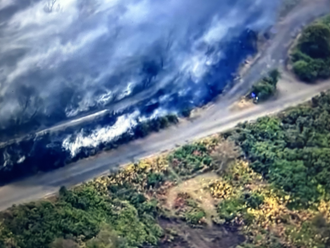
Wildfire near Dunwich - Screenshot
Fire in the Bible indicates the presence of God, purifying humanity or as a symbol of divine judgement motivating change and conversion. In many States of the USA, wildfires now occur perennially growing in number. Trump' gleeful denial of, and contribution to, climate change has an impact not just on America's future but on the rest of the world, on what Pope Francis in Laudato Si calls memorably "our common home".
The secular term applicable to Trump's energy policies might be a 'crime against humanity' - or against the future of humanity - and in the language of faith on considering Creation in Genesis, a sin against 'the Spirit of God moving over the waters" (the Hebrew word evokes an image of a bird hovering).
A raging wildfire hit the East Anglian coast south of Dunwich last weekend. It led BBC News. A lady walker found the tiny fire that started it all but had neither sand nor water to put it out. At the fire's southern most extent, the prompt and courageous action of the fire service, drawn from all over Suffolk and beyond, saved the historic Coast Guard Cottages, a National Trust centre.
The centre offered holiday accommodation, pleasant staff and a café with passable coffee, a favourite destination for walks, a serene beach below the cliffs. No-one ever imagined the cottages would feature on television, and in newspapers, overlooking some 370 acres of blackened heathland on one side and Sizewell B on the other, part National Trust nature reserve and part Royal Society for the Protection of Birds (RSPB) bird sanctuary.
Reading about the coastal area burning west of Bordeaux and a huge blaze heading for Madrid is one thing. Seeing a beautiful landscape turned to ashes on your doorstep, where once a swathe of purple heather led to the cliffs and a shimmering sea, home to a unique collection of flora and fauna, is another. Climate change creates hotter, drier conditions that make wildfires more likely and, spreading fast, increasingly dangerous. It isn't only what happens to other people.
But this is not a message that oil-companies and most political Parties faced with difficult choices want to hear. They needn't worry. As the fire moved underground into the roots of the vegetation, with no more exciting pictures of billowing flames and new devastation, The Daily Telegraph published on 1 August a little divisive distraction. "Rewilding Blamed for Suffolk Wildfire" headed a rambling article based on a few off-hand comments from local inhabitants of the neighbouring village of Weselton, where evacuees had been housed, alongside interviews with sundry knowledgeable experts and commentators.
The mistake of the RSPB according to the - atypical - local vox pop cited was pursuing a "green agenda" - brought on presumably by wishing to preserve a suitable habitat for its varied and rare birds, its raison d'etre. The National Trust were also accused of having 'overlooked in the name of green projects'' - none cited - residents' interests. Though for many these interests included eco-tourism and catering for beach holidays, not necessarily exclusive if you enjoyed watching the terns plummet into the sea to take small fish in their sudden vertical dives.
The Telegraph article does carry a response from the RSPB pointing out that it cuts firebreaks on the land, improves water retention and conducts public awareness campaigns on the dangers of barbecues and leaving rubbish. The National Trust, apart from warning people not to fall off the cliffs, and correct dog behaviour, also has large notices about fire hazards and barbecues.
Only one problem: the area had not been 'rewilded'; it was no more nor less wild than when I first walked its paths over 25 years ago. The area had been routinely managed, grazed by cattle, deer and muntjac. The Telegraph article was at best tendentious and gave a false impression of local reaction which was predominantly shock and sadness.
And there were plenty of relevant follow-up stories waiting. Tucked in the past coverage is mention that the Suffolk Fire Service - surprisingly - had to rent a commercial helicopter, thereby acquiring an easily available source of water, the sea, which could be scooped up and dropped along the fire service's frontline. It made a difference. These wildfires are a national issue and require national assets. Why can't the UK have a dedicated helicopter at the disposal of fire-fighters ready to go just as a local fire crew is ready to go? Four, one for each nation, would be desirable but probably utopian. And is it beyond IT companies to have a number on all mobiles connecting to the local fire service, on the basis of location, rather than a generic emergency number? At this rate, we are going to need one. Like heart attacks, in a terrain that is dry, highly combustible and starting to burn, every minute counts.
There is still some mileage in the old arguments about the value of rewilding but it is hardly a priority as temperatures soar, droughts occur, rivers dry up and devastating fires break out in many European countries. Wildfires are more likely to occur in nature reserves simply because they frequently have considerable human through-put. And nor does rewilding itself or the preservation of unique habitats and areas of outstanding beauty cause fires.
There is need for an immediate response to the rapid onset of climate change in Europe. And this indeed should be part of a wider government strategy. There are economic implications such as prioritizing investment in renewable sources of energy and carbon capture. But wildfire prevention is also an obvious candidate for Prime Minister Burnham's devolved approach to government. As in the example of the importance of rapid helicopter support, there is need for well-thought out ways of finding more effective ways of making national assets, innovations, means of protection such as water storage available locally, plus adequate staffing for the fire services.
We hear a much about national security and the urgent need for more/ better drones, ballistic missiles, AI controlled warfare and clever IT hackers. As I passed by the Westleton to Dunwich road today, with its manned barrier ensuring unencumbered access for fire-engines, or looked again at the pictures of the new wasteland once an area of natural beauty, a question comes to mind. Shouldn't we be asking if climate change is no less a clear and present danger to our national security than Putin?
Neglecting or ignoring the environmental impact of political and personal decisions is not limited to Trump and MAGA. It seems inexplicable given the scientific evidence and obvious harm already evident. In the words of Pope Francis' Laudato Si: "Once the human being declares independence from reality and behaves with absolute dominion, the very foundations of our life begin to crumble.…man sets himself up provoking a rebellion on the part of nature". The ravaged strip of Suffolk coast illustrates in microcosm what he means.
Professor Ian Linden is Visiting Professor at St Mary's University, Strawberry Hill, London. A past director of the Catholic Institute for International Relations, he was awarded a CMG for his work for human rights in 2000. He has also been an adviser on Europe and Justice and Peace issues to the Department of International Affairs of the Catholic Bishops Conference of England and Wales. Ian chairs a new charity for After-school schooling in Beirut for Syrian refugees and Lebanese kids in danger of dropping out partnering with CARITAS Lebanon and work on board of Las Casas Institute in Oxford with Richard Finn OP. His latest book was Global Catholicism published by Hurst in 2009.
To read Dr Linden's blog see: www.ianlinden.com/latest-blogs/
 Facebook
 Twitter
 LinkedIn
 Print
Print Email
Email















 Facebook
 Twitter
 YouTube
 LinkedIn
 Pinterest