

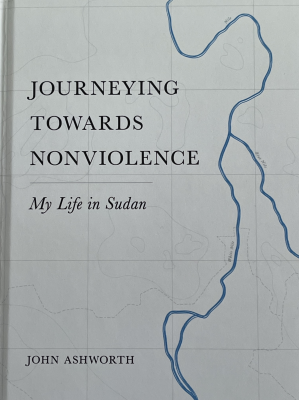
Book: Journeying Toward Nonviolence by John Ashworth
Priest, missionary, aid worker and peace builder: this memoire reads like a thriller at times. John Ashworth's story also provides a heart-breaking account of how Africa's newest country, South Sudan, born of so much hope in 2011, remains the poorest nation in the world, according to the UN Human Development Index.
Ashworth, a young ordained Roman Catholic priest, asked to be sent to a place where he was needed. His diocese was Malakal, a region in the southern part of Sudan that is the size of Great Britain. His parish was the size of Belgium, and the only paved road led from the air strip to the governor's palace. If Ashworth wished to get around, he had to wade through crocodile-infested swamps, spend days digging his jeep out of muddy potholes, and walk in hot, humid conditions. Consequently, he had a parasite eating away at him for nine years.
The ruling Islamist regime in Khartoum made life as awkward as possible for Christians (some things never change) and required five stamps from five different offices in five different locations to make a simple , short journey. Christians were under continual threat of expulsion, torture and attack, with church premises confiscated - again, nothing changes in Sudan.
From the 1980s onward, the southern rebels fought a bush war (the Second Civil War) against the Islamist regime. However, they showed little concern for the civilians for whom they claimed to be fighting, blocking aid, punishing those who were insufficiently enthusiastic, and funding their war economy through theft - all of which continues in South Sudan and Sudan, where residual tribal differences are weaponised by kleptocratic politicians and soldiers.
Ashworth tells of hair-raising episodes when he was under fire, kidnapped and harassed by rebels and regime figures. He also makes uncomfortable observations about some of the big international aid agencies. During a famine, one NGO refused to take Ashworth's word that tens of thousands of Sudanese were in dire need. Rather, the NGO insisted it would sending its own "multi-agency assessment team" which never arrived. They also evacuated at the first sign of danger whereas local civil society and the churches were left to try to offer protection, aid, and to negotiate peace deals.
When Ashworth could finally access the marginalised region of Blue Nile, he brought in a Sudanese doctor who had been working in Egypt. However, a big medical aid agency would not help because the man was not a surgeon. The fact that he had no other option but to perform amputations with a bayonet did not move the NGO to help.
Ashworth formed the Sudan Ecumenical Forum which has played a central role in drawing international attention to the suffering of the Sudanese people by preparing well-researched and data-driven reports. Those reports added to the pressure on the international community to allow the largely non-Arab and non-Muslim population of the southern part of Sudan, persecuted for decades, to secede after a referendum in 2011. The church continues this noble work today, as South Sudan struggles to attract the diplomatic attention it deserves.
Journeying Toward Nonviolence by John Ashworth, Redhaven Books
Rebecca Tinsley's novel about Sudan, When the Stars Fall to Earth, is available on Amazon.
 Facebook
 Twitter
 LinkedIn
 Print
 Email












 Facebook
 Twitter
 YouTube
 LinkedIn
 Pinterest