

South Sudan - the church is central to peace and development
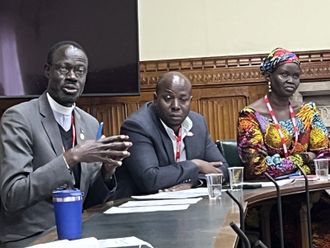
Christians in South Sudan look to the United Kingdom to support their peacebuilding efforts and front-line aid work. British Parliamentarians heard a message of hope and resilience from representatives of faith groups and civil society at a meeting at Westminster this week. Churches remain central to civil society despite continuing conflict, climate shocks, and daunting humanitarian challenges.
The Reverend Tut Mai Nguoth told MPs that for decades, the South Sudan Council of Churches has brought together faith groups to guide successive peace processes and agreements, as well as providing schools, clinics and wells.
But despite Nguoth's optimism, the meeting heard that the country faces a political system in which tribalism is weaponized, provoking a cycle of conflict and poverty. South Sudan ranks 193rd out of 193 countries which the UN measures for its human development index, despite the country's oil wealth.
Angelina Nyajima Jial of Hope Restoration South Sudan told the meeting that teachers, doctors, nurses and other civil servants have not been paid for many months, although they continue to work, serving their communities. The reduction in international aid has directly impacted the number of girls being sent to school as poverty increases and families place the priority on educating their sons. Child marriage and forced marriage are rising once more as a consequence. The need for a dowry leads to increasingly violent cattle theft. Jial said that it has taken years of effort to get women's voices heard in South Sudan, and their influence is once more being lost in areas where traditions persist.
South Sudan has had to absorb 1.4 million returnees and Sudanese refugees fleeing the war at a time when their own conflict stops farmers reaching their fields, and international aid is being cut.
James Wani, Christian Aid's Programme & Partnership Lead in South Sudan, told MPs that the international community must look beyond the proposed elections in December to partner with the people of South Sudan for long term peace and to build and strengthen governance mechanisms. Local civil society groups, women-led organisations and faith actors must be at the centre of a peaceful and democratic transition.
Wani called on the international community to keep the pressure on the South Sudanese government. Effective diplomatic partnership is needed, with global solidarity and close collaboration with the C5, IGAD and the AU required and increased investments in conflict prevention and peacebuilding, he said.
UK development aid to South Sudan has been cut by 39% from 2025-26 to 2026-27 and largely goes to various UN agencies working in South Sudan, rather than directly to the South Sudan government which has been accused of gross corruption by respected international monitors such a Transparency International. Britain has committed a baseline figure of £72m a year for the next three years. In addition, the UK is giving £500,000 to the World Health Organization to strengthen the country's Ebola preparedness. However, the South Sudanese at the meeting pointed out that too small a proportion of money given to the UN arrives with front-line local NGOs.
"This year, only 17% of humanitarian funding in South Sudan went to local humanitarian responders, even though we are on the frontlines. Why do international actors continue to send the majority of their funds to UN agencies, which have very high overhead costs, meaning that by the time the funding reaches communities, very little remains?" commented Angelina Jial.
"This year marks 10 years since the Grand Bargain and Charter4Change commitments to scale up locally led humanitarian response," she continued. "I had the opportunity to meet with colleagues from Ukraine who told me that 80% of humanitarian aid in Ukraine goes to local humanitarian actors. But in South Sudan, less than 20% goes to local actors. This needs to change."
Rebecca Tinsley is the founder of the human rights group Waging Peace.
LINK
Waging Peace: https://wagingpeace.info/
 Facebook
 Twitter
 LinkedIn
 Print
 Email










 Facebook
 Twitter
 YouTube
 LinkedIn
 Pinterest