

Latin Patriarch on Solemnity of Our Lady Queen of Palestine 2026
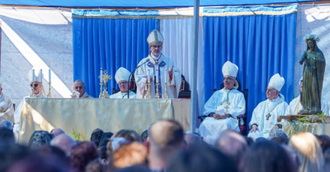
Cardinal Pizzaballa preaching at Deir Rafat
Source: LPJ
Cardinal Pierbattista Pizzaballa, Latin Patriarch of Jerusalem, delivered this homily today for the Solemnity of Our Lady Queen of Palestine 2026 at Deir Rafat.
Acts 1:12-14; Revelation 11:19a; 12:1-6a, 10a; Luke 1:41-50
Dear Excellencies,
Dear Brothers and Sisters,
May the Lord give you peace!
As we do every year, we gather here, at the feet of the Virgin Mary, to entrust to her our Church and the life of this Holy Land of ours. Each of us brings something in our heart: a concern for our family, a person for whom to pray, a burden that we may not even be able to put into words. We come together as one family, gathered by our Mother.
Today, our thoughts turn first to the nine Christian brothers who were killed in Hammoud, in the Kerak region of Jordan, while attending a funeral. We entrust the victims and the injured to the Lord, we stand in solidarity with their families and the Greek Orthodox community affected by this tragedy. Their grief is our grief. We call for justice and protection of all communities, and we pray that this wound will not break the fraternal bonds between Christians and Muslims in Jordan. Together, we want to persevere in safeguarding these relations, even in this hour of trial.
Fewer of us are gathered here today for this feast day, as the tense situation in Palestine has prevented many from joining us. We live amid growing tensions and violence that affect everyone and fill us with sorrow. Today, let us pray for all. Let us pray for our brothers and sisters in Jordan, let us pray for our families in Palestine, and all those in our Holy Land who suffer from oppression, afflicted by injustice and violence. To all who could not be with us today, I say: you are part of our community, and we carry you in our prayers. We are here for you too, together placing ourselves under Our Lady's mantle.
In the mid of this very difficult situation, we find ourselves in, what does the Gospel have to say for us today? What does the Virgin Mary invite us to reflect on? We find a question in the Gospel we have just heard, which I would like to dwell on. It is the question said by Elizabeth when Mary enters her home: "And why is this granted to me that the mother of my Lord should come to me? " (Lk 1:43)
It is a question filled with wonder. Elizabeth knows Mary and knows that she is her relative. Yet, in this encounter, she recognizes something that goes beyond their family bonds. In that young woman coming toward her, the Lord himself draws near. Mary carries Jesus within her, and through her presence, Elizabeth receives a visit from God.
I believe we need to rediscover this way of seeing. We are accustomed to asking ourselves where God amid all we are going through. It is a valid question that arises especially when suffering continuous for long and answers seem nowhere to be found. Today's Gospel walks with us through this question and invites us to look attentively at what takes place in a home, in an encounter between two people. It is precisely there that the Lord is at work.
The Evangelist indicates that Elizabeth "was filled with the Holy Spirit" (Lk 1:41). It is the Spirit who enables her to recognize the presence of the Lord. Infront of her stands Mary, but through eyes of faith, Elizabeth recognizes that she is being visited by God. Let us ask for this gift for ourselves. We need it, because weariness can cloud our vision making us unable to see those who draw near to us, the goodness given to us, and the faithfulness with which God continues to accompany us.
In recent years, we have asked here for the strength to continue believing in love, and the courage to return to the life of our communities. Today, I would like us to ask how can we recognize and welcome the Lord precisely within our life, in the relationships entrusted to us every day.
Our land bears deep wounds. Let us think of the families in Gaza, of those who have lost loved ones, and of those who are still waiting to be able to live in a home and go through a day without fear. In our communities, too, we know how difficult it is to speak to young people about tomorrow when the present seems to consume all our energy. The life of our communities is also wounded when we cannot gather and pray together, and when even the simplest things of life, such as moving from one place to another, visiting others, and working, become so difficult because of the situation. Let us bring all of this into our prayers, together with the suffering of every family in this land.
And there is a struggle that is maybe less visible, yet affects many of us: feeling alone in one's own life. Two people can live under the same roof and no longer be able to speak to one another. We can attend the same parish and know nothing of the suffering of the person sitting beside us. When we are worried, our inner world can easily become entirely consumed by our own problems. Then we find it harder to make space for what others are going through.
Hearing the Gospel of the Visitation in these difficult days makes us feel even more deeply the value of an encounter. Mary, who carries within her such a great mystery, makes room for Elizabeth. The gift she has received from God enables her to reach out to another person. Jesus' presence within her becomes closeness: it enters a home and touches someone's life in a tangible way. Even when we cannot be physically together, we are called to find ways to draw close to one another, so that no one feels abandoned. Even when we cannot physically reach one another, we are called to seek out possible ways of expressing this closeness, so that no one feels abandoned.
This is also a question for our faith. The Lord whom we hear in the Word and receive in the Eucharist-what place does he find in our relationships?
Mary does not keep the gift she has received to herself. The Son entrusted to her sets her on her way towards Elizabeth. We can understand the vocation of the Church in the same way: the Church becomes fully alive when she goes beyond herself to encounter others, especially those going through times of trial and uncertainty.
This is the desire I carry in my heart for our Church today: that we may remain capable of visiting others and allowing ourselves to be visited. For we, too, need to be reached, listened to and consoled. It is a matter of not withdrawing into our fears and weariness, but of preserving an inner space that remains open to God's visitation, for He comes to meet us also through the presence and words of others. In a land marked by fear and division, a community that knows how to welcome others and draw near to them becomes a sign of God's presence among His people.
I am well aware that, in the face of our country's immense suffering, all this may seem so little. A visit does not restore what has been destroyed. A kind word does not solve the issue of unemployment. Charity also calls us to concrete commitment, one that responds to people's needs and safeguards their dignity. Yet with every act of assistance, there is also a closeness that we can offer. Those who suffer need to know that their lives matter, that someone is willing to carry part of their burden. Each of us can begin to live this out, wherever we may be.
Something else happens in Elizabeth's home that deserves our attention. Mary carries the Lord, and Elizabeth recognizes Him. Yet, Mary also receives a word: "Blessed are you who believed that what was spoken to you by the Lord would be fulfilled" (Lk 1:45). In this encounter, God's gift is welcomed and recognized. Faith finds a voice that blesses it, and someone with whom to share its wonder.
We, too, need this. We need brothers and sisters who can help us recognize God's work when we struggle to see it. And we need the humility to allow ourselves to be cared for by others. Sometimes we know how to care for others, yet find it very difficult to admit that we, too, need someone's presence, advice or prayer. Communion deepens when we also learn how to receive.
I would like our communities to increasingly reflect this spirit. I think especially of those who have drifted away and may be waiting for someone to remember them; of those who are grieving and find themselves alone after the first few days have passed; and of young people who have difficult questions and are looking for someone willing to listen to them fully. We can ask the Virgin Mary to help us recognize these people and make ourselves available to meet them.
From this encounter, the Magnificat is born. After Elizabeth's words, Mary says: "My soul magnifies the Lord" (Lk 1:46). Joy finds expression within a relationship in which God has been recognized. I believe this is a precious lesson for us, too. There are times when we struggle to pray, and the faith of a brother or a sister carries us through. There are days when someone helps us find a reason to give thanks. The Lord uses these encounters to keep our faith going.
Today, we invoke Mary as Queen of Palestine. The Gospel shows us this Queen entering the home of a relative, carrying the Son she has received. This is too how we wish to welcome her into our Church: as the Mother who leads us to Jesus and teaches us to make room for one another.
Let us entrust our patriarchal diocese, our families, and all the inhabitants of this land to Our Lady Queen of Palestine. In a special way, we entrust to her those who can no longer expect anything good from life. May she obtain for us a gaze capable of recognizing the Lord who comes to visit us, and a heart willing to bring Him to others.
Mary, Mother of our Lord, come into our homes. Console those who mourn their dead and sustain those who live in isolation and fear. Accompany the struggles of our land and teach us to welcome your Son. Help us to safeguard His presence among us, so that those who are alone may find a community, and those who have lost hope may gradually learn to hope again. Amen.
 Facebook
 Twitter
 LinkedIn
 Print
 Email









 Facebook
 Twitter
 YouTube
 LinkedIn
 Pinterest