


Cardinal Pizzaballa: The West Bank is a 'lawless land'
Source: Vatican Media
The West Bank has become "a lawless land" and tensions between settlers and the Palestinian population are continually rising. The situation is ongoing "without any effective security or legal restraints," Cardinal Pierbattista Pizzaballa, Latin Patriarch of Jerusalem, said yesterday, on the final day of the Meeting for Friendship Among Peoples in Rimini.
"The fact that there is a situation of continuous aggression by settlers is well established," he said. "The West must help raise its gaze somewhat, create perspectives, and also help calm this continuing downward spiral through ever greater diplomatic efforts." The Cardinal pointed to diplomacy, despite "all its weakness," as "the only way to try to resolve the conflict while avoiding the use of weapons, violence and military force."
The Patriarch also spoke about Gaza, where the situation "has deteriorated enormously" and remains "very devastated from a human point of view." Nevertheless, he noted, it is "more stable from a certain perspective; politically, there is a great deal of discussion."
Yet, Cardinal Pizzaballa issued a warning: "We must not confuse hope with 'everything will be fine' or with a political solution. Hope is something else." It arises, he explained, "from within," through encounters and through people - "Israelis and Palestinians, Jews, Muslims and Christians" - just as happened during the Meeting. These are people who choose to put themselves on the line "to do something beautiful, to help, to support, or even simply to refuse to dehumanize the other."
The two-state solution, involving Israel and Palestine, reaffirmed by the Pope, "is the only way to recognize the right of Israelis and Palestinians to have a home in their own land," he said. "Sooner or later the Pope will come to the Holy Land - it is only a matter of time. I think it is necessary to prepare the conditions for this visit so that it can truly bear fruit. We will work on this together with the Holy Father, but I believe we should not rush, and we should also avoid spectacular gestures that simply remain isolated events. The visit must be part of a meaningful process."
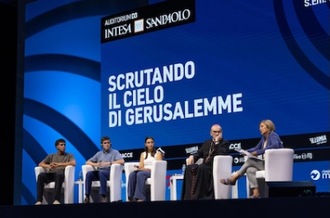
In an event speaking at the end of the day, entitled 'Gazing at the Sky of Jerusalem,' the Cardinal responded to questions from a student from Milan, a young man from the United States, and a high-school student of Ukrainian origin who lives in Rimini. Their questions drew on themes from the Cardinal's pastoral letter, 'They Returned to Jerusalem with Great Joy', published last April and addressed to his diocese, which encompasses Israel, Palestine, Jordan and Cyprus.
Responding to the Ukrainian student, Cardinal Pizzaballa said it is necessary to prevent the dehumanizing logic of war from becoming "your way of thinking, of surviving," because "war steals from young people the most beautiful years of their lives, when it does not take their lives altogether. This is true for Ukraine, but also for the Middle East. War has its own dynamics, and they brutalize you. The other person is exorcized, because if the other is human and close to you, it becomes difficult to strike them."The dynamics of war, he stressed, "must not take possession of the conscience."
What is necessary, Cardinal Pizzaballa continued, is "to avoid reducing peace to a slogan, as well as naïve approaches to a complex reality" such as that of the Middle East and beyond. Peace requires political action, which has its own dynamics. Politics, moreover, is shaped by balances, interests and power relations. The problem arises when it is reduced to partisan interests and balances of power, "and the consequences are visible."
What is needed, therefore, is someone who raises their voice, "who reminds us what the common good is," because it "must not be neglected or forgotten." In the Middle East, the sense of the common good has been lost, the Patriarch observed. It seems that institutions are guided by what is good for themselves or for their own political side. Religious leaders must therefore remind people of this. Politics is also about civil society, and at a time when political institutions show weakness and an inability to work for the common good, there is a need to change the language being used.
Cardinal Pizzaballa was also asked how one can confront suffering and remain steadfast in a reality such as that of the Middle East. His answer was to look to the Cross, "the place where Jesus humanly fails, but which for us is the source of salvation," and from which the Resurrection emerges.
The suffering in the region, he explained, is the suffering of broken relationships and the violence that people witness, of those who are no longer there, and of the inadequacy one feels in the face of different situations. "Because you cannot do everything": you cannot reach everyone or offer as much help as you would like. Prayer, therefore, is the place where one can entrust one's helplessness, the Patriarch said. When one falls, when one thinks one can no longer go on, one must look to Christ and "begin again." In times of suffering, it is important not to leave those who suffer alone; more important than many words is simply being there.
But how can hope be kept alive?
In a Middle East "so torn apart, burdened by hatred, resentment and hardship," cultivating hope is not easy. The Cardinal stressed that hope "is not a solution to the problems." Moreover, no solution is yet visible on the horizon.
"We must be realistic because the situation has deteriorated," he acknowledged, explaining that hope "is not waiting for something that must come from outside. It is born within the heart; it is the child of faith; it is the awareness that we are not alone. In faith, it is the presence of an encounter with Christ in the people, in the faces, in the associations and communities that put themselves on the line to do something together."
Cardinal Pizzaballa pointed to young people at Gaza's public university with whom he recently met, full of vitality and a desire to live. "That is a source of hope," he said, noting that they agreed that violence must be rejected.
Among the questions put to the Cardinal was one about interreligious dialogue. It develops when people are not "afraid to encounter the other," when they are secure in their own faith and therefore do not feel threatened by others, relating to them "without prejudice."
Cardinal Pizzaballa explained that he prefers the expression "interreligious dialogue" rather than "dialogue between religions," because it is believers who speak to one another, starting from their own experiences of faith. It is communities that engage in dialogue.
Until now, he observed, dialogue between Jews, Christians and Muslims has largely taken place among elites. Instead, dialogue needs to grow among ordinary people. "After the Gaza war, we cannot return to the way things were before; there have been so many wounds and misunderstandings," he noted. What is needed, therefore, are "opportunities at the local level" where dialogue can grow, "because that is where something beautiful and different is born and created."
To see the other person positively, Cardinal Pizzaballa encouraged people to meet and get to know others rather than categorize them. "Everyone in the Holy Land feels like a victim, and the only victim, and this is a vicious circle. The other becomes an enemy. The first violence begins in the heart and in words," the Cardinal stressed.
"Everyone in the Holy Land feels like a victim, and the only victim, and this is a vicious circle. The other becomes an enemy. The first violence begins in the heart and in words"
He urged people to meet people with their own stories, emotions and relationships. "This helps us not to generalize." What is needed, he summarized, are "witnesses within our communities who can help overcome the boundaries that exist, but which must not be impermeable - we need people who create openings."
It is necessary to break out of the vicious circle of seeing oneself as the only and sole victim and viewing others as perpetrators.
To understand and assess events today, amid so much polarization and so many fake news stories, Cardinal Pizzaballa believes it is necessary to "listen to multiple voices." Algorithms often cause people to see only what interests them, making it important to listen even to voices "with which we do not agree" and to know how to assess the language others use - to recognize whether it is aggressive and dehumanizing and therefore should not be followed.
"This is a task that must be undertaken continually in the Middle East," he said, where "nothing is as it appears and everything is very complicated."
Another theme from the Patriarch's pastoral letter explored during the conversation was the "purification of memory." For the Latin Patriarch of Jerusalem, this "does not mean forgetting the past," but rather refusing to allow "the experience of pain and injustice" to determine the future and shape interpretations of history.
There are different narratives in the Middle East, he noted, and they may not be shared by everyone. But one cannot deny the way others understand the facts, nor should distorted interpretations of history be used to justify resentment among future generations.
"We must hand on a redeemed past to new generations," the Cardinal concluded. "This is necessary and decisive at every level: in universities, schools, mosques, churches and families."
Finally, in the face of indifference, "what is needed is passion, which is contagious," along with "joy and friendship."
 Facebook
 Twitter
 LinkedIn
 Print
Print Email
Email







 Facebook
 Twitter
 YouTube
 LinkedIn
 Pinterest