

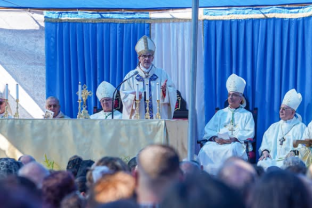
Israel goes to the polls

Photo: IDF Spokesperson's Unit / CC BY-SA 3.0
Fr David Neuhaus SJ, an Israeli Jesuit priest, born in South Africa to a Jewish family writes: Tomorrow, October 27, 2026, Israelis go to the polls. The influence of the events of 7.10.2023, when almost 1200 Israelis and others were killed, thousands wounded, and over 250 kidnapped, by Palestinian militants crossing into Israel from Gaza, seems to be particularly significant in determining secular Jewish-Israeli voter patterns. Many commentators are noting a swing to the right among the younger generation. According to various polls, about 70% of Jewish Israelis aged 15 to 24 identify as right-wing. This could lead to a surge in support for the extreme right-wing parties of Itamar Ben Gvir and Bezalel Smotrich. The important themes that characterize the Israeli right-wing are:
- Support for the annexation of the Palestinian territories and ending any talk of a "two-state solution", and the strengthening of Jewish settlements there,
- Continued war on all fronts, especially destroying Gaza, ethnically cleansing parts of the West Bank, occupying southern Lebanon and Syria, and destroying Iran too,
- So-called "reform" of the judicial system so that the courts can no longer serve as an independent authority offering judicial oversight of the legislative (Knesset) and executive (government) authorities,
- Strict control of the Palestinian Arab minority in Israel, ensuring a Jewish ethno-centric regime, where "non-Jews" are marginalized,
- Increased focus on the Jewish nationalist identity of the state, marginalizing further "non-Jews", particularly Palestinian citizens of Israel.
Some Jewish Israelis see Binyamin Netanyahu as the only experienced, strong man to lead Israel beyond the present crisis, even if many are troubled by his corruption, arrogance, and narcissism. Perhaps, more importantly, many will vote for Netanyahu because those campaigning to replace him seem mediocre, lacking experience, charisma and vision, tainted by previous political struggles.
In the days before the elections, Gadi Eisenkot, a former army general, who lost his son and his nephew during the war in Gaza, and his party, have emerged as the largest winner… but not garnering enough to reach a majority without a coalition with other parties. It is striking to note that Eisenkot (like most of the other opponents of Netanyahu) has mouthed much of the same right-wing agenda that characterizes the one he seems to be determined to replace.
Two important groups in Israel might have a decisive influence on the elections. Palestinian citizens of Israel constitute about 20% of the population. However, they tend to be very divided. In the past, about half of this group has chosen not to participate in the elections, many believing that the elections change nothing with regard to their situation of discrimination and marginalization. Two parties led by Palestinians are encouraging them to vote, the United Arab List and the Joint List. They are expected to win together over 10% of the seats in the Knesset. Ultra-Orthodox Jews also constitute an important segment of Israeli society, numbering about 15% of the population. This group is also very divided and the traditional political parties that represent the interests of this group are under attack for having failed to protect ultra-Orthodox interests.
It is possible that the results of the elections will lead to a stalemate, preventing the formation of a new government. State President Herzog is calling for a national unity government, bringing Netanyahu and his foes together in a "Jewish, Zionist government" in order to avoid another round of elections. Whatever the results of the elections, it is unlikely that they will make Israel a more equal, more just, or more peaceful country, nor will they bring about any real change for those who most need it: the Palestinians in the Gaza Strip and the West Bank, the Palestinian citizens of Israel, those suffering the most from poverty, and those still dreaming of equality, justice and peace.
For those of us who are committed to the struggle for equality, justice, and peace in Palestine/Israel, the elections must not distract us from continuing to fight:
- to end the genocide in the Gaza Strip and the ethnic cleansing in the West Bank,
- to push to dismantle the apartheid regime that promotes discrimination inside Israel,
- to raise consciousness in the world that silence on Palestine is complicity with evil,
- to promote a vision of a land in which Palestinians and Israelis, Jews, Christians, and Muslims, live in equality, justice, and peace.
In my opinion, one of the most eloquent and passionate candidates for a seat in the Knesset this time around is Dr Maha Karkabi-Sabbah. A member of the Balad party, she is running as number seven on the Joint List. If she is elected, she will be a new face in the Knesset. She is a sociologist, who most recently worked in Ben Gurion University in Beer Sheba.
(She is one of two candidates among the top ten on the Joint List who are from the Christian Palestinian community).
View a subtitled interview with Dr Maha here: www.youtube.com/watch?v=feEx8goFvkc
+972 offers some enlightening articles on the elections:
Amos Brison, "Eisenkot is trying to outflank Netanyahu on the right. It's a failed strategy",
Read here: www.972mag.com/eisenkot-netanyahu-election-failed-strategy
Eli Bitan, "Days away from Israeli elections, a 'sour mood' pervades the Haredi (ultra-Orthodox) street",
Read here: www.972mag.com/haredi-parties-israel-elections-public-disillusionment
Areej Sabbagh-Khoury, "Israel's election won't change the renewed reality of political apartheid",
Read here: www.972mag.com/palestinian-citizens-israel-political-apartheid
 Facebook
 Twitter
 LinkedIn
 Print
 Email








 Facebook
 Twitter
 YouTube
 LinkedIn
 Pinterest