


London: Zurbaran - Master of the Baroque at National Gallery
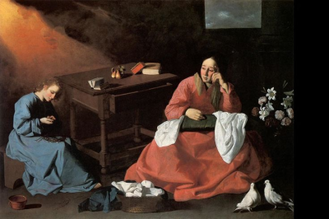
Francisco de Zurbaran, Christ and the Virgin in the House at Nazareth circa 1640 (c) Szepmuveszeti Museum of Fine Arts Budapest
Francisco de Zurbaran, 1598-1664, born in Fuente de Cantos, was one of the greatest artists of 17th century Spain, alongside Murillo and Velazquez. Exhibiting artistic talent from an early age his father, an affluent cloth merchant, sent Francisco aged fifteen to Seville as an apprentice to artist Pedro Diaz de Villnueva for three years.
Seville, one of the wealthiest cities in Europe was a haven for artists during the Catholic Reformation, exalting piety and devotion through the Arts.
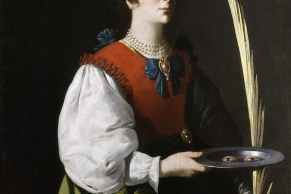
Noted for his use of intense dramatic lighting he was influenced by Caraveggio, although his style is more austere. His superb craftmanship in portraying fabrics in portraits is exemplified in the Muslim convert princess 'St.Casilda,' (1635). His realism in sublimely serene Still Life paintings such as 'A Cup of Water and a Rose' was profoundly effective.
He was much in demand for monumental religious works, painting amazing altarpieces and depictions of the crucifixion for religious orders .
In 1626 the Dominicans commissioned 21 paintings of him to be completed in eight months. Fourteen depicted the life of St Dominic , one of St Thomas Aquinas, one of St Bonaventure and four other Doctors of the Church. Only five paintings are known to have survived.
Zurbaran's earliest signed and dated work is an extraordinary powerful 'Crucifixion' in 1627 for the Dominicans of San Pablo el Real and was kept in their sacristy for over two hundred years. Christ's muscular body is highlighted against a total dark background with a startlingly white loin cloth. It caused a sensation in Seville; 'everyone who sees it …. believes it to be a sculpture. ' Three years later he was invited to make Seville his permanent home by the City Council as their principal artist.
Seven rooms currently exhibit over 40 of his paintings at the National Gallery, the largest Zurbaran exhibition to be shown in Britain.
His extraordinarily inventive iconography is seen in his 1630 portrayal, 'The Vision of St Alonso Rodriguez', for the Jesuits.
Lay brother Rodriguez was an early proponent of devotion to the Sacred Heart of Jesus and the Immaculate Heart of Mary. The celestial vison depicts Christ and his mother, surrounded by music playing angels and putti, holding out their hearts towards earth, casting beams of light over the kneeling saint, who is supported by an angel, as his arms are outstretched in prayer and his eyes look heavenward in ecstasy.
The motif of heaven and earth as two realms with parallel scenes is used again in 'The Apotheosis of St Thomas Aquinas', (1631) a complex and grandiose composition.
In 1634 he received an invitation from the royal court at Madrid to contribute eleven paintings, including the mythological Labours of Hercules, to decorate the Hall of Realms for a new royal palace, Buen Retiro.
'Hercules and Cerberus' and 'Hercules and the Cretan Bull' from the series are exhibited in Room Five alongside the massive 'Colossal Head', circa 1635, recently attributed to Zurbaran.
Returning to Seville he made a vast altar piece for the Carthusians in 1636 which was dispersed during the Napoleonic Wars. Its separate panels are reunited for the exhibition in a presumed arrangement.
The central panel certainly was the vision of the Virgin Mary at the 'Battle between Christians and Muslims at El Sotillo , site of the Carthusian Charterhouse .' An Annunciation' or 'Circumcision' and 'Adoration of the Shepherds' flanked the main work but the placing of 'The Apotheosis of St Bruno', founder of the Carthusians, and 'The Virgin of the Rosary with the Carthusians' with other smaller pictures are uncertain. The National Gallery has made a possible reconstruction.
A depiction of his 1628 'Saint Serapion', was painted for the Mercedarian's, whose mission was to rescue captured and enslaved Christians during Muslim conflicts. Saint Serapion offered himself as a hostage in exchange and was brutally martyred in 1240.
Zurbaran's dramatically lit emotive image captures him in his white habit, his wrists tethered to posts with a look of total acceptance on his features.
Zurbaran painted many smaller paintings for private devotion including the charming rosy cheeked 'The Young Virgin', (1632-3), and 'The Family of the Virgin', (1630).
'Christ and the Virgin in the House of Nazareth', circa 1640, radically interposes still life images into a complex iconographical scene. A melancholic Mary looks towards her youthful son who pricks his finger on a crown of thorns prefiguring his Passion. Tears glisten on her cheeks. The presence of two white doves at her feet symbolise The Presentation of Christ in the Temple, alluding to Christ's mission and the seven sorrows of Mary .A vase of lilies symbolise her purity of heart .On her lap is white linen foretelling Christ's shroud .
One of his last paintings was 'The Veil of Veronica ', (1658) when he returned to Madrid. It was only rediscovered as a signed work in 1968. The mystical image left on the cloth is outlined in a reddish stain, perhaps alluding to The Shroud of Turin.
'The Crucified Christ with a Painter',(1650) traditionally has been viewed as an image of St Luke holding a palette and gazing at the Crucifixion. Modern scholarship considers it could be Zurbaran himself, or himself as the image of an artist. Perhaps it is a combination of both perspectives - Zurbaran portraying himself as the Evangelist painter expounding the power of art…
A lavishly illustrated catalogue accompanies this superb exhibition.
The exhibition runs until 23rd August 2026. There are admission charges.
 Facebook
 Twitter
 LinkedIn
 Print
Print Email
Email









 Facebook
 Twitter
 YouTube
 LinkedIn
 Pinterest