


Sunday Reflection with Canon Robin Gibbons: 11 October 2026
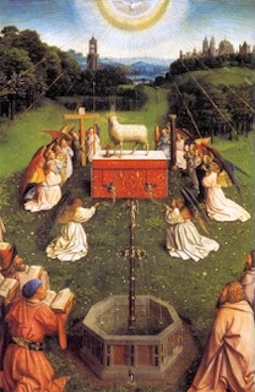
Jan van Eyck - Ghent Altarpiece - Adoration of the Lamb detail
Twenty-eighth Sunday in Ordinary Time
On first hearing or reading through it the gospel this Sunday is simply quite awful. It's a dreadful tale of forced hospitality, murder and naked brutality. We can pick up the dreadful sequence of the tale, firstly those invited to the wedding feast of the King's Son are summoned, and not untypically for a down trodden people resist this summons : 'He ( the King) dispatched his servants to summon the invited guests to the feast, but they refused to come'.(Mt 22:3)
The King then sends another deputation and lays it on thick, calves and fattened cattle have been slaughtered and everything is NOW ready! Yet again there is a sustained refusal by some, and a rebellion of sorts by others, who kill the servants. Them comes a brutal reaction and the whole tale escalates into a kind of madness, the King's response is ghastly, people are murdered and a city is destroyed! But the peculiarities of this story doesn't end at this point, for the King orders other servants to do something strange: 'Go out, therefore, into the main roads and invite to the feast whomever you find. 'The servants went out into the streets and gathered all they found, bad and good alike, and the hall was filled with guests'. (MT 22:9,10)
So now we have the forced inclusion of anybody to the wedding feast, and then in what seems to be a twist in the tale, a really unfair act by the King, who spotting a guest without wedding clothes, has him thrown out with excessive and punitive force, hands and feet bound-into the darkness. In human terms this all seems grossly unfair, after all the man has been compelled to come to the feast on the spur of the moment, so why treat him like this, and why the final phrase of verse 14: ''Many are called but few chosen'?
There are ways in which we can find some justification for parts of the King's reaction.
The first is of course, that we understand that this is not a real event, it is a parable told by Jesus and meant for the audience of those Chief priests and Scribes, so we know that it will certainly have deeper meanings.Secondly Matthew also warns us that it is a tale about the 'Kingdom of Heaven'! There is a suggestion that Jesus is using a tyrant archetype to drive his point home, given the state of government and occupation in his time, as well as illustrations of bad and cruel rulers in Scripture, this King fits into the narrative of tyrannical rule experienced in real time!
One problem is that the Scriptural context in this parable needs to be further explained to us, most biblical commentators see the image of the King's destruction of the city and killing of the inhabitants as a prophetic reference to what happened to Jerusalem in 70 CE, when the Romans sacked the city, destroyed the Temple and killed the inhabitants, but here in this gospel also seen through the lens of the rejection of the Christ as Messiah, with the servants of the King in the gospel standing in for the messengers of the Good News.
There is also the historical-cultural context of the wedding feast and the King, in ancient Near Eastern contexts, this absolute refusal by the guests to attend a king's banquet made far more serious by the murder of his royal messengers was considered an act of political treason and a declaration of war. Thus the king's retaliation, whilst it is very severe, does represent standard ancient warfare tactics against treasonous subjects. That might help us understand the violence of the tale, but what of the guest thrown out for not wearing a wedding garment?
In such a context of a 'high society' wedding, it was the custom for the host (here the King) to give those invited a robe to wear at the festivities, to refuse was considered an insult to the very honoured and deep tradition of hospitality and welcome. The indication that the man in the story had actually been given or offered one, but had actually insulted the laws of hospitality and respect by refusing to put it on, is indicated by these two sentences:' But when the king came in to meet the guests he saw a man there not dressed in a wedding garment. He said to him, 'My friend, how is it that you came in here without a wedding garment?' But he was reduced to silence'. (Mt 22:11,12)
It is the silence that points to a deliberate action, he could not give a valid excuse to the host as he would have had to pass by the house servants handing them out as he entered. So suddenly what appears to be a strange and rather vicious response by the King, turns out to be an event based on considerable rudeness and flaunting of traditional rules of hospitality by the unnamed man towards the King, his host.
All this helps, but how does it apply to us? Perhaps the first reading might allow us a way into the text, firstly it is eschatological, it deals with an event, yes, the fall of Jerusalem, but for the gospel follower it points to the coming of the Kingdom and the Wedding Feast of the Lamb where all will be welcome except (and this ties us to the man cast out) those who reject the Lord's gracious and loving hospitality and refuse to accept Christ as the true Messiah, the many that are not chosen! The Prophet Isaiah foretells this in wonderful poetry:
' On this mountain the LORD of hosts
will provide for all peoples
A feast of rich food and choice wines,
juicy, rich food and pure, choice wines.
On this mountain he will destroy
the veil that veils all peoples,
The web that is woven over all nations.
He will destroy death forever.'(Is 25: 6-8)
The Oracle of the Lord opens out for us a place of complete peace and joy, where time is no more except the time of the Lord and where death is totally vanquished, this is the Wedding Feast of the Lamb that is Christ our expectation that at the end of all things the Christ will gather us in good and bad, and then…well then there is that reminder of Judgement. If we try to squeeze the Christ and the image of God into one that suits us, then parables like this break down our interpretation and remind us that God is beyond all our machinations and imaginings, but that in Christ, this `God is revealed to us by that omni-present charism of the Life Giving Spirit. We cannot constrain God, we cannot create a saccharine image of bland niceness, nor of an angry , furious, paternalistic tyrant, all we can do is be open to the hospitality of God each and everyday, and respond with loving gratitude, trust and honest dialogue in prayer to the Lord Jesus our true Messiah. So do take heart from this parable, that we are all invited to the great feast of the Kingdom, but make note of the darker side, all occasioned by a rejection of the King. That is the casting out, we start the process by rejecting the love that is God. The many who are called need also to become the chosen by freely accepting the garment of the Lord's invitation!
As a coda, go to the psalm of today's Mass, one we all know well, Psalm 23, but this time read it and pray it with this parable in mind. This shepherd Lord guides and cares for us all the days of our life, then stays with us, beyond death to welcome us into the Kingdom and the great feast :
' You set a table before me
in front of my enemies;
You anoint my head with oil;
my cup overflows.
Indeed, goodness and mercy will pursue me
all the days of my life;
I will dwell in the house of the LORD
for endless days'.(Ps 23:5,6)
Amen.
Lectio
Extract from Pope Francis Angelus Address October 11th 2020
… However, the Lord places one condition: to wear a wedding garment. Let us return to the parable. When the hall is full, the king arrives and greets the latest guests, but he sees one of them without a wedding garment, that kind of little cape that each guest received as a gift at the entrance. The people went as they were dressed, as they were able to dress; they were not wearing gala attire. But they were given a type of capelet, a gift, at the entrance. That man, having rejected the free gift, excluded himself: thus, the king could do nothing but throw him out. This man accepted the invitation but then decided that it meant nothing to him: he was a self-sufficient person; he had no desire to change or to allow the Lord to change him. The wedding garment - this capelet - symbolizes the mercy that God freely gives us, namely, grace. Without grace we cannot take a step forward in Christian life. Everything is grace. It is not enough to accept the invitation to follow the Lord; one must be open to a journey of conversion, which changes the heart. The garment of mercy, which God offers us unceasingly, is the free gift of his love; it is precisely grace. And it demands to be welcomed with astonishment and joy: "Thank you, Lord, for having given me this gift".
Extract from the Paschal Sermon (Used at Pascha Matins in the Byzantine Rite) by St John Chrysostom
He gives rest unto the one who comes at the eleventh hour, even as unto the one who has wrought from the first hour.
And He shows mercy upon the last, and cares for the first; and to the one He gives, and upon the other He bestows gifts. And He both accepts the deeds, and welcomes the intention, and honours the acts and praises the offering. Wherefore, all of you enter into into the joy of your Lord; and receive your reward, both the first, and likewise the second. You rich and poor together, hold high festival. You sober and you heedless, honour the day. Rejoice today, both you who have fasted and you who have disregarded the fast. The table is full-laden; you must all feast sumptuously. The calf is fatted; let no one go hungry away.
All of you, enjoy the feast of faith: Receive all the riches of loving-kindness. let no one bewail their poverty, for the universal kingdom has been revealed. Let no one weep for their iniquities, for pardon has shown forth from the grave. Let no one fear death, for the Saviour's death has set us free. He that was held prisoner of it has annihilated it. By descending into Hell, He made Hell captive.
 Facebook
 Twitter
 LinkedIn
 Print
Print Email
Email













 Facebook
 Twitter
 YouTube
 LinkedIn
 Pinterest