

Sunday Reflection with Canon Robin Gibbons November 15th 2026
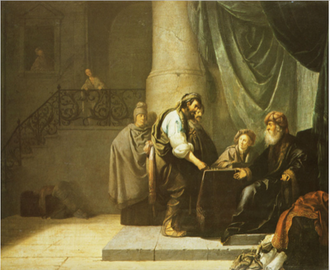
Willem de Poorter's Parable of The Talents
Thirty-Third Sunday in Ordinary Time
The parable of the talents, which is our Sunday Gospel, needs some very definite explanation, because its real message is nothing to do with our personal gifts and skills, but everything to do with our actions and task in being a good steward for the Lord. The problem is of course that word 'talent' which in the English language is a metaphor and is used, either individually or collectively, to refer to people's abilities or skills particularly for their performance in areas such as music, art, acting, sport, problem solving or even attractiveness. It is even used as a collective noun, such as a company recruiting 'talent' for its purposes! This means we need to be more careful in our application of it within this parable, for this kind of linguistic understanding is not what the 'talent' in Matthew's parable represents at all.
I have heard too many homilies on this parable, which segued into the many realms of how we can best apply and utilise our talents for the gospel. Yes, this is good counsel, but not what this gospel is about at all, in this parable the ability of each servant is fully understood as a means to an end and not as a talent.
So what can we discover that helps us understand the real meaning of Jesus' teaching. Yet again my immediate instinct is to refer back to the actual scriptures themselves, and look at the historical context as a way of comprehension, then examine just how Jesus applies his illustration for each one of us. The first point is to look at that word talent, what is it? The context helps us firstly to re-evaluate its meaning, here we see that it is some unit of wealth not an ability the servants possess.
In Greek the word 'talanton' refers to an enormous unit of money or a heavy and valuable weight usually in silver and gold, immediately this places the setting in a tale about a master about to go on a long journey, handing over his actual and enormous wealth to his servants in trust. Secondly, NT scholars point out the bigger context, that this reflects the situation between Israel and God and of course the mission of Jesus. Here he is speaking to a Jewish audience on the brink of a great national and spiritual crisis, a theological parable in which the master represents God, and his journey, absence and return to settle accounts, refers to the purposes of God and demands of Jesus calling his disciples to be fruitful.
What can we take from this passage? The reframing of the story as one of stewardship and not individual talent immediately allows us to understand two aspects of discipleship. One is about the enterprising servants who took a risk and doubled the value of the wealth, the really enormous value of their master's wealth, entrusted to their care. Can you discern part of our Christian calling represented in these two characters ? The answer is there before us and is an antidote to false pride, for the servants are NOT commended for their talent in having carefully calculated and mastered a portfolio of wealth, rather they are commended for an obedience to the master's trust, who knows their abilities, and also for faithfully and actively working for his aims and not seeking to gain anything for themselves, Isn't this what we are called to do, be good stewards for the Lord without seeking any reward for what we do in his name?
Then there is the figure of the third, timid and fearful servant. I feel a bit sorry for this character, after all though he has not increased the values of the talent entrusted to him, nevertheless it has not depreciated in value. However he has chosen the 'safe' option out of fear, understanding his master as a 'hard' man. This is not what any of us are called to be in discipleship, that is a 'safe' person, fearful in our understanding of faith and of Jesus. We are entrusted with the task of being good stewards for the Lord, whose aims in faith are aligned with the teachings of Jesus our Christ and part of whose task is to go on the journey of 'understanding' our master. This servant fails because he refuses to take a risk for the Kingdom, fails in that calling to be a faithful part of the mission of the Kingdom, instead he retreats from encounter and becomes a defensive and negatively minded character. This Gospel is a clear reminder by Jesus of our vocation to try and remain faithful to the master but also to enter into a relationship with him, so that we too may be entrusted with greater responsibilities in the Kingdom.
Lectio
Our task as image-bearing, God-loving, Christ-shaped, Spirit-filled Christians, following Christ and shaping our world, is to announce redemption to a world that has discovered its fallenness, to announce healing to a world that has discovered its brokenness, to proclaim love and trust to a world that knows only exploitation, fear and suspicion…The Gospel of Jesus points us and indeed urges us to be at the leading edge of the whole culture, articulating in story and music and art and philosophy and education and poetry and politics and theology and even-heaven help us-Biblical studies, a worldview that will mount the historically-rooted Christian challenge to both modernity and postmodernity, leading the way…with joy and humour and gentleness and good judgment and true wisdom. I believe if we face the question, "if not now, then when?" if we are grasped by this vision we may also hear the question, "if not us, then who?" And if the Gospel of Jesus is not the key to this task, then what is?"
NT Wright, Challenge of Jesus: Rediscovering Who Jesus Was and Is
Sonnet 19: When I consider how my light is spent
by John Milton
When I consider how my light is spent,
Ere half my days, in this dark world and wide,
And that one Talent which is death to hide
Lodged with me useless, though my Soul more bent
To serve therewith my Maker, and present
My true account, lest he returning chide;
"Doth God exact day-labour, light denied?"
I fondly ask. But patience, to prevent
That murmur, soon replies, "God doth not need
Either man's work or his own gifts; who best
Bear his mild yoke, they serve him best. His state
Is Kingly. Thousands at his bidding speed
And post o'er Land and Ocean without rest:
They also serve who only stand and wait."
Copyright Credit: John Milton, "Sonnet 19 ["When I consider how my light is spent"]" from The Sonnets of Milton: With Introduction & Notes (Glasgow: Maclehose, Jackson and Co., 1921): Public domain.
 Facebook
 Twitter
 LinkedIn
 Print
 Email













 Facebook
 Twitter
 YouTube
 LinkedIn
 Pinterest