

Sunday Reflection with Canon Robin Gibbons: October 25th 2026
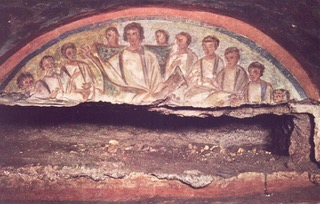
Christ and the Apostles, Catacombs of Domitilla, 4th century AD Rome
Thirtieth Sunday in Ordinary Time
Lectionary: 148
There are moments in our faith life, or as others might put it, stops on our faith journey, when we are faced with an emptiness in prayer, or perhaps what we regard as a silence from God, which sometimes can come in the form of disillusionment with what we have found as comfort and consolation from our faith. These moments or times are not to be understood as that painful process of the 'dark night of the soul', which is a transitory state of extreme spiritual emptiness, described in terms of inner painfulness or darkness. This is when, as St John of the Cross describes: "God leads into the dark night those whom He desires to purify from all these imperfections so that He may bring them farther onward."(John of the Cross, Dark Night of the Soul)
This is not quite what I am referring to, for many of us will not experience that strange gift of the dark night, but rather other forms of change, more like gradual steps of growth into the life of Christ, where there are points, moments of different realisation, which often come as a question, perhaps from the Lord, that strips away some of our certainties and pushes us into a more adult reflection on faith.
The philosopher Simone de Beauvoir tells us that these moments are not about loss, or real cynical disillusion , much more moments of radical reengagement with the essential heart of our faith. Beauvoir viewed them not as a tragedy, but as the ultimate, necessary confrontation with human truth. She puts it very beautifully when she writes: "Since we do not succeed in fleeing it, let us therefore try to look the truth in the face. Let us try to assume our fundamental ambiguity. It is in the knowledge of the genuine conditions of our life that we must draw our strength to live and our reason for acting" (Beauvoir: The Ethics of Ambiguity) Why this kind of reflection about facing the truth? Because I see in the story found in our gospel this Sunday precisely this same moment of change, a moment when what is the essence of divine truth reveals itself in a new way through the words of Jesus.
This story comes at a point when Jesus is finishing his final public ministry, just after his triumphal entry into Jerusalem and before his betrayal, trial, passion and death. So it is an intense moment about the ultimate realisation of the truth of who Jesus actually is and of how we accept him as Lord and Saviour. In our passage from Matthew 22 he is being questioned on behalf of a group of religious leaders by a scholar of the law :'…and one of them [a scholar of the law]* tested him by asking, "Teacher, which commandment in the law is the greatest?" '(Mt 22:34,35)
Since Rabbinic tradition accepted 613 Laws and divided them into perfect and not so perfect, this question is a trap set by those who opposed him to see if he would pick one of the Laws as a higher precept, thus devaluating the rest and provoking a dangerous religious argument and one they all hope might lead to his condemnation and perhaps death. Jesus recognising all this answers in a profoundly simple way, but one which challenges the hypocrisy of those who want to trap him.
He answers with three statements, the first he takes from the Shema ( Deuteronomy 6:5) which anchors the answer in our total human response of allegiance to the God of love. The second he takes from Leviticus 19:18, 'love your neighbour as yourself 'which he states is 'like' the first, in other words inseparable from it. And finally for all of us, Jesus synthesises these two commandments as the peg or hanger, on which all the Law rests. This to my mind is exactly one of those transitioning moments for the scholar of the Law when things are stripped away in order for him, and us, to take a new step forward into the revelation of the utter simplicity of God's relationship to us, one without barriers, in which we eventually face the truth of ourselves, and in doing do discover that faith is an exciting journey into discovering the presence of Christ, within our own loving hearts, minds and souls, and in love of our neighbour as in our true selves.
Lectio
The Shema
"Hear, O Israel: The Lord our God, the Lord is one! You shall love the Lord your God with all your heart, with all your soul, and with all your strength. "And these words which I command you today shall be in your heart. You shall teach them diligently to your children, and shall talk of them when you sit in your house, when you walk by the way, when you lie down, and when you rise up. You shall bind them as a sign on your hand, and they shall be as frontlets between your eyes. You shall write them on the doorposts of your house and on your gates." (Deuteronomy 6:4-9)
The teaching of Jesus
Deuteronomy 6:5 New International Version
5 Love the Lord your God with all your heart and with all your soul and with all your strength.
Leviticus 19:18 New International Version
18 "'Do not seek revenge or bear a grudge against anyone among your people, but love your uas yourself. I am the Lord".
Thomas Merton
New Seeds of Contemplation
"We thank [God] less by words than by the serene happiness of silent acceptance. It is our emptiness in the presence of His reality, our silence in the presence of His infinitely rich silence, our joy in the bosom of the serene darkness in which His light holds us absorbed, it is all this that praises Him."
 Facebook
 Twitter
 LinkedIn
 Print
 Email











 Facebook
 Twitter
 YouTube
 LinkedIn
 Pinterest