


Sunday Reflection with Canon Robin Gibbons November 8th 2026
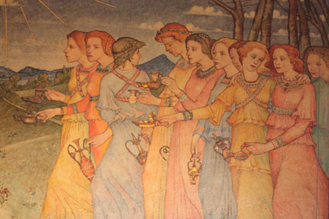
Parable of the Ten Virgins by Phoebe Traquair, Mansfield Traquair Church, Edinburgh Wiki Image
Twenty Third Sunday in Ordinary Time
(Remembrance Sunday in the UK)
In one sense the parable of the ten virgins is easy to understand, if we remind ourselves that the status of the attendants is not the subject matter of the story, rather it is what they do or do not do that concerns us.
They are part of the ceremonial activity that surrounded the third distinct part of the cultural setting of a first century Jewish wedding ceremony.
The context of the tale is the emotional moment of the anticipated arrival of the Bridegroom to attend the banquet in the home of the bride.
The dramatic division of the ten into five foolish and five wise or prudent attendants, sets the scene for what is to come, their task of ritual welcome at the arrival of the bridegroom, and their accompaniment and procession with lights for him and his friends to the feast.
Whilst we have to note that all ten attendants have lamps and oil, the difference is that only the five wise ones have anticipated the potential need for extra oil, which one suspects is a prudent requirement for their lit lamps, particularly in these extended festivities where the groom comes to find his bride at an unexpected time, announced only when he is very near to her home. So it is with Jesus' story, the groom does not arrive until midnight, and even then unexpectedly, so that those who are unprepared for his coming find themselves not only without oil but cannot get any in the immediacy of the moment as the others do not share their oil with them, but tell them to go and get some from the merchant, no doubt a very difficult task at that hour of the night. On their return, despite having filled their lamps, they now find themselves locked out of the feast and even worse are openly unrecognised by the Groom, they are no longer part of the feast.
Whilst commentators might argue who these bridesmaids really represent, possibly Israel, we can understand the story as one in which the bridegroom is Jesus at his second coming, represented also by the wedding feast which is that banquet prepared for us all in the Kingdom of heaven. The symbol of the lamp is important for the oil it contains as fuel for light can be understood at the gift of that indwelling faith which is the light of Christ given us by the outpouring of the Holy Spirit. This is a reminder that our faith is something we need to nurture, care about, so that we keep the lamp of our hearts, minds and souls ready and filled with the merciful love of the `Lord, and the wick which is its outward expression trimmed and burning brightly to shine before others and help guide them toward Christ who is the true Bridegroom and our Light.
Yet at the core of this story is a question for us. Are we ready to welcome the Lord Jesus with the light of our faith and love? Do we, like the wise and prudent attendants, remain alert so that we can recognise the Groom? For there is that meeting with the Lord which we all experience through faith; in each other, in the stranger, in our actions, in the hearing of the Word, and in the Eucharist and other sacraments. And, if we do, are we prepared to welcome Christ when he comes again in glory? It is a reminder of the necessity of faithfulness, of living out our faith in a real way, not simply being associated with it in a token sense. If we do try, even if at times we feel we might have fallen far short of the ideal of a follower of Jesus, then these words, which come from Matthew's parable of the talents that follows this story of the ten virgins, will illuminate our hearts as perhaps the bridegroom's words did to those five wise attendants: 'Well done, my good and faithful servant. Since you were faithful in small matters, I will give you great responsibilities. Come, share your master's joy.' (Mt 25:23) Let us pray then that we may have the great gift of prudence, the gift of the Holy Wisdom of God.
Lectio
Remembering the departed in sure and certain hope.
1 Thessalonians 4:13-18
We do not want you to be unaware, brothers and sisters,
about those who have fallen asleep,
so that you may not grieve like the rest, who have no hope.
For if we believe that Jesus died and rose,
so too will God, through Jesus,
bring with him those who have fallen asleep.
Indeed, we tell you this, on the word of the Lord,
that we who are alive,
who are left until the coming of the Lord,
will surely not precede those who have fallen asleep.
For the Lord himself, with a word of command,
with the voice of an archangel and with the trumpet of God,
will come down from heaven,
and the dead in Christ will rise first.
Then we who are alive, who are left,
will be caught up together with them in the clouds
to meet the Lord in the air.
Thus we shall always be with the Lord.
Therefore, console one another with these words.
Augustine: Sermon 43
The five wise virgins came, and went in. How many are you, my Brethren, in the profession of Christ's Name! let there be among you the five wise, but be not five such persons only. Let there be among you the five wise, belonging to this wisdom of the number five. For the hour will come, and come when we know not. It will come at midnight, Watch ye.
Thus did the Gospel close; Watch, for you know neither the day nor the hour. But if we are all to sleep, how shall we watch? Watch with the heart, watch with faith, watch with hope, watch with charity, watch with good works; and then, when you shall sleep in your body, the time will come that you shall rise. And when you shall have risen, make ready the lamps. Then shall they go out no more, then shall they be renewed with the inner oil of conscience; then shall that Bridegroom fold you in His spiritual embrace, then shall He bring you into His House where you shall never sleep, where your lamp can never be extinguished. But at present we are in labour, and our lamps flicker amid the winds and temptations of this life; but only let our flame burn strongly, that the wind of temptation may increase the fire, rather than put it out.
 Facebook
 Twitter
 LinkedIn
 Print
 Email














 Facebook
 Twitter
 YouTube
 LinkedIn
 Pinterest