

Sunday Reflection with Canon Robin Gibbons: 22 November 2026
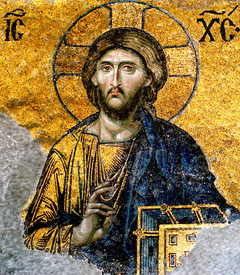
Jesus Christ from Hagia Sophia
Solemnity of Christ the King
There is a part of me which dislikes this feast as it is commonly represented, a Christ who is very much the potentate of human imagination, and yes, also a judge - but and this helps me understand who he is a bit more, a just one, who when he comes again to judge us all, will separate the 'sheep' from the 'goats', a rather unfortunate animal metaphor these days, especially for those of us who love and appreciate the gifts goats bring to human life!
We can move beyond this image and get to the real meaning, for as Matthew reminds us this image is only a way of helping us see the King Jesus judging 'like' a shepherd, actively counting and dividing his flock, and that's the image, meeting the coming King is finding the one who is about to divide us into two groups.
Nonetheless Matthew goes on to show us that the Son of Man at the end of time is a kingly judge who separates people into two main categories based on who they are, in the sense of how they have reacted to him represented in the 'least amongst us'. There is the element of surprised alarm by the two groups because they did not know or understand that this is how they would encounter the King.
Our judgement is not about prayer, fidelity to doctrine, rubrical correctness, wealth, success, power or charismatic leadership, but it is all to do with our attitudes and behaviour, summed up by a compassionate and loving attitude towards the Christ found in the needy, and an active compassion towards them and their needs which is done without thought of one's own reward.
I suspect that some of us will wonder how this judge image squares up with the God of love? In one sense the question needs to be understood and framed in a wider context, that of discipleship and commitment. We are called to be disciples, we are given the great commandment of love as our guide and the compass we continually refer to is the Holy Spirit who points us towards the Christ and we are called to follow him.
The first reading from the prophet Ezekiel gives us sight of the true shepherd, a kind, just and loving pastor, who leads in love, caring, defending, protecting, and above all understanding each one of the flock, which is the true vocation of the Divine Judge and Ruler of all. Further on in the same chapter we read that the Holy One reminds us all of one important thing, the necessity of a reciprocal relationship :'Thus they shall know that I, the LORD, their God, am with them, and that they are my people, the house of Israel-oracle of the Lord GOD. Yes, you are my flock: you people are the flock of my pasture, and I am your God - oracle of the Lord GOD. ( Ez 34: 30,31)
This means that our understanding of Christ as King of the Universe also needs further explanation and more exploration than our limited imagination can provide. We cannot do justice to Christ as King unless we place his ministry in the context of the fulfilment of Gods promises and the restoration of all life in the renewed `Kingdom, that new age where Christ as King hands everything over to the Father, and where the Triune God rules in love over restored and renewed creation. That is why our second reading from I Corinthians 15 is key to discovering just what the ministry of Christ the King is about. Crucial to this understanding is how Paul sees Christ's rule, and how we can glimpse Christ the King as a role, part of the handing over of all things to the `Father. Christ the King's mission is the defeat of death and the bringing to life all who exist, and it is only then at the restoration of all things in the New Creation that the end becomes the beginning of eternal life:
' For just as in Adam all die,
so too in Christ shall all be brought to life,
but each one in proper order:
Christ the first fruits;
then, at his coming, those who belong to Christ;
then comes the end, ( I Cor 15 : 22-24b)
I hope this helps you, as it has me, to understand the Kingship of Christ as a ministry, part of the dynamic of love that is the Holy Trinity, for the Kingship of Christ has a purpose as long as this fragile earth lasts and I find Paul opens out this task in a very imaginative way: 'then comes the end, when he hands over the kingdom to his God and Father, when he has destroyed every sovereignty and every authority and power. For he must reign until he has put all his enemies under his feet'. (I Cor 15: 24-25) And of course that greatest of enemies is death, defeated in the resurrection of Christ.
So this Sunday when I think of Christ as King, I understand him as the one who turns our concepts of power and prestige upside down, whose judgement heralds the restoration of creation in the Kingdom forever challenges us in the here and now to reform our lives, and conform them to the vocation of the good shepherd, but this mission of kingship will end, when all is completed and he hands over all things to the Father and all will be complete. As Paul puts is so succinctly: 'When everything is subjected to him, then the Son himself will (also) be subjected to the one who subjected everything to him, so that God may be all in all.'(I Cor 15:26)
Lectio
From The Hope of Eternal Life 2010
www.usccb.org/committees/ecumenical-interreligious-affairs/hope-eternal-life
141. The New Testament foresees not only the transformation of humanity in the resurrection, but also the transformation of all of creation and its release from suffering (Matt. 19:28; Rom. 8:18-25). While at least one New Testament text speaks explicitly of a coming kingdom of God on earth (Rev. 20:4) and other texts hint at it (Matt. 19:28; 1 Cor. 6:2), it is not a main emphasis. The main emphasis in New Testament texts regarding the final kingdom of God or the kingdom of heaven does not fall on its location but on God's triumph over death and evil, God's gathering of the redeemed, and the communal nature of the kingdom, with the redeemed dwelling with God, with Christ, and with each other forever (Matt. 8:11-12; 13:43; 24:30; 25:34; 1 Cor. 15:24- 28; 1 Thess. 4:16-17).
From
THE ECUMENISM OF THE NEW MARTYRS
by Josef L Maj
'The greatest homage which all the Churches can give to Christ on the threshold of the third millennium will be to manifest the Redeemer's all-powerful presence through the fruits of faith, hope and charity present in men and women of many different tongues and races who have followed Christ in the various forms of the Christian vocation' (TMA 37).
This following of Christ, which expresses faith in Christ and witnesses to him, begins with Baptism and is realised in the Church.
'For - affirms the Second Vatican Council, in the dogmatic Constitution on the Church - those who believe in Christ, who are reborn not from a perishable but from an imperishable seed through the Word of the living God, not from the flesh, but from water and the Holy Spirit, are finally established as a 'chosen race, a royal priesthood, a holy nation, a purchased people ... You who in times past were not a people, but are now the people of God' (cf 1 Pt 2, 9-10). This people is called by Christ to communion of life, charity and truth, and has also been chosen by Him to be an instrument of redemption for all mankind and sent out to the whole world: 'God has gathered together as one all those who in faith look upon Jesus as the author of salvation and the source of unity and peace, and has established them as the Church, that for each and all she may be the visible sacrament of this saving unity'. (LG 9). Through the centuries, this Church of Christ works for salvation and bears fruits of holiness and fidelity to the Lord even to the shedding of blood.
The Church however, according to the Council documents 'recognises that in many ways she is linked' (LG 15) with all those who are baptised and being called Christians are united with her by bonds of faith (cfr ibidem). The Decree on Ecumenism clearly explains this reality: 'For those who believe in Christ and have been baptised are brought into a certain, though imperfect, communion with the Catholic Church' (UR 3). After mentioning the many other elements which characterise this partial communion, elements which at the same time are means of sanctification, belonging also to other Christians, the dogmatic Constitution of the Church adds: 'Likewise we can say that in some real way they are joined with us in the Holy Spirit, for to them also he gives his gifts and graces, and is therefore operative among them with his sanctifying power. Some, indeed he has strengthened to the extent of the shedding of their blood. (LG 15).
 Facebook
 Twitter
 LinkedIn
 Print
 Email









 Facebook
 Twitter
 YouTube
 LinkedIn
 Pinterest