


Richard Dadd - Beyond Bedlam at Royal Academy of Arts
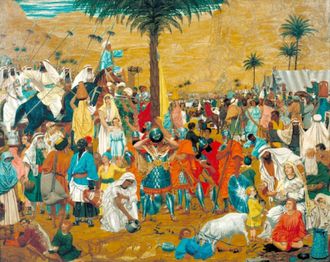
The Flight Out of Egypt - Richard Dadd
Over 100 works by the troubled genius Richard Dadd are presented in this absorbing exhibition. He spent over 20 years in Bethlem, ending his days in Broadmoor in 1886. His most celebrated fantasy works crammed full of fairies verging on the macabre were painted in the asylum. He also painted portraits and vivid scenes inspired by his travels.
Dadd was born in Chatham in 1817. The family moved to London, near Trafalgar Square in 1834. Aged 19 he enrolled as an art student at the Royal Academy of Arts, showing early promise and winning medals for his drawings and watercolours.
Charming studies portray his family. Two siblings developed similar mental illness to him. A self- portrait, 1841, depicts a sensitive young man and a friend described his 'exceeding gentleness' and sweet nature.
He joined the Clique, a group of young artists who created compositions inspired by Shakespeare and Byron.
Dadd gained popularity for his illustrations of English folklore and fairy scenes inspired by 'A Midsummer Nights' Dream.'
In 1842 on completion of his art studies, he was engaged by Welsh lawyer Sir Thomas Phillips to accompany him on an Eastern Mediterranean tour as a draughtsman. Dadd filled his sketchbooks with intricate studies of people and landscapes.
The exhausting itinerary stressed Dadd and he began to suffer delusions. On returning to England, he killed his father on 28th August 1843, believing him to be a devil. He was arrested and committed to the Criminal Wing of Bethlem Hospital the following year.
Enlightened Superintendents encouraged him to paint, even commissioning works from him. In 1857 he was moved to more comfortable quarters and had access to art books.
Fifteen of his 33 Passions in watercolour, pen, ink and pencil, are exhibited. Undertaken between 1853-7, they are mostly allegorical genre scenes from everyday life, Shakespeare or his childhood memories of Chatham as portrayed in Patriotism.
'Agony-Raving Lunatic' illustrates the conventional treatment of lunatics with a writhing man in chains, with his hand on his head alluding to his struggle with his mind.
'Insignificance or Self Contempt', 1854, portrays a figure bearing resemblance to the elderly Turner - who had tutored Dadd at the Royal Academy. Dadd's use of light in such works as his luminous watercolour 'View of the Island of Rhodes', 1845, probably owes much to Turner's tutelage.
Other watercolours were inspired by popular ballads and legends such as Robin Hood.
'The Artist's Halt in the Desert', 1845, was missing for over 120 years. It was discovered on BBC TV in 1986 on the Antiques Road Show when it was valued for £100,000 and subsequently bought by the British Museum. Conveying an air of eerie serenity, Dadd and his party are illuminated by moonlight and the camp firelight beside the Dead Sea. The artist is seated at the far right of the fire and was already exhibiting signs of paranoid schizophrenia.
His most celebrated oil on canvas, 'The Fairy Fella's Master Stroke', 1865, was painted over nearly a decade focusing on the figure of Queen Mab of as described by Mercutio in 'Romeo and Juliet '.
A woodcutter raises an axe to split a hazelnut for the fairy coach. Excessively detailed imagery pervades the scene. The painting was presented to the Tate by Siegried Sassoon in memory of his friend Julian Dadd, the artist's great nephew whom Sassoon served with in WWI.
Dadd wrote a poem explaining the figures in his painting, linking it to Shakespeare and folklore. Inspired by the picture, Queen's 1974 music Album features the song 'The Fairy Feller's Master Stroke'.
A colourful painting of 1849 now known as The Flight out of Egypt, was untitled by Dadd. Rather like an icon, the complex picture denotes several theological scenes. The whole picture seems to recall the prophetic end of days when all nations and peoples are called to the Holy Mountain, in the Book of Revelation and the river of the Water of Life, 'clear as crystal' is revealed.
A bustling caravan of peoples includes the Holy Family at the corner of the foreground, who fled to Egypt. Mountains in the background gushing with water might symbolise the rock struck by Moses in the desert. A central figure quaffs water from a huge green drinking vessel maybe signifies Horus the dying and rising sun god. Dadd identified with Egyptology believing ancient cultures pre-figure Christianity. Sadly this became confused in his mind on his return to England and resulted in patricide.
In the 1860's he was asked to create designs for certificates for exemplary conduct by hospital attendants towards patients. A mentally ill man and woman are seen wandering alone and then with a caring companion. The second image demonstrates the patients' recovery so that they are indistinguishable from the staff.
He produced amazing art demonstrating the borderline between genius and insanity .
Don't miss this unforgettable exhibition before it closes on 25 October. Open Tuesday - Sunday.
For more information see: www.royalacademy.org.uk/exhibition/richard-dadd
 Facebook
 Twitter
 LinkedIn
 Print
Print Email
Email











 Facebook
 Twitter
 YouTube
 LinkedIn
 Pinterest