


Michaelina Wautier celebrated at The Royal Academy
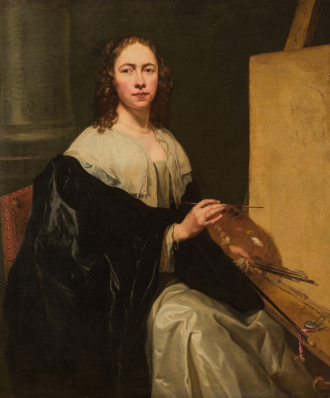
Michaelina Wautier Self Portrait c.1650, Private Collection
The Royal Academy of Arts current exhibition of extraordinary seventeenth century artist Michaelina Wautier is unmissable. Rediscovered thirty years ago, this is the first ever exhibition of her work in the UK.
Born around 1614 in Mons, then part of the Spanish Netherlands, to an affluent French speaking Walloon Catholic family, her exact date of birth is uncertain.
Her father, who died in 1617 was a page at the court.
Her brother, Charles, became a noted artist working in Brussels and it is likely she contributed to his commissions as well as her own. It is probable that his sister, who Latinised her name from Michelle to Michaelina, shared his studio, situated near the court. Both painted in a Caravaggesque style with use of chiaroscuro dramatically enhancing light.
Michaelina 's work had greater depth and character, especially in her portraiture and religious scenes.
She was particularly adept at painting children and aged faces. Her style embraces a number of genres from portraiture to history and religious scenes as well as floral studies, considered more appropriate for female artists at that time, although in adding a butterfly to one and a dragonfly to another, she adds religious symbolism.
Unlike her counterpart in Italy, Artemisia Gentileschi, there is little documentation about her. Only in the last century has she remerged from the shadows as a great artist in her own right. Many works were attributed either to her brother after her death or to other established artists.
However, in her lifetime she was recognised and enjoyed the patronage of Archduke Leopold Wilhelm of Austria, governor of the Spanish Netherlands.
Her striking self-portrait opens this landmark exhibition, and presents a poised, self-assured woman gazing outward at us, her artist's palette and brushes in her hand, sitting by her easel.
She is fashionably dressed and wears pearls. It is known that for two centuries the portrait was displayed at Althrop House, home of the Spenser family. In 1851 it was erroneously catalogued as depicting Artemisia Gentileschi.
Michaelina became a noted portraitist by the time she was thirty.
A particularly striking depiction of the Italian Jesuit missionary, Martino Martini in Chinese court attire is displayed alongside other portraits by her and her brother. An inscription identifies Martini by his Chinese name Wei Kangguo.
It is likely that she collaborated with some of Charles' major religious works such as 'The Calling of St Matthew'. The figure of the boy with the book could well be by her, exhibiting greater introspection and whose features bear a resemblance to her androgynous picture of 'St John the Evangelist'.
She added the words 'invenit et fecit' ('invented and made') to her signatures on two of her large scale religious paintings, asserting her skill and individuality.
The earliest use of that signature by her was in 1649 on 'The Mystic Marriage of St Catherine'. Recent technical analysis revealed use of a reddish base layer, common in southern Europe, suggesting she was familiar with Italian techniques. The curators speculate that she might have accompanied her brother Charles to Italy and gained knowledge of Caravaggio whose style they echo and studied classical sculpture there.
Looking closely at St Catherine there is a similarity to the artist's features and the pearl bracelets to those in her affirming self-portrait. Could she be portraying herself in this devotional masterpiece?
She also used this description on 'The Education of the Virgin', 1656, a beautifully lit composition showing a particularly tender relationship between Mary and her mother, St Anne, who has an arm about her shoulders and gently touches her wrist with the other hand. Her father stands behind them, one hand resting prayerfully on his heart and the other gesturing towards his daughter. Wautier's brushwork excels in painting textures and folds of drapery in this and all her works.
It was only in 2019 that her captivating Five Senses paintings were found at an auction. Normally allegorical subjects were portrayed by idealised female figures, but Michaelina broke the mould with young boys defining the senses. Smell is particularly humorous with a boy holding his nose smelling a rotten egg.
Michaelina depicts herself as a Bacchante in the mythological 'Triumph of Bacchus',1655-59, gazing impassively outwards, disassociating herself from the drunken scene, and boldly asserting herself as an artist.
Her last known work is 'The Annunciation,'1659. Light falls dramatically on Mary's stomach. Despite having been cut down from a much larger canvas it is an emotive picture depicting Mary's open handed receptiveness and simplicity, responding to the angels' message, who points upwards to the dove of the Holy Spirit with a shaft of light descending.
Recently discovered documentation indicates that another Annunciation by her was recorded as belonging to the Discalced Carmelite church in Mechelen in 1770 alongside a Crucifixion by her brother. These pictures have yet to be rediscovered.
There are only 35 known works by Michaelina and 25 are displayed here. It is hoped that this exhibition will lead to further discoveries of her outstanding talent as one of the leading European artists of the Baroque era.
An excellent illustrated catalogue examines the technique and latest scholarship on this remarkable artist.
Michaelina Wautier is at the Royal Academy of Arts
Now until 21 June - Tuesday -Saturday 10am-6pm Fridays 10am-9pm
£15 Admission, concessions available.
LINK
The Royal Academy: www.royalacademy.org.uk/
 Facebook
 Twitter
 LinkedIn
 Print
Print Email
Email












 Facebook
 Twitter
 YouTube
 LinkedIn
 Pinterest