

Pope Francis' Vehicle of Hope denied permission to enter Gaza
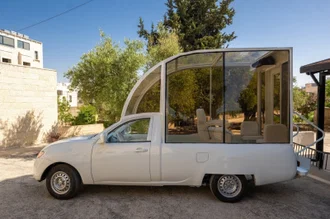
The Vehicle of Hope still stranded in Bethlehem
Source: Caritas Sweden
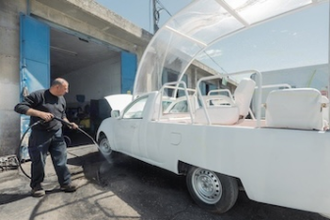
One of Pope Francis last wishes was for his popemobile, used during his 2014 visit to Bethlehem, to be converted into a mobile clinic for the children of Gaza. Caritas Sweden last year adapted the vehicle - but the Israeli authorities have still not given it permission to move.
Swedish Cardinal Anders Arborelius writes: "In November last year, I travelled to Bethlehem to inaugurate this Vehicle of Hope. In the town where Christ was born, where God chose not to remain distant from human suffering but to enter it, we blessed a modest instrument of healing. I was reminded then of Pope Francis's words: 'Children are not numbers. They are faces, names, and stories. And each one matters.'
"Since then, the vehicle has not moved. It remains parked near Manger Square, only a few miles from Gaza, waiting for permission to enter. Despite repeated appeals, access continues to be denied.
During that same visit, I met children from Gaza receiving treatment in a nearby hospital. Their bodies and faces bore the marks of war: injury, fear, loss, and despair. In the presence of such suffering, one recalls the words of Christ: whatever we do for the least of our brothers and sisters, we do for him. To look into the eyes of a wounded child is not only to witness pain. It is to encounter a moral claim that cannot be postponed, explained away, or made secondary.
At the heart of the Christian faith is the mystery of the Incarnation: that God drew near to us in Jesus Christ and shared the vulnerability of human life. The deepest meaning of being a disciple of Christ, is therefore not simply to profess beliefs, but to let love take flesh in the world. Faith cannot remain abstract when suffering stands before us. It must become mercy.
This initiative is not political. It is not a provocation. It is an act of mercy.
And mercy is never something small. In a world formed by power, fear, and calculation, mercy is one of the clearest signs that we have not given up on our humanity. It is the refusal to pass by. It is the decision to remain nearby. It is the recognition that every human being, especially every child, possesses a dignity that no war can erase.
In Gaza today, children face not only violence, but the collapse of basic health care. Illnesses that should be treatable go untreated. Chronic conditions worsen. Minor injuries become life-threatening. In such circumstances, even a small mobile clinic can become a lifeline.
The Vehicle of Hope will not resolve a conflict created by adults, even though children are among its first victims. But for these children, and perhaps also for us, it can bring something essential: presence, tenderness, compassion, and hope. In the Christian tradition, to remain with those who suffer is never a marginal act. It is where faith becomes visible. It is where compassion takes flesh. It is where the dignity of the human person is defended not only in principle, but in love.
Humanitarian aid must never be made subject to political calculation. This is a principle of international law, but it is also a test of conscience. To deny medical care to children is to cross a moral line that should disturb us all. No political objective, no strategic hesitation, and no appeal to necessity can finally absolve us from the duty to protect innocent life.
I do not underestimate the complexity of the situation, nor the potential security concerns involved. But no lasting security can ever be built on the suffering of the innocent. Compassion is not a threat to peace. It is one of its preconditions.
"The mobile clinic named Vehicle of Hope is ready, together with a close to a dozen other mobile clinics. Medical teams stand prepared. Only permission is lacking.
I therefore appeal to those with the authority to act: allow this vehicle to enter Gaza. Let it serve the children who need care. Let it be a sign that even now, mercy has not been silenced, and that humanity has not entirely surrendered to indifference.
History will judge us by how we respond to the suffering of children in Gaza and elsewhere. But before history judges us, we must answer to something deeper: the call of conscience, and for believers the call of God, who asks whether we were able to recognise the dignity of every human life when it was most wounded and most defenceless.
Sometimes that call asks very little of us.
"Sometimes it asks us simply to let a vehicle pass."
Cardinal Anders Arborelius, OCD
Bishop of Stockholm
For more information about the Vehicle of Hope, see: www.vehicleofhope.org
 Facebook
 Twitter
 LinkedIn
 Print
Print Email
Email












 Facebook
 Twitter
 YouTube
 LinkedIn
 Pinterest