


Winston Churchill: the Painter, at the Wallace Collection
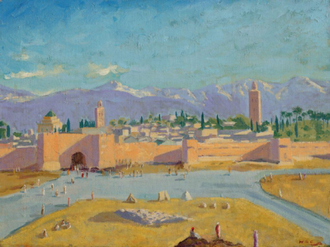
Sir Winston Churchill. 'The Tower of the Koutoubia Mosque'1943. Image courtesy: Private collection@Churchill Heritage Ltd.
Winston Churchill was a great statesman, soldier, and writer. He had many interests and hobbies including painting which became a vital part of his life during World War I. 'Painting is complete as a distraction," he explained, "I know of nothing which, without exhausting the body, more entirely absorbs the mind.'
The Wallace Collection, London, displays nearly 60 of his works in this absorbing exhibition. Included are his easel, paints and brushes, alongside his spectacles and a quarter bottle of Pol Roger, his favourite champagne and reputedly the last bottle he drank, a week before he died in January 1965.
Co-Curator Dr Lucy Davis said that Churchill approached painting with an intensity that mirrored his political life.
He started painting aged 40 following his dismissal from the Admiralty after the disastrous Gallipoli and Dardanelles campaigns, for which initially he was held responsible. His wife Clementine thought he would die of grief.
Painting proved a great therapy for him. He wrote about it later, urging others to take up the brush in a bestseller 'Painting as a Pastime', originally entitled Hobbies.
He sought advice from leading British artists including John Lavery, William Nicholson, from whom he said he learned the most, and Walter Sickert.
He painted a portrait of Lavery in his studio which was exhibited in 1919 by the Royal Society of Portrait Painters. Lavery portrayed Churchill painting in the garden of Warren House, Warren Road, Kingston upon Thames (not Kingston Hill, as catalogued.) The house is now a hotel and conference centre.
Churchill's own painting of the attractive rose bedecked Loggia there is also featured, depicting himself and the Paget family, who owned Warren House, with other house guests circa 1916-17.
In 1916 Churchill enlisted with the Scots Fusiliers and was deployed to the front line in Belgium taking his painting equipment with him. When his battalion HQ was bombarded, he recorded the scenes. These are exhibited in the first room with other early paintings including stunning still life, alongside one by his mentor William Nicholson.
During the 1920's and 1930's Churchill spent much time writing and painting. He liked to paint the homes of friends he visited and gift them to his hosts.
He painted Blenheim Palace several times, the Spencer - Churchill ancestral seat, to which he had a particular attachment as his birthplace and the home of his celebrated ancestor whose military prowess he admired.
In 1921 Churchill was appointed Colonial Secretary and chaired the Cairo conference. He made an eight day tour of Palestine and stayed in Jerusalem. He was deeply impressed by the spectacular view of the Old City and the Kidron Valley from Government House and painted an evocative painting at sunset.
Churchill painted Britain's' oldest Palladian bridge at Wilton several times in his developing impressionistic style. A favourite version displayed was painted in 1922 which he presented to Queen Elizabeth II in 1960.
He won his first art prize in 1925 for a painting of Chartwell, his country home, depicted in the snow. A celebrated painting in 1922 highlights the goldfish pool and its rippling water. Reflections on water became a particular focus in his Impressionistic and Post Impressionistic style.
Churchills paintings of the South of France and Morocco exude warmth and light. La Dragonnaire, Cap Martin,1937 is a homage to Van Gogh with dappled light darting through the olive grove of twisted tree trunks and cluster of irises.
He visited Morocco six times painting 'the red city ' of Marrakech between 1935-1959. He persuaded President Roosevelt to meet him there in 1943. Following their meeting he painted 'The Tower of the Khoutoubia Mosque' with the backdrop of the Atlas Mountains and gave it to Roosevelt. It was the only painting he did during WWII.
In 1947 he was invited to submit a painting for the Summer Exhibition, which he did under the pseudonym of David Winter. He was appointed Honourary Academician Extraordinary the following year in recognition of his 'achievements in the Art of Painting,' alongside his eminent services to the realm.
Churchill continued painting until shortly before his death in 1965. Over fifty years he produced over 500 paintings. After his death Prime Minister Wilson asked for a painting for the House of Commons and Lady Churchill presented him with a splendid depiction painted in Venice in 1951.
Contemplating his mortality, Churchill declared, 'When I get to heaven, I mean to spend a considerable portion of my first million years in painting and so get to the bottom of the subject.'
Don't miss the display by the shop about the Wallace Collection at War and Artists Aid Russia exhibition in 1942.
A painting by war artist Carel Weight caught my eye, 'It Happened to Us, Bombing Raid in the Suburbs,' 1940, on loan from RAF Hendon. In the foreground is a red trolley bus displaying its destination as Malden. German bombers swoop down as pedestrians scatter seeking shelter- and a dog (not a British bulldog - more of a scruffy spaniel), barks fiercely.
Winston Churchill the Painter until 29th November - Admission charges
Wallace Collection at War until 25th October - free admission
For more information see: www.wallacecollection.org/churchill
Watch a short film about the exhibition: www.youtube.com/watch?v=-Qy6ZSYoNQg&t=2s
 Facebook
 Twitter
 LinkedIn
 Print
Print Email
Email









 Facebook
 Twitter
 YouTube
 LinkedIn
 Pinterest