

Beneath the Surface - the impact of mining on people and land
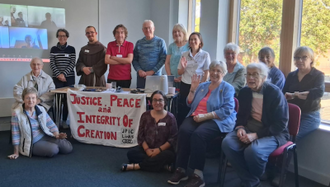
Religious and Associates of JPIC (Justice, Peace and Integrity of Creation) Links met on zoom and in person at the FCJ centre for Spirituality and Eco-justice in London on Saturday 10 October to hear about problems associated with the global mining industry and the ways in which Catholic communities and organisations are responding to them.
Mining was chosen as the subject of the gathering because of its importance to the global economy and to our daily lives.
Next to agriculture, it is the industry that we rely on most for our contemporary way of life. But it is enormously destructive, disrupting huge amounts of land, damaging ecosystems and uprooting communities living over mineral deposits. It is associated with human rights abuses and the production of massive quantities of toxic waste, some of which will remain dangerous for hundreds of thousands of years.
London is a key centre for financing this industry, and many of us unwittingly invest in it through our pension funds, insurance companies or banks, or through paying local taxes which get invested in mining to support local authority pension funds. Church organisations are among those which invest in it. At the same time, the Church around the world, at local, national, regional and international levels, is deeply involved in the struggle to address this destruction and injustice, and church members are among the many who have been murdered for their opposition to the industry's negative impacts.
The day started with a prayer in which Daughter of the Cross, Sister Gillian Price, Chair of JPIC Links, began by describing her own grandfather's experience of working in the South Wales coal mining industry in the early part of the twentieth century. As former Co-ordinator of London Mining Network (LMN), I then facilitated proceedings.
Dr Séverine Deneulin, Director of Integral Human Development at the Jesuit-linked Laudato Si' Research Institute (LSRI) at Campion Hall, Oxford, and Associate Fellow at the Oxford Department of International Development, spoke about her work on the role of the Catholic Church in promoting integral ecology in the context of mining. She began with an overview of the industry and the ecological and human rights problems associated with it. She then introduced Catholic Approaches to Mining: A Framework for Reflection, Planning, and Action, a document authored by Séverine and her colleague Caesar Montevecchio of the Catholic Peacebuilding Network at Notre Dame University in the USA and published in October last year.
The Framework contains helpful and inspiring information about what Church communities and organisations around the world are doing in response to the challenges posed by the mining industry in the light of Catholic Social Teaching, which has had increasing amounts to say about mining. These responses include:
• Accompaniment as the foundation: listening to the cries of the communities and wounded ecosystems and walking with them in contemplation and action;
• Documentation and communication of human rights violations, ecological damages, criminalisation of protest, etc;
• Education: legal literacy, advocacy skills, water monitoring skills, etc, with Catholic universities playing a major role;
• Advocacy, including legal action, Environmental Impact Assessments, dialogue roundtables, etc;
• Ecological conversion and solidarity between the Global North and Global South, involving use of investment funds, disinvestment and reduction of consumption; and
• Spirituality as underpinning all actions.
A request from mining-affected communities to provide case studies of success to inspire other struggling communities led to the Cases of Impact project. Séverine spoke about three of the case studies, one in Brazil, one in the Democratic Republic of Congo and one in the Philippines. She then gave examples of helpful involvement by Religious Congregations.
Séverine made clear that the Church never takes the lead in communities' struggles to protect their lives and lands: local affected communities always do. The Church's role is to support them in their struggles. Religious congregations, she said, can assist in a variety of ways according to context: for instance, accompanying one specific community over the long term; using investments to pressure companies to improve their behaviour; disinvesting from mining; reducing material consumption; educating themselves and others about the effects of the mining industry; or helping protect environmental defenders. Participants shared something of the many ways their own religious communities are already involved in advocacy with mining-affected communities.
University College London lecturer Dr Diana Salazar, Latin America Coordinator at London Mining Network, spoke about the role of London in the world's mining industry and the work of LMN. London is the world's biggest centre for investment in the minerals industry. Several of the world's biggest mining companies, and many smaller mining companies, are listed on the London Stock Exchange, including its Alternative Investment Market (AIM). British high street and investment banks, pension funds and insurance companies invest hundreds of millions of pounds a year in scores of mining projects across the globe, connecting working people's earnings in Britain with the fate of mining-affected communities around the world. The mining industry's key lobbying organisation, the International Council on Mining and Metals (ICMM) is based in London. So are the world's most important metals price fixing mechanism, the London Metal Exchange, and the leading precious metals trader, the London Bullion Market Association (LBMA). The UK Government often gives UK-based mining companies diplomatic support overseas, even when their activities are opposed by local people.
Diana explained that LMN bases its work on solidarity with mining-affected communities, using its location in London as a way to create pressure for change. She noted the problems caused by the way the transition towards a lower-carbon economy is being handled: in order to maintain energy-intensive consumer economies in some parts of the world, indigenous and other land-based communities are being sacrificed in other places in order to increase mining of minerals such as copper and rare earth minerals; and mining of metals for the low-carbon transition also underpins increased military expenditure and the development of AI.
The day ended with Mass celebrated by Fr Jean Nyembo SJ. Fr Jean is from DRC, where he worked as Managing Director of CARF, the Jesuit-run Centre Arrupe pour la Recherche et la Formation in Lubumbashi, which has worked for many years with communities affected by mining.
LINKS
Both LSRI and LMN produce reports and educational materials.
LSRI: https://lsri.campion.ox.ac.uk/
Catholic Church and Mining: https://lsri.campion.ox.ac.uk/node/1822
Subscribe to LSRI newsletter: https://campion.us10.list-manage.com/subscribe?u=b3585b7498938fdf94b9ede63&id=26c141e3d2
LMN: https://londonminingnetwork.org/
LMN educational materials: https://londonminingnetwork.org/2020/10/education-resources/
Subscribe to LMN newsletter: https://londonminingnetwork.us3.list-manage.com/subscribe?u=c24fb513fdd6c17178d7b384c&id=0445293c07
 Facebook
 Twitter
 LinkedIn
 Print
Print Email
Email














 Facebook
 Twitter
 YouTube
 LinkedIn
 Pinterest