


Palestinian Christians respond to Britain's new settlement measures
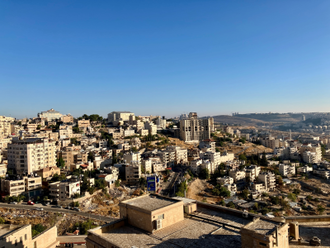
View of Bethlehem from Casa Nova hotel
Source: Aid to the Church in Need
A student made to kneel at a checkpoint, a family rationing water and a university student planning every journey around the risk of settler harassment... Matt Adcock reports from Jerusalem and the West Bank on how Palestinian Christians are measuring the latest British announcement against the realities of ordinary life.
One young man of 15 arrived late for college while I was visiting Ramallah. He had not missed his bus or overslept. On his way from Taybeh, he had been stopped at a checkpoint, taken out of his taxi and made to kneel on the ground for an hour.
He eventually reached the Episcopal Technological and Vocational Training Centre, where he is learning the practical skills needed to find work. But humiliation like that cannot simply be left at the classroom door. Here was a young person doing exactly what we tell young people everywhere to do: get up, study and build a future. Even the journey to his lesson had become an ordeal.
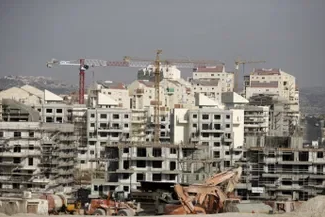
I was in the Holy Land with Friends of the Holy Land when the British Government announced its new measures aimed at illegal Israeli settlement activity. The plans include a ban on imports of goods from settlements in the occupied territories, a prohibition on advertising settlement land in Britain, and powers to sanction people and companies that support, facilitate or profit from settlement expansion. The Government says the measures target settlement activity rather than Israel or Jewish people, and that the necessary legislation should be in place within six to nine months.
In Westminster, that is a significant policy announcement. In Ramallah, Bethlehem and Beit Jala, Palestinian Christians measure it against a more immediate question: will this make daily life any easier?
Friends of the Holy Land is a non-political Christian charity. Our work is to help vulnerable Christian families remain in the land of their birth. The people I spoke to did not offer one neat response. What I heard was a mixture of hope, exhaustion and apprehension.
In Ramallah, an older Christian man I will call Nabil has been unable to work since permits allowing Palestinians to cross into Israel for employment were withdrawn. "I have worked all my life," he told me. "I do not want charity. I want the chance to earn money and look after my family."
He welcomed the British announcement because it might help people outside the region understand that settlements are not a distant diplomatic issue. They affect roads, land, jobs and whether young people believe they can build a future at home. Yet he was blunt about its immediate limitations: "Tomorrow morning I will still wake up without work. My permit will still be gone."
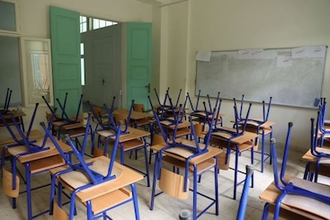
That loss of employment is being felt far beyond individual households. At St Andrew's Episcopal School in Ramallah, Fr Fadi Diab told us that many families are struggling to pay their fees. The school offers discounts to families with several children, but many parents now have so little regular income that even reduced fees are beyond them. Staff have sometimes had to withhold books until payments are made, not because they want to punish children, but because a school that cannot pay its teachers or buy materials will eventually be unable to educate anyone.
This is where the local Church is carrying a weight that can easily be missed in political reporting. Across Jerusalem and the West Bank, Christian institutions run schools, vocational centres, clinics, disability services and programmes for older people. Most serve Christian and Muslim families together. They are not relics guarding a fading past. They are part of the social infrastructure holding life together now.
At the training centre in Ramallah, young Christians and Muslims study hospitality, culinary arts and information technology. In Bethlehem, Friends of the Holy Land is supporting nursing students at Bethlehem University, the only Catholic university in the Holy Land. These projects are not only about gaining qualifications. They are attempts to create a credible answer when a young Christian asks, "Can I make a life here, or must I leave?"
One Bethlehem University student, whom I will call Lina, travels from Taybeh. She described delays, intimidation and harassment by settlers on her way to and from lectures. For a British student, a difficult journey may mean a cancelled train. For Lina, it can mean calculating whether a road will be open, whether she will be stopped and whether she can get home safely.
She welcomed the British action more openly than Nabil. "Silence makes people believe that what is happening is normal," she said. "For us, it is not normal to plan every journey around whether the roads will be open." The measures would not change her journey immediately, she added, but they told her that somebody had at least seen what was happening.
In Beit Jala, a retired Christian woman I will call Mariam was more anxious. Her family's water supply is regularly interrupted; on one occasion it did not run for 40 days. She survives on a pension of approximately 1,000 shekels a month (about £250). Friends of the Holy Land helped install a rooftop tank, giving the household a reserve when the taps run dry and sparing them some of the cost of buying tanker water.
"We still have to ration every drop," she told me. Her fear is that if international pressure begins to inconvenience or anger settlers, Palestinian communities may experience the repercussions through further restrictions, closed roads or intimidation. "Governments make decisions far away," she said, "but if there is anger afterwards, it is our communities that may suffer."
Her caution should not be mistaken for opposition to international action. It reflects the vulnerability of a small community accustomed to living with the consequences of decisions made by people far more powerful than themselves.
The practical pressures accumulate. In one home, FHL funding had paid for a room to be treated for severe damp. It was bright, clean and dry. Beyond its doorway, however, the rest of the house remained wet. The family told us that rainwater ran down the walls and the damp was contributing to breathing problems. The intervention had worked, but the money had not extended far enough to finish the job.
In another home, an older man unable to work lived with his widowed sister and a brother carrying serious physical and psychological trauma. FHL had helped meet medical costs. Before we could properly ask about any of this, the family wanted to make us coffee.
That happened repeatedly. People living with painfully little drew up chairs, found cold drinks and insisted that we should be welcomed. Their hospitality was not a sentimental detail. It was an assertion that they were hosts, neighbours and members of a living community, not simply a collection of needs waiting to be photographed.
The same determination was visible in Bethlehem's Christian institutions. At the School of Joy, children with learning difficulties made exuberant music in a classroom designed around their abilities rather than their limitations. At St Martha's House, older Christian women shared food, friendship and the knowledge that somebody would notice if they were absent. From an office beside St Catherine's Church, the nurses of Bethlehem Care and Hospice Trust travel to people with life-limiting illnesses, bringing palliative care, reassurance and dignity into their homes.
These encounters stopped the week becoming a catalogue of hardship. The Christian presence here is under extraordinary pressure, but it is not passive. It teaches, heals, trains, feeds, employs and welcomes. The question is whether it can continue to do so while movement is restricted, employment disappears and the cost of ordinary life becomes unmanageable.
Britain's new measures matter because political silence can help abnormal conditions appear permanent. Targeting the economy of illegal settlements also makes a meaningful distinction between opposition to occupation and hostility towards Israel or Jewish people, a distinction that must be guarded carefully amid rising antisemitism.
But an announcement is not yet a changed life. Its effect will be judged in whether Nabil can work, whether Mariam can rely on water, whether Lina can reach university without fear and whether the young man from Taybeh can arrive at college without being forced to his knees.
Until then, Palestinian Christians will continue doing what I saw them do throughout the week: holding families, schools and communities together, offering hospitality even when they have little, and asking the worldwide Church not to look away.
Friends of the Holy Land's mission is to stand with them. Will you stand with us?
Names of individual Palestinian Christians have been changed for their protection. The views quoted are personal and do not claim to represent every Palestinian Christian.
Matt Adcock is Head of Communications and Fundraising at Friends of the Holy Land.
LINK
Friends of the Holy Land: www.friendsoftheholyland.org.uk/
 Facebook
 Twitter
 LinkedIn
 Print
Print Email
Email






 Facebook
 Twitter
 YouTube
 LinkedIn
 Pinterest