

Gospel in Art: The world itself could not contain the books that would be written
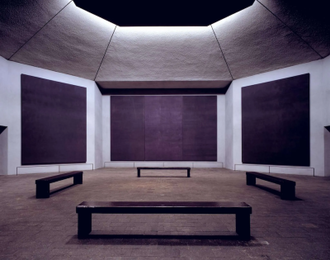
The Rothko Chapel, Comprising 14 paintings by Mark Rothko (1903-1970), Built in 1971 © The Rothko Chapel, Houston, Texas, all rights reserved
Source: Christian Art
Gospel of 23 May 2026
John 21:20-25
At that time: Peter turned and saw the disciple whom Jesus loved following them, the one who also had leaned back against him during the supper and had said, 'Lord, who is it that is going to betray you?' When Peter saw him, he said to Jesus, 'Lord, what about this man?' Jesus said to him, 'If it is my will that he remain until I come, what is that to you? You follow me!' So the saying spread abroad among the brothers and sisters that this disciple was not to die; yet Jesus did not say to him that he was not to die, but, 'If it is my will that he remain until I come, what is that to you?'
This is the disciple who is bearing witness about these things, and who has written these things, and we know that his testimony is true.
Now there are also many other things that Jesus did. Were every one of them to be written, I suppose that the world itself could not contain the books that would be written.
Reflection on the chapel
Today's gospel reading gives us the concluding verses of the Gospel of John, the fourth and last Gospel to be written, from which we have been reading for the past seven weeks of the Easter season. I have always found the closing lines deeply moving. At the very end of the Gospel of John, the evangelist reminds us that Jesus did far more than could ever be fully recorded in writing. The Gospel we hold in our hands offers us a profound vision of Christ, and yet the writer humbly admits that what has been written is only a glimpse of the fullness of who Jesus truly is. It is almost as though language itself reaches its limit before the mystery of Christ. Good, as that is how it should be. After all that is said, sung, written, painted, we find ourselves in front of the mystery of Christ. And perhaps the same could be said of all four Gospels. Together they reveal Christ to us with extraordinary beauty and truth, yet they do not exhaust the mystery of His person.
Recently, a friend of mine was speaking about the place where he has worked for more than twenty years. Reflecting on his work colleagues, he suddenly said to me: "There is so much more to me than what they can see." Those words stayed with me. In some ways, they echo the feeling expressed at the end of today's Gospel. Saint John realises that no written account could ever fully contain the depth of who Christ is. There is always more beyond what can be seen or described. And perhaps the same is true, in a smaller but still true way, for every human person. We spend so much of life only seeing fragments of one another: the outward roles, the surface conversations, the visible successes or failures. Yet beneath every human face lies a hidden depth of memories, wounds, hopes, fears, longings, and silent prayers that others may never fully know. If we are truly created in the image and likeness of God (which we are!), then each human being carries within them something of the mystery of God Himself. No person can ever be reduced entirely to what appears on the surface.
Throughout history, artists have wrestled with one of the greatest challenges imaginable: how do you paint this divine mystery? How do you make the invisible mystery, visible? God is beyond colour, beyond shape, beyond full human comprehension. And yet artists across the centuries have tried to make visible something of the unseen reality of God. Some turned to light flooding through darkness. Others used gold backgrounds to suggest eternity. Some painted gestures of tenderness, silence, or sacrifice to hint at divine love. Sacred art, at its deepest level, is not merely illustration; it is an attempt to paint a window toward mystery.
Interestingly, some modern artists came to believe that the closer art moved away from literal representation, the closer it could come to mystery itself. Instead of painting recognisable figures, landscapes, or stories, they began exploring whether pure colour, light, space, and silence could evoke something deeper, something almost spiritual. One of the artists who understood this was Mark Rothko. Rothko insisted that his great floating fields of colour (such as at the Rothko Chapel in Houston, Texas, illustrated) were not abstract exercises in design, but deeply emotional and even spiritual experiences. He wanted viewers to stand close to his paintings and almost enter them. In places like the Rothko Chapel, his dark monumental canvases create an atmosphere of silence, meditation, and mystery.
LINKS
Christian Art: https://christian.art/
Today's reading: https://christian.art/daily-gospel-reading/john-21-20-25-2026/
 Facebook
 Twitter
 LinkedIn
 Print
Print Email
Email







 Facebook
 Twitter
 YouTube
 LinkedIn
 Pinterest