


Gospel in Art: Yes, Lord... you know that I love you
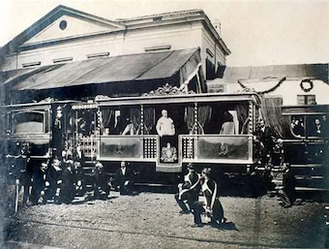
Pope Pius IX in a papal train, Photograph taken in 1862, Daguerrotype © Wikimedia
Source: Christian Art
Gospel of 22 May 2026
John 21:15-19
When Jesus had revealed himself to his disciples and they had finished breakfast, Jesus said to Simon Peter, 'Simon, son of John, do you love me more than these?' He said to him, 'Yes, Lord; you know that I love you.' He said to him, 'Feed my lambs.' He said to him a second time, 'Simon, son of John, do you love me?' He said to him, 'Yes, Lord; you know that I love you.' He said to him, 'Tend my sheep.' He said to him the third time, 'Simon, son of John, do you love me?' Peter was grieved because he said to him the third time, 'Do you love me?' and he said to him, 'Lord, you know everything; you know that I love you.' Jesus said to him, 'Feed my sheep. Truly, truly, I say to you, when you were young, you used to dress yourself and walk wherever you wanted, but when you are old, you will stretch out your hands, and another will dress you and carry you where you do not want to go.' (This he said to show by what kind of death he was to glorify God.) And after saying this he said to him, 'Follow me.'
Reflection on the First Photograph of a Pope
After Saint Peter denied Jesus three times during the dark hours before the Crucifixion, one might expect the risen Christ to confront him with accusation or disappointment. Yet when Jesus meets Peter again on the shore after the Resurrection, as we hear in today's Gospel, His question is not: "Why did you deny me?" Instead, Jesus asks: "Do you love me?" Three times Peter had denied knowing Christ; now three times he is invited to profess his love. Jesus does not trap Peter inside the failures of his past. He gently leads him beyond them. The past is acknowledged, but it does not have the final word. What matters now is the present moment. This is why the sacrament of confession is so powerful and so liberating. In confession, we place our sins into the hands of Christ, and our sins are being firmly put into the past, through His mercy. What has been forgiven no longer needs to imprison us! The present is what will make us blossom.
And perhaps the question Jesus asks Peter is also the question addressed to each one of us today: "Do you love me?" At the heart of Christianity lies not first a rule, a structure, or even a duty, but a relationship of love. Christ asks not merely for obedience, but he first asks for the heart. He desires to become our deepest love, the centre around which everything else in life finds meaning. Only after Peter declares his love does Jesus entrust him with the care of the flock: "Feed my sheep."Before mission comes love. Before leadership comes communion. Before he became our first pope, Peter had to declare his love. The same remains true for us. Any work we do in God's name must flow first from intimacy with Him. Love comes before mission.
Today's Gospel strangely reminds me of a moment connected to one of Peter's successors: the first photographs ever taken of a pope. Photography was invented in the early 19th century, with the first successful permanent photograph created around 1826 by Joseph Nicéphore Niépce in France. A few years later, in 1839, Louis Daguerre introduced the daguerreotype process, which brought photography to much wider public. When photography was still a strange and unsettling new invention, many within the Church were deeply suspicious of it. Some believed that painted portraits possessed greater dignity and humanity than this new mechanical process of capturing an image. One cardinal even described painting as a "far superior and more benevolent presentation of a human being" than photography. Yet Pope Pius IX (1792 - 1878), the first pope ever photographed, accepted this new medium and allowed himself to be captured by the camera lens. Elected in 1846 and reigning until 1878, he held one of the longest papacies in the history of the Church, surpassed only by the traditionally estimated reign of Saint Peter, who is believed to have led the early Church for around 35 years.
For centuries, the popes had been depicted only through painting, mosaics, sculpture, and engravings. Suddenly, through photography, the pope appeared with startling realism: vulnerable, human, immediate. And perhaps this connects beautifully with today's Gospel. When Jesus restores Peter, He does not restore an idealised hero. He restores a wounded man who had failed. Christ does not ask him, "Why did you betray me?" but "Do you love me?" Christianity has never been about presenting flawless images of ourselves. It is about allowing Christ to meet us truthfully in our weakness and transform us through love. In a way, those first photographs of a pope carry something of that same realism: not an untouchable icon painted into perfection, but the pope as a living human being... frail, ageing, imperfect, yet still entrusted with the mission first given to Peter: "Feed my sheep.".... Popes always in need of our support and prayers.
LINKS
Christian Art: https://christian.art/
Today's reading: https://christian.art/daily-gospel-reading/john-21-15-19-2026/
 Facebook
 Twitter
 LinkedIn
 Print
Print Email
Email










 Facebook
 Twitter
 YouTube
 LinkedIn
 Pinterest