

Gospel in Art: Jesus lifted up his eyes to heaven
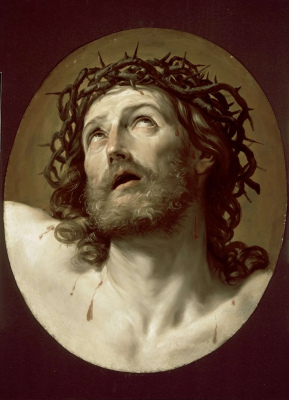
Head of Christ Crowned with Thorns by Guido Reni, painted in 1630's © Detroit Institute of Arts, Gift of James E Scripps, 89.23.
Source: Christian Art
Gospel of 19 May 2026
John 17:1-11a
At that time: Jesus lifted up his eyes to heaven, and said, 'Father, the hour has come; glorify your Son that the Son may glorify you, since you have given him authority over all flesh, to give eternal life to all whom you have given him. And this is eternal life, that they know you, the only true God, and Jesus Christ whom you have sent. I glorified you on earth, having accomplished the work that you gave me to do. And now, Father, glorify me in your own presence with the glory that I had with you before the world existed.
'I have manifested your name to the people whom you gave me out of the world. Yours they were, and you gave them to me, and they have kept your word. Now they know that everything that you have given me is from you. For I have given them the words that you gave me, and they have received them and have come to know in truth that I came from you; and they have believed that you sent me. I am praying for them. I am not praying for the world but for those whom you have given me, for they are yours. All mine are yours, and yours are mine, and I am glorified in them. And I am no longer in the world, but they are in the world, and I am coming to you.'
Reflection on the painting
In today's Gospel we enter into one of the most intimate moments in all of the Gospel of John: the great prayer of Jesus spoken on the eve of His Passion. We will be reading from this great prayer for the next couple of days. Jesus begins by turning toward His Father and praying for Himself: "Father, glorify your Son." Yet the glory He speaks of is not worldly triumph or earthly success. Christ knows that the road to glory will first lead through suffering and the Cross. Before the Resurrection comes the lifting up upon Calvary. Jesus is able to return to the Father because He knows He has remained faithful to the mission entrusted to Him: "I have accomplished the work you gave me to do."nThose words speak quietly to each one of us. We too have been entrusted with work to carry out during our time on earth. Each life has a vocation, a calling, a mission through which we are asked to reveal something of Christ to the world. And we do not do this alone. Christ not only sends us on mission, He remains with us every step of the way.
As this prayer unfolds, Jesus gradually turns His attention from His communion with the Father toward His communion with His disciples. He intercedes for those who will remain in the world after His departure, knowing that their witness will often be difficult and that the world may resist the Gospel they proclaim. Prayer, here becomes deeply communal. And perhaps our own prayer is meant to reflect this same movement. At times prayer draws us into personal intimacy with God, where we pray for ourselves; and at times we pray for others. In truth, these two dimensions can never fully be separated. The closer we draw to God, the more deeply we begin to carry others with us. True prayer enlarges the soul and includes others. It teaches us that our personal love of God and love of neighbour always belong together.
Our Gospel reading today opens with the striking words: "Jesus lifted up his eyes to heaven." It is therefore fitting that we accompany this passage with this somewhat haunting painting by Guido Reni. Reni was one of the great painters of the Italian Baroque, celebrated for the extraordinary spiritual beauty of his figures. Again and again in his paintings, whether depicting Christ, the Virgin Mary, or the saints, we find this distinctive upward gaze toward heaven. Reni himself never fully explained this recurring feature, but art historians have often noted how his figures seem caught between earth and eternity, their eyes lifted beyond the visible world toward divine reality. The upward gaze becomes almost a visual prayer.
In our painting, Christ is shown crowned with thorns, His face marked by suffering and exhaustion. Yet what is so moving is that the pain does not close Him inward. Instead, His eyes rise upward toward the Father. The crown of thorns presses painfully into His flesh, and tears seem almost ready to form, yet there remains extraordinary gentleness in His expression. The dark background isolates Christ completely, forcing us to confront not the crowd, not the soldiers, not the violence, but the interior suffering of Jesus Himself. Reni paints not merely physical agony, but communion: the Son turning toward the Father even in the midst of humiliation and pain. It beautifully echoes today's Gospel: before facing the Cross, Jesus lifts His eyes to heaven in prayer. Even surrounded by suffering, Christ remains rooted in His relationship with the Father.
LINKS
Christian Art: https://christian.art/
Today's reading: https://christian.art/daily-gospel-reading/john-17-1-11a-2026-2/
 Facebook
 Twitter
 LinkedIn
 Print
Print Email
Email













 Facebook
 Twitter
 YouTube
 LinkedIn
 Pinterest