


Gospel in Art: And I am no longer in the world, but they are in the world
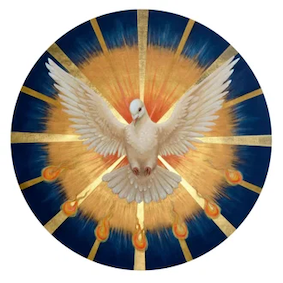
Holy Spirit by Yeinier Gonzalez 2022
Source: Christian Art
Gospel of 17 May 2026
John 17:1-11a
At that time: Jesus lifted up his eyes to heaven, and said, 'Father, the hour has come; glorify your Son that the Son may glorify you, since you have given him authority over all flesh, to give eternal life to all whom you have given him. And this is eternal life, that they know you, the only true God, and Jesus Christ whom you have sent. I glorified you on earth, having accomplished the work that you gave me to do. And now, Father, glorify me in your own presence with the glory that I had with you before the world existed.
'I have manifested your name to the people whom you gave me out of the world. Yours they were, and you gave them to me, and they have kept your word. Now they know that everything that you have given me is from you. For I have given them the words that you gave me, and they have received them and have come to know in truth that I came from you; and they have believed that you sent me. I am praying for them. I am not praying for the world but for those whom you have given me, for they are yours. All mine are yours, and yours are mine, and I am glorified in them. And I am no longer in the world, but they are in the world, and I am coming to you.'
Reflection on the painting
There is a charming story told of a primary school teacher who wanted her pupils to learn the Apostles' Creed by heart, line by line. She explained how its origins traced back to the 'Old Roman Creed', used as a baptismal confession in Rome as early as the 2nd century and how it has twelve main statements corresponding to the twelve apostles after which it is named. To help the class remember it, she chose twelve children, each responsible for reciting one line every morning. One day, all seemed to be going smoothly. One child confidently proclaimed, "He ascended into heaven." Another continued, "and is seated at the right hand of God the Father Almighty." A third added, "from there he will come to judge the living and the dead." Then suddenly there was silence. The teacher looked up in confusion, until a little girl quietly said, "Oh… Eric forgot his line about the Holy Spirit." It is a gentle and amusing story, but perhaps it touches on a deeper truth: so often, we too forget the Holy Spirit.
It is striking that in the Apostles' Creed the statement about the Holy Spirit is so brief: "I believe in the Holy Spirit." And then the creed moves on. Yet we stand now only days away from the great feast of Pentecost, when the Church celebrates the coming of the Holy Spirit upon the apostles. In the liturgy, the readings now begin to speak more insistently about the Spirit, almost as if the Church is gently reminding us not to overlook Him. The Holy Spirit has often been called the "forgotten Person" of the Blessed Trinity. We easily pray to the Father. We naturally turn toward Christ. But the Spirit can seem mysterious, elusive, hard to grasp. And perhaps that is precisely why the Church invites us in these days to become more attentive to Him. In this Gospel passage, the Holy Spirit is not named directly, yet the whole prayer of Jesus moves toward the coming of the Spirit... introducing the readings for this coming week.
Throughout the history of Christian art, artists have wrestled with how to depict the Holy Spirit, the invisible presence of God moving through the world. Most commonly, the Spirit appears as a dove, inspired by Christ's baptism in the Gospel of Matthew, where the Spirit descends upon Jesus like a dove from heaven. In paintings of Pentecost, the Spirit is often shown as tongues of fire resting above the heads of the apostles and the Virgin Mary, expressing divine energy and courage. Medieval artists sometimes painted golden rays streaming from heaven, while Baroque painters filled entire scenes with swirling light and movement to suggest the unseen power of God. Because the Holy Spirit cannot be contained in a single human form, artists often turned to symbols: wind, flame, light, breath, wings. And perhaps that is fitting. The Holy Spirit moves like the wind itself... unseen, yet deeply felt... quietly breathing divine life into the Church and into each human heart.
One of my favourite contemporary depictions of the Holy Spirit painted in recent years is this beautiful roundel by Yeinier Gonzalez from 2022. It feels both ancient and new at the same time. It is firmly rooted in the great traditions of Christian sacred art, yet it possesses a freshness and luminosity that speaks powerfully to the modern eye. Inspired by the great Pentecost hymn Veni Sancte Spiritus (often called the "Golden Sequence"), Gonzalez sought to create an image that conveys not only the majesty of the Holy Spirit, but also His consoling presence. The striking interplay between deep blues and radiant golds evokes the hymn's beautiful phrase dulce refrigerium, the "sweet refreshment" of the Spirit. The gold shimmers like heaven breaking into the world, while the blue suggests depth, silence, and the interior life of the soul.
LINKS
Christian Art: https://christian.art/
Today's reading: https://christian.art/daily-gospel-reading/john-17-1-11a-2026/
NOTE
Dear readers - Earlier I made a mistake and posted tomorrow's reading up today. So sorry about that. Here's the link to tomorrow's reading for those people who were already reading it! : https://christian.art/daily-gospel-reading/john-16-29-33-2026/
 Facebook
 Twitter
 LinkedIn
 Print
Print Email
Email






 Facebook
 Twitter
 YouTube
 LinkedIn
 Pinterest