

Gospel in Art: When a woman has delivered the baby, she no longer remembers the anguish
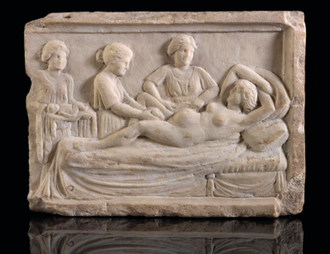
Carved marble plaque depicting a birthing scene, Excavated in Ostia, Italy, 400 - 300 BC. © Welcome Collection, London
Source: Christian Art
Gospel of 15 May 2026
John 16:20-23a
At that time: Jesus said to his disciples, 'Truly, truly, I say to you, you will weep and lament, but the world will rejoice. You will be sorrowful, but your sorrow will turn into joy. When a woman is giving birth, she has sorrow because her hour has come, but when she has delivered the baby, she no longer remembers the anguish, for joy that a human being has been born into the world. So also you have sorrow now, but I will see you again, and your hearts will rejoice, and no one will take your joy from you. In that day you will ask nothing of me.'
Reflection on the Ancient Roman Relief
One of the greatest joys entrusted to humanity is the birth of a child. There is something almost sacred in that moment when a mother and father first look upon the life they have long awaited. For the mother especially, the pain and exhaustion of labour suddenly give way to wonder as she holds her child for the first time. My niece, Alexandra, gave birth a month ago to a little boy, and when I went to visit her in hospital, it was such a powerful moment. The mother's physical pain in childbirth is suddenly transformed by the arrival of new life. The very moment she holds her child in her arms for the first time, love begins to eclipse the physical suffering that came before it. The pain is not erased, but it is overwhelmed by wonder, tenderness, and the profound joy of new life.
It is striking that when Jesus searched for an image powerful enough to speak about the joy of the Resurrection and Ascension, He turned to this very experience when he was speaking to them at the Last Supper in today's reading. Jesus knows that His disciples are standing on the edge of deep sorrow. His death is approaching, and He speaks honestly of their coming grief: they will weep, mourn, and feel lost in darkness at the crucifixion. Yet Christ does not leave them there. He looks beyond the Cross toward the dawn of Easter morning, assuring them that their sorrow will be turned into joy, just as the anguish of childbirth gives way to rejoicing when new life enters the world. This is the heart of the Christian mystery: out of suffering, God brings life; out of darkness, He brings light; out of death, He brings resurrection. And this promise is not only for the life to come! Even now, whenever we become aware of the presence of the risen Christ walking beside us, speaking to us, strengthening us, we begin to taste something of that heavenly joy already.
Our ancient Roman marble relief, dating circa 400 BE to 300 BC, shows a birth scene. In the carving, a mother reclines upon a draped couch while three women attend to her, all clothed in flowing Roman robes. One gently holds the newborn child. In the Roman world, childbirth was entirely overseen by women, especially midwives, and men were generally absent unless complications required the intervention of a physician for a wealthy household. Images such as this may have been created to comfort expectant mothers, offering reassuring and positive visions of birth in a world where childbirth carried great danger. There is also the possibility that this plaque may once have formed the front panel of a small sarcophagus for an infant who died during birth or shortly afterwards. If so, then this relief becomes more than a domestic scene; it becomes a quiet meditation on the fragile boundary between life and death, joy and sorrow. Even in grief, the image preserves the tenderness surrounding the arrival of a child into the world, a poignant reminder of how precious and vulnerable every human life is from its very first breath.
LINKS
Christian Art: https://christian.art/
Today's reading: https://christian.art/daily-gospel-reading/john-16-20-23a/
 Facebook
 Twitter
 LinkedIn
 Print
Print Email
Email









 Facebook
 Twitter
 YouTube
 LinkedIn
 Pinterest