


Gospel in Art: Saint Pancras, Martyr
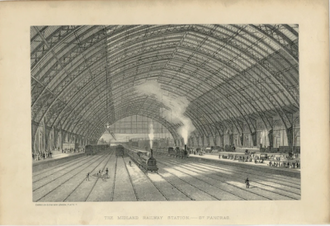
The Midland Railways Station, St Pancras, 1880, chromolithograph on paper © Alamy
Source: Christian Art
Gospel of 12 May 2026
John 16:5-11
At that time: Jesus said to his disciples, 'Now I am going to him who sent me, and none of you asks me, "Where are you going?" But because I have said these things to you, sorrow has filled your heart. Nevertheless, I tell you the truth: it is to your advantage that I go away, for if I do not go away, the Helper will not come to you. But if I go, I will send him to you. And when he comes, he will convict the world concerning sin and righteousness and judgement: concerning sin, because they do not believe in me; concerning righteousness, because I go to the Father, and you will see me no longer; concerning judgement, because the ruler of this world is judged.'
Reflection on the Antique Print
Today we celebrate the feast of Saint Pancras, whose name 'Pancratios' in Greek, means "the one who holds firm" or "strong in everything." Pancras of Rome was a young Roman orphan who embraced Christianity at a time when doing so meant risking everything. At just fourteen years old, he was martyred for his faith during the persecution under Diocletian around 303 AD. In the days before his execution, Pancras was brought before the authorities and ordered to make a sacrifice to the Roman gods. He refused. Impressed by the boy's courage, the emperor is said to have offered him wealth, status, and a future, if only he would renounce Christ. But Pancras stood firm. He chose fidelity over comfort, truth over compromise. Enraged, the emperor condemned him to death, and he was beheaded on the Via Aurelia in Rome on 12 May 303AD.
For those of us living in London, the name "St Pancras" most immediately brings to mind the great railway station rather than the young martyr. St Pancras railway station takes its name from the surrounding parish of St Pancras, itself dedicated to Pancras of Rome, whose cult spread widely across Europe in the Middle Ages. The station was built between 1868 and 1876 as one of London's great early railway termini, designed by the engineer William Henry Barlow with its vast iron-and-glass structure, and fronted by the magnificent Gothic Revival Midland Grand Hotel by George Gilbert Scott. So every time we pass through St Pancras, we unknowingly echo the name of a fourteen-year-old saint whose quiet courage still resonates, hidden in plain sight amid the movement and noise of modern London.
Our antique print depicts the rail tracks inside the station in 1880. In the 19th century, as railways spread rapidly across Europe and beyond, train stations were conceived not merely as functional buildings, but as monuments to modernity. Cities commissioned their finest architects and engineers to design them, turning stations into grand civic gateways: cathedrals of movement and progress. Vast glass roofs, like that of St Pancras railway station, showcased cutting-edge engineering, while richly decorated façades gave these places a sense of beauty. They were spaces where art, architecture, and technology came together, reflecting a belief that even the most practical aspects of life deserved to be surrounded by beauty.
As for the parish of St Pancras itself, its origins go back much further. The area in north London was already known by this name by the medieval period, centred around an ancient church dedicated to Pancras of Rome. The original St Pancras Old Church is one of the oldest Christian sites in England, with roots possibly stretching back to the 5th century, though much rebuilt over time. Why dedicate it to such a young Roman martyr? His cult spread widely across Europe in the very early Church, especially because he was seen as a powerful witness of youthful faith and courage.
Saint Pancras, pray for us.
LINKS
Christian Art: https://christian.art/
Today's reading: https://christian.art/daily-gospel-reading/john-16-5-11-2026/
 Facebook
 Twitter
 LinkedIn
 Print
Print Email
Email
















 Facebook
 Twitter
 YouTube
 LinkedIn
 Pinterest