

Gospel in Art: If you love me, you will keep my commandments
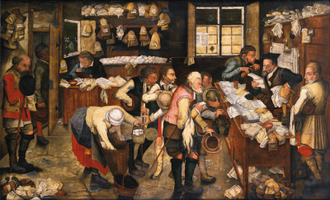
The Peasant Lawyer, by Pieter Breughel the Younger, 1620 © Grohmann Museum at Milwaukee School of Engineering, Milwaukee
Source: Christian Art
Gospel of 10 May 2026
John 14:15-21
At that time: Jesus said to his disciples, 'If you love me, you will keep my commandments. And I will ask the Father, and he will give you another Helper, to be with you for ever, even the Spirit of truth, whom the world cannot receive, because it neither sees him nor knows him. You know him, for he dwells with you and will be in you.
'I will not leave you as orphans; I will come to you. Yet a little while and the world will see me no more, but you will see me. Because I live, you also will live. In that day you will know that I am in my Father, and you in me, and I in you. Whoever has my commandments and keeps them, he it is who loves me. And he who loves me will be loved by my Father, and I will love him and manifest myself to him.'
Reflection on the painting
The opening line of today's Gospel from the Gospel of John is striking in its simplicity and its force: "If you love me, you will keep my commandments." Jesus places love and obedience side by side: not as opposites, but as inseparable. True love is not vague or sentimental; it takes shape in being obedient. Love and obedience are two expressions of the same reality: a heart turned towards God.
And yet, in our culture, we often separate the two. Law and obedience are seen as restrictive. Love is seen as liberating. Hence hey two are considered to be opposed and excluding the other. Even when we read the Gospel, we can fall into this trap: imagining the Pharisees as rigid followers of the law without love, and Jesus as purely about love without law. But that is too simplistic. As Peter Kreeft puts it so well: "Jesus was anti-legalism, but not anti-law." He does not abolish the commandments, He fulfils them, and shows that their deepest purpose is love.
This brings us to something essential: love is not first of all a feeling. It is a decision, an act of the will. That is why Jesus can command it. We are called to choose to love: to will the good of the other, even when it is difficult, even when it costs. And we are not left to do this alone. Jesus promises the gift of the Holy Spirit, the Advocate, the one who stands beside us. We call the Holy Spirit the Advocate because Jesus uses the Greek word Paraklētos, meaning one who is "called alongside" to help, guide, and defend. It has a legal flavour, like a lawyer who speaks on your behalf, but it is much richer: the Holy Spirit not only defends us, but also comforts, strengthens, and leads us into truth.
In a very charming, human way, this role is echoed in the lively painting by Pieter Brueghel the Younger, where we see a village advocate, a village lawyer surrounded by people seeking help. They are bringing what little they have (eggs, fruit, poultry) in exchange for guidance and defence. They bring their offering in exchange for the services of the lawyer. But the Holy Spirit is of course infinitely more than any legal advocate such as the one depicted in our painting. He does not simply defend us; He transforms us. He teaches us how to love, how to live the commandments not as burdens, but as the path to true freedom.
LINKS
Christian Art: https://christian.art/
Today's reading: https://christian.art/daily-gospel-reading/john-14-15-21-2026/
 Facebook
 Twitter
 LinkedIn
 Print
Print Email
Email
















 Facebook
 Twitter
 YouTube
 LinkedIn
 Pinterest