


Gospel in Art: Solemnity of the Ascension of the Lord
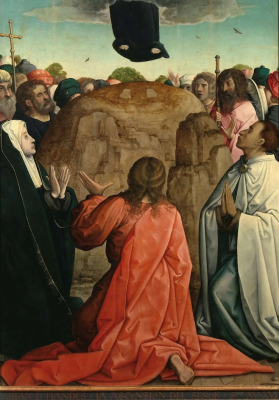
The Ascension by Juan des Flandres © Prado Museum, Madrid
Source: Christian Art
Gospel of 14 May 2026
Matthew 28:16-20
At that time: The eleven disciples went to Galilee, to the mountain to which Jesus had directed them. And when they saw him they worshipped him, but some doubted. And Jesus came and said to them, 'All authority in heaven and on earth has been given to me. Go, therefore, and make disciples of all nations, baptising them in the name of the Father and of the Son and of the Holy Spirit, teaching them to observe all that I have commanded you. And behold, I am with you always, to the end of the age.'
Reflection on the painting
In our painting by Juan des Flandres (a Flemish artist active in Spain), painted between 1514 and 1519, we see Christ, veiled by a cloud, ascending into heaven. This wonderful and rather unusual composition by Juan de Flandes focuses almost entirely on the reaction of those left behind as Christ ascends. We only see the feet of Christ disappearing into the clouds. The apostles and the Virgin are looking upward in awe, confusion, prayer, and longing. The kneeling figure in the centre foreground (the one we see from the back in the reddish-orange robe) is most likely meant to be Saint John. The kneeling figure on the right in pale robes may be Saint Peter or another apostle, though the identification is less certain. It may even be the commissioner of the painting. Behind him stands Saint James, to the right of the rock, depicted with a pilgrim's staff.
One of the most beautiful aspects of this painting is precisely the central figure seen from behind. By tnot seeing his face, Juan de Flandes almost invites us into the scene. We kneel with him. We gaze upward with him. We become one of the disciples staring into the heavens as Christ disappears from sight. It echoes the words from the Acts of the Apostles: "And while they were gazing into heaven as he went…" (Acts 1:10). Note also the footprints on top of the rock, where Jesus once stood. This panel, along with three others by the same artist, once adorned the main altarpiece at the Church of San Lázaro in Palencia.
It is very effective just to show the feet of Christ, implying that the rest of his body is outside the painting, having moved into a different space (literally!). Christ's physical departure from the earthly realm and his ascension into heaven mark the end of his earthly mission. By highlighting the footprints on the rock, the artist underscores the tangible evidence of Christ's presence and how his departure was a REAL event, reinforcing the spiritual significance for us the viewer.
Our Gospel reading today for the feast of the Ascension stresses exactly this point. It makes clear that the moving on of Jesus as a result of his ascension did not lead to an absence from his disciples. At the end of today's gospel reading we read, 'Go, therefore, and make disciples of all nations'. He gives them, and therefore us, a clear mission: to be witnesses of Christ and help spread the Good News. But he also guarantees that he remains with them, not in body but in spirit.
LINKS
Christian Art: https://christian.art/
Today's reading: https://christian.art/daily-gospel-reading/matthew-28-16-20-2026-2/
 Facebook
 Twitter
 LinkedIn
 Print
Print Email
Email















 Facebook
 Twitter
 YouTube
 LinkedIn
 Pinterest