

Gospel in Art: Ask, and you will receive
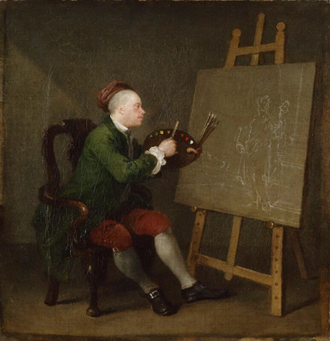
Self portrait by William Hogarth © National Portrait Gallery, London / Creative Commons
Source: Christian Art
Gospel of 16 May 2026
John 16:23b-28
At that time: Jesus said to his disciples, 'Truly, truly, I say to you, whatever you ask of the Father in my name, he will give it to you. Until now you have asked nothing in my name. Ask, and you will receive, that your joy may be full.
'I have said these things to you in figures of speech. The hour is coming when I will no longer speak to you in figures of speech but will tell you plainly about the Father. In that day you will ask in my name, and I do not say to you that I will ask the Father on your behalf; for the Father himself loves you, because you have loved me and have believed that I came from God. I came from the Father and have come into the world, and now I am leaving the world and going to the Father.'
Reflection on the painting
There are many forms of prayer: praise, thanksgiving, silence, adoration. Yet perhaps the kind of prayer that rises most naturally from the human heart is the prayer of petition. We instinctively want to ask God things. We turn toward God with open hands. It is striking that the one prayer Jesus explicitly taught His disciples, the Lord's Prayer, is filled with such petitions: "Give us this day our daily bread… forgive us our trespasses… lead us not into temptation." Even Christ Himself prayed in this way. In the agony of the garden at Garden of Gethsemane, He cried out: "Father, if it be possible, let this cup pass from me." On the cross, He prayed the words of Psalm 22: "My God, my God, why have you forsaken me?" Before raising Lazarus, Jesus lifted His eyes to heaven and petitioned His Father. Before choosing the apostles, He spent the night in prayer. Again and again throughout the Gospels, we see Jesus turning toward the Father in dependence and intimate conversation. Even the Son of God prayed with the humility of one who asks...
In today's Gospel, Jesus encourages us to do the same: "Ask and you will receive". Yet we know from experience that prayer does not always unfold in the way we hoped. We do not always receive what we ask for. We pray for healing, and illness remains. We pray for peace, and wars continue. We pray for answers, and heaven can seem silent. But perhaps Christ is teaching us that no sincere prayer is ever lost. When we bring our petitions before God, we create space for Him to enter our lives more deeply. Prayer slowly reshapes us. It teaches us trust. Like a painter layering colour upon a canvas, or a sculptor patiently chiselling stone, God works within the hidden depths of the soul through every prayer we offer, slowly adding extra layers in our souls, slowly cutting of rough edges. We may not always receive what we asked for, but through prayer we always receive something of God Himself: His grace.
As I mentioned, God is like an artist patiently painting layer upon layer upon the canvas of our lives, shaping us, colouring us, refining us through every joy, sorrow, prayer,... This small, charming painting by William Hogarth captures something of that creative process. Hogarth, one of the most important and influential English artists of the 18th century, believed deeply in the power of art to reveal truth about human nature. He became famous not only for his portraits, but especially for his sharply observant narrative series such as A Harlot's Progress and A Rake's Progress. These works told moral stories of human downfall, temptation, vanity, and self-destruction. Hogarth called them "modern moral subjects," and through engravings they reached a wide public, making him one of the first truly popular British artists. He also fought passionately for artists' rights, helping secure the Engraving Copyright Act of 1735, protecting creative works from being copied illegally.
In this painting, Hogarth depicts Thalia, the Muse of Comedy from ancient Greek mythology. Traditionally, Thalia was one of the nine muses, associated with theatre, laughter, and comic poetry. She is often shown holding a theatrical mask or appearing joyful and animated. We do not know whether Hogarth used a specific real-life model for Thalia, though artists often painted muses using contemporary sitters or actresses as inspiration. What is striking here is the act of painting itself: Hogarth stands before the canvas bringing a figure slowly into existence through colour and imagination. A few layers of paint have been laid dow, but many more layers will be needed. Just as the artist patiently builds the painting stroke by stroke, so too God works upon the human soul over time. None of us is completed in a single moment. No prayer is immediately answered. We are painted gradually by the Divine Artist, sometimes in bright colours, sometimes in darker tones, yet always knowing that if we stay close to Him, the final image will reflect something of His beauty and truth.
LINKS
Christian Art: https://christian.art/
Today's reading: https://christian.art/daily-gospel-reading/john-16-23b-28/
 Facebook
 Twitter
 LinkedIn
 Print
Print Email
Email









 Facebook
 Twitter
 YouTube
 LinkedIn
 Pinterest