

Gospel in Art: The world has hated them because they are not of the world
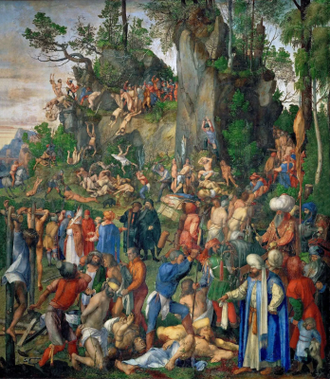
Martyrdom of the Ten Thousand, by Albrecht Dürer, 1508 © Kunsthistorisches Museum, Vienna / Wikimedia
Source: Christian Art
Gospel of 20 May 2026
John 17:11b-19
At that time: Jesus lifted up his eyes to heaven, and praying said, 'Holy Father, keep them in your name, which you have given me, that they may be one, even as we are one. While I was with them, I kept them in your name, which you have given me. I have guarded them, and not one of them has been lost except the son of destruction, that the Scripture might be fulfilled. But now I am coming to you, and these things I speak in the world, that they may have my joy fulfilled in themselves. I have given them your word, and the world has hated them because they are not of the world, just as I am not of the world. I do not ask that you take them out of the world, but that you keep them from the evil one. They are not of the world, just as I am not of the world. Sanctify them in the truth; your word is truth. As you sent me into the world, so I have sent them into the world. And for their sake I consecrate myself, that they also may be consecrated in truth.'
Reflection on the painting
Our painting today by Albrecht Dürer, The Martyrdom of the Ten Thousand, is one of the most harrowing depictions of Christian martyrdom in German Renaissance art. The painting illustrates the legendary massacre of ten thousand Christians on Mount Ararat, said to have been carried out by the Persian King Sapor under orders linked to the Roman emperors Hadrian and Antoninus Pius. Commissioned by Frederick the Wise, who possessed relics believed to come from these martyrs, the work originally hung in the relic chamber of the palace church in Wittenberg. Dürer fills the rocky landscape with scenes of unspeakable brutality: crucifixions, beheadings, stonings, torture, and bodies crushed beneath hammers. The rulers overseeing the slaughter appear clothed in rich eastern garments, while many executioners wear Ottoman dress, a detail that would have deeply unsettled viewers of Dürer's time, especially in the shadow of the fall of Fall of Constantinople in 1453 and the growing fear of Ottoman expansion into Europe. And then, almost unexpectedly, in the midst of this chaos and bloodshed, Dürer paints himself standing calmly within the scene, holding a staff inscribed with the words: "This work was done in the year 1508 by Albrecht Dürer, German." It is a striking detail, the artist placing himself inside the suffering he depicts, almost as a witness standing among the martyrs.
This painting speaks to our Gospel reading of today. Jesus prays for His disciples on the eve of His Passion, fully aware of what lies ahead for them. He knows they will soon be scattered across the world, separated from one another, carrying the Gospel into unfamiliar lands and often hostile environments. Christ understands that faithfulness to the truth will not always be welcomed. The disciples will face rejection, ridicule, persecution, and for many of them, martyrdom itself. Jesus tells them plainly that the world will hate them because they no longer belong to the world. Silence would have been safer. Remaining hidden would have spared many of them suffering and death. Yet the Gospel was never meant to remain locked away in fear. The disciples are sent out precisely so that the light of Christ may reach the darkest corners of the earth.
And perhaps that is what makes martyrdom so profoundly moving within our Christian tradition. The martyrs did not seek suffering for its own sake. They simply loved Christ more than they feared death. Looking at Dürer's painting, amid all its violence and horror, we are confronted by a deeper question: what truth would we be willing to suffer for? The martyrs remind us that faith is not merely an idea to admire comfortably from a distance. It asks for courage. It asks for witness. It asks for fidelity even when costly. And throughout history, the blood of martyrs has become, as the early Christians said, the seed of the Church. Even when scattered, even when persecuted, even when silenced by violence, the Gospel continued to spread - carried by those who refused to deny the One for whom they were willing to give everything.
LINKS
Christian Art: https://christian.art/
Today's reading: https://christian.art/daily-gospel-reading/john-17-11b-19-2026/
 Facebook
 Twitter
 LinkedIn
 Print
Print Email
Email












 Facebook
 Twitter
 YouTube
 LinkedIn
 Pinterest