


Gospel in Art: That they may be one even as we are one
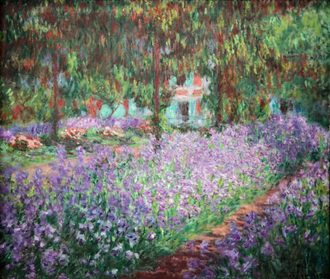
The Artist's Garden at Giverny by Claude Monet, 1900 © Musée d'Orsay, Paris / Alamy
Source: Christian Art
Gospel of 21 May 2026
John 17:20-26
At that time: Jesus lifted up his eyes to heaven, and praying said, 'I do not ask for these only, but also for those who will believe in me through their word, that they may all be one, just as you, Father, are in me, and I in you, that they also may be in us, so that the world may believe that you have sent me.
'The glory that you have given me I have given to them, that they may be one even as we are one, I in them and you in me, that they may become perfectly one, so that the world may know that you sent me and loved them even as you loved me.
'Father, I desire that they also, whom you have given me, may be with me where I am, to see my glory that you have given me because you loved me before the foundation of the world. O righteous Father, even though the world does not know you, I know you, and these know that you have sent me. I made known to them your name, and I will continue to make it known, that the love with which you have loved me may be in them, and I in them.'
Reflection on the painting
In today's Gospel, Jesus lifts His eyes to the Father and prays one of the most moving prayers in all of Scripture: "that they may all be one." Christ prays not only for the disciples gathered around Him, but for all future believers, for the whole Church spread throughout the world and across history. He prayed then for the Church now. Yet this unity that Jesus longs for is not a lifeless uniformity where every person becomes identical. Divine unity is more beautiful than that. It is more like a garden. In a great garden, every flower is different: roses, lilies, violets, wildflowers, each possessing its own colour, fragrance, and form. And yet together they create harmony. Together they form something far more beautiful than any single flower could ever become alone.
This image appears often throughout Christian spirituality. Saint Francis de Sales (1567-1622) once wrote: "Consider the variety of graces and gifts with which God adorns the garden of His Church. Some are roses, some lilies, some violets." What a beautiful vision of humanity. Each of us is planted by God within His divine garden, each carrying unique gifts, wounds, personalities, and callings. Some souls radiate visibly like brilliant roses; others remain hidden and humble like small violets beneath leaves. Some are called to great public witness like tall sunflowers; others quietly spread goodness through unseen acts of love. Yet every flower matters. Every life contributes something to the beauty of the whole. The tragedy comes when flowers compare themselves endlessly to one another instead of simply blooming where God has planted them.
This image reaches deep into the roots of Scripture itself. The Bible begins in a garden, the Garden of Eden, where humanity first walks with God. Throughout Scripture, God's people are compared to vineyards, branches, olive trees, and fields ready for harvest. And after the Resurrection, when Mary Magdalene first encounters the risen Christ near the tomb, she mistakes Him for the gardener. Perhaps she was more right than she realised. Christ truly is the Divine Gardener, patiently cultivating human souls, watering them with grace, pruning what must be cut away, helping each life grow toward its fullness. And perhaps this is what Jesus prays for in today's Gospel: that despite all our differences, we may remain rooted together, one in divine love.
This beautiful vision of unity in diversity finds a remarkable visual echo in The Artist's Garden at Giverny by Claude Monet, painted in 1900. Monet created this garden at his home in Giverny, where he spent decades carefully cultivating flowers, ponds, trees, and pathways. The garden itself became both his sanctuary and his artistic inspiration. He painted flowers obsessively, not because he was merely interested in botany, but because he was captivated by light, colour, atmosphere, and the fleeting beauty of nature itself. He once said that his garden was his "most beautiful masterpiece." Looking at this painting, we are drawn into a sea of colour and life where countless flowers bloom together beneath soft light. No single flower dominates the garden. The beauty of this painting emerges through the communal harmony of each flower.
LINKS
Christian Art: https://christian.art/
Today's reading: https://christian.art/daily-gospel-reading/john-17-20-26-2026/
 Facebook
 Twitter
 LinkedIn
 Print
Print Email
Email















 Facebook
 Twitter
 YouTube
 LinkedIn
 Pinterest